



Question: 2. John invests 3000 at time t= 0 and 2000 at time t = 2. He receives a return of 3500 at time t= 1
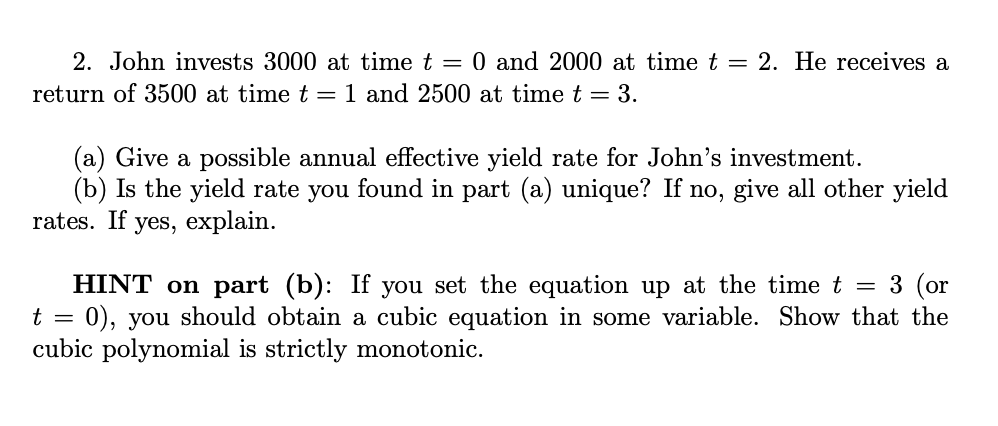
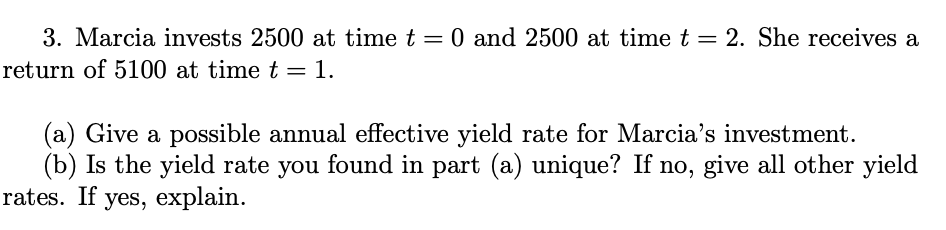
2. John invests 3000 at time t= 0 and 2000 at time t = 2. He receives a return of 3500 at time t= 1 and 2500 at time t= 3. (a) Give a possible annual effective yield rate for John's investment. (b) Is the yield rate you found in part (a) unique? If no, give all other yield rates. If yes, explain. HINT on part (b): If you set the equation up at the time t = 3 (or t 0), you should obtain a cubic equation in some variable. Show that the cubic polynomial is strictly monotonic. 3. Marcia invests 2500 at time t= 0 and 2500 at time t= 2. She receives a return of 5100 at time t=1. (a) Give a possible annual effective yield rate for Marcia's investment. (b) Is the yield rate you found in part (a) unique? If no, give all other yield rates. If yes, explain. 2. John invests 3000 at time t= 0 and 2000 at time t = 2. He receives a return of 3500 at time t= 1 and 2500 at time t= 3. (a) Give a possible annual effective yield rate for John's investment. (b) Is the yield rate you found in part (a) unique? If no, give all other yield rates. If yes, explain. HINT on part (b): If you set the equation up at the time t = 3 (or t 0), you should obtain a cubic equation in some variable. Show that the cubic polynomial is strictly monotonic. 3. Marcia invests 2500 at time t= 0 and 2500 at time t= 2. She receives a return of 5100 at time t=1. (a) Give a possible annual effective yield rate for Marcia's investment. (b) Is the yield rate you found in part (a) unique? If no, give all other yield rates. If yes, explain
Step by Step Solution
There are 3 Steps involved in it

Get step-by-step solutions from verified subject matter experts