







Question: 2. Let A be an array of size n containing the numbers 1,...,n in some or- der. If A[i] and Ai + 1] differ by
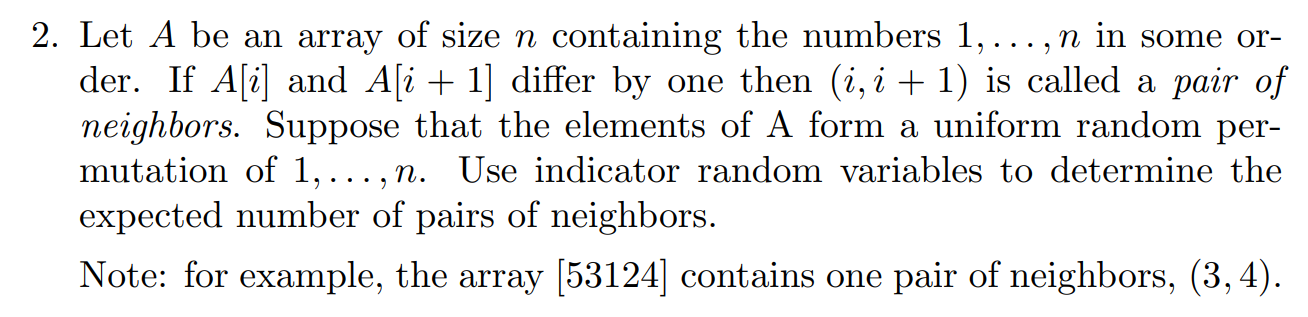
2. Let A be an array of size n containing the numbers 1,...,n in some or- der. If A[i] and Ai + 1] differ by one then (i, i + 1) is called a pair of neighbors. Suppose that the elements of A form a uniform random per- mutation of 1,...,n. Use indicator random variables to determine the expected number of pairs of neighbors. Note: for example, the array (53124] contains one pair of neighbors, (3,4). 2. Let A be an array of size n containing the numbers 1,...,n in some or- der. If A[i] and Ai + 1] differ by one then (i, i + 1) is called a pair of neighbors. Suppose that the elements of A form a uniform random per- mutation of 1,...,n. Use indicator random variables to determine the expected number of pairs of neighbors. Note: for example, the array (53124] contains one pair of neighbors, (3,4)
Step by Step Solution
There are 3 Steps involved in it

Get step-by-step solutions from verified subject matter experts
 Study Help