







Question: 2. Let D= { objects}. Let P(x) be the predicate x is a car. Let Q(x) be the predicate x has a flat tire. Let
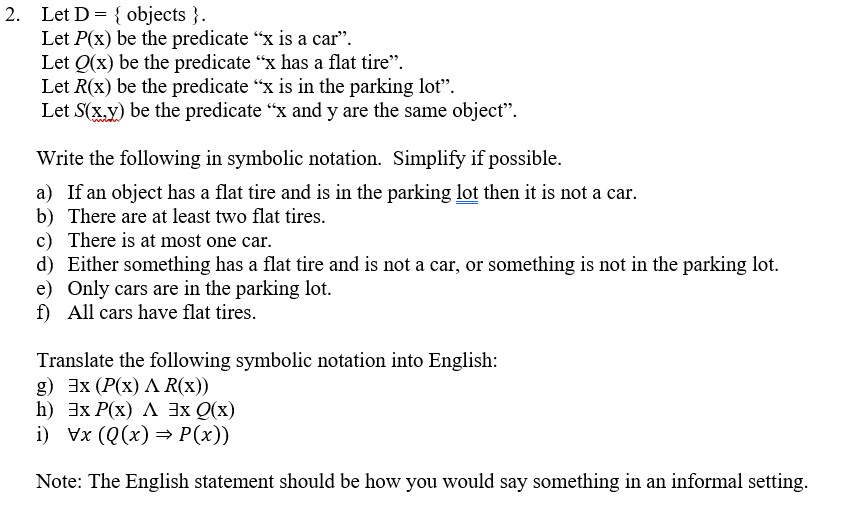
2. Let D= { objects}. Let P(x) be the predicate "x is a car. Let Q(x) be the predicate x has a flat tire. Let R(x) be the predicate x is in the parking lot. Let S(x,y) be the predicate x and y are the same object. Write the following in symbolic notation. Simplify if possible. a) If an object has a flat tire and is in the parking lot then it is not a car. b) There are at least two flat tires. c) There is at most one car. d) Either something has a flat tire and is not a car, or something is not in the parking lot. e) Only cars are in the parking lot. f) All cars have flat tires. Translate the following symbolic notation into English: g) 3x (P(x) A R(x) h) 3x P(x) A 3x Q(x) i) Vx (Q(x) = P(x)) Note: The English statement should be how you would say something in an informal setting
Step by Step Solution
There are 3 Steps involved in it

Get step-by-step solutions from verified subject matter experts
 Study Help