







Question: 2. Let Deterministic Quicksort be the non-randomized Quicksort which takes the first element as a pivot, using the partition routine that we covered in class
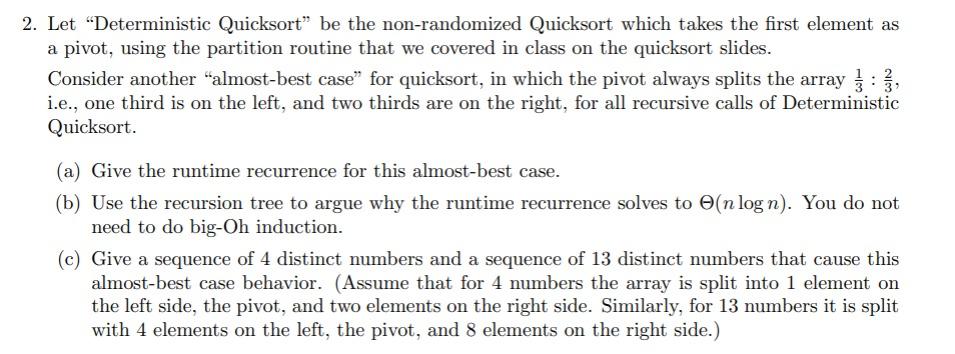
2. Let "Deterministic Quicksort" be the non-randomized Quicksort which takes the first element as a pivot, using the partition routine that we covered in class on the quicksort slides. Consider another "almost-best case" for quicksort, in which the pivot always splits the array 31:32, i.e., one third is on the left, and two thirds are on the right, for all recursive calls of Deterministic Quicksort. (a) Give the runtime recurrence for this almost-best case. (b) Use the recursion tree to argue why the runtime recurrence solves to (nlogn). You do not need to do big-Oh induction. (c) Give a sequence of 4 distinct numbers and a sequence of 13 distinct numbers that cause this almost-best case behavior. (Assume that for 4 numbers the array is split into 1 element on the left side, the pivot, and two elements on the right side. Similarly, for 13 numbers it is split with 4 elements on the left, the pivot, and 8 elements on the right side.)
Step by Step Solution
There are 3 Steps involved in it

Get step-by-step solutions from verified subject matter experts
 Study Help