







Question: Let f(x) = 4x + 4x + 5. Then according to the definition of derivative f'(-4) is the limit as a tends to of

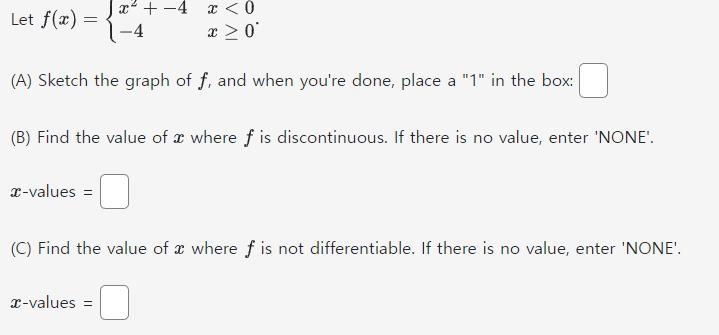
Let f(x) = 4x + 4x + 5. Then according to the definition of derivative f'(-4) is the limit as a tends to of the expression The value of this limit is x < 0 x > 0 (A) Sketch the graph of f, and when you're done, place a "1" in the box: Let f(x) = x +-4 -4 (B) Find the value of where f is discontinuous. If there is no value, enter 'NONE'. x-values = (C) Find the value of a where f is not differentiable. If there is no value, enter 'NONE'. x-values =
Step by Step Solution
3.46 Rating (162 Votes )
There are 3 Steps involved in it
It seems theres a mixup with the images youve provided The first image contains a question about finding the derivative of a quadratic function at a p... View full answer

Get step-by-step solutions from verified subject matter experts
 Study Help