







Question: 2. Let the function fun be defined as: int fun(int *k) * 4 return 3 * (*k) -1; Suppose fun is used in a program
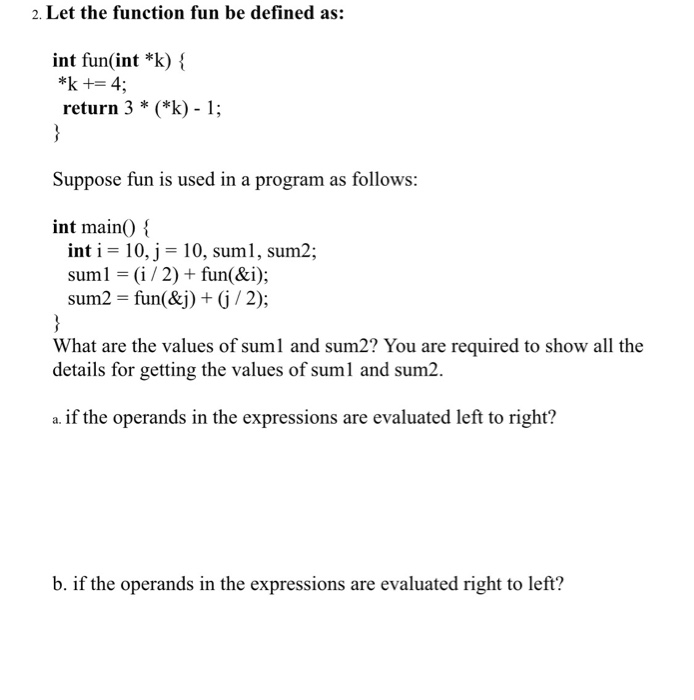
2. Let the function fun be defined as: int fun(int *k) * 4 return 3 * (*k) -1; Suppose fun is used in a program as follows: int main{ int i = 10, j = 10, sum1, sum2; sum (i/2) + fun(&i); sum2 fun(&j) + (j/2); What are the values of suml and sum2? You are required to show all the details for getting the values of suml and sum2 a. if the operands in the expressions are evaluated left to right? b. if the operands in the expressions are evaluated right to left? 2. Let the function fun be defined as: int fun(int *k) * 4 return 3 * (*k) -1; Suppose fun is used in a program as follows: int main{ int i = 10, j = 10, sum1, sum2; sum (i/2) + fun(&i); sum2 fun(&j) + (j/2); What are the values of suml and sum2? You are required to show all the details for getting the values of suml and sum2 a. if the operands in the expressions are evaluated left to right? b. if the operands in the expressions are evaluated right to left
Step by Step Solution
There are 3 Steps involved in it

Get step-by-step solutions from verified subject matter experts
 Study Help