



Question: 2. Let X and Y be independent exponential random variables, both having the same parameter 1. (a) Find P[Y - X > >]. Draw a
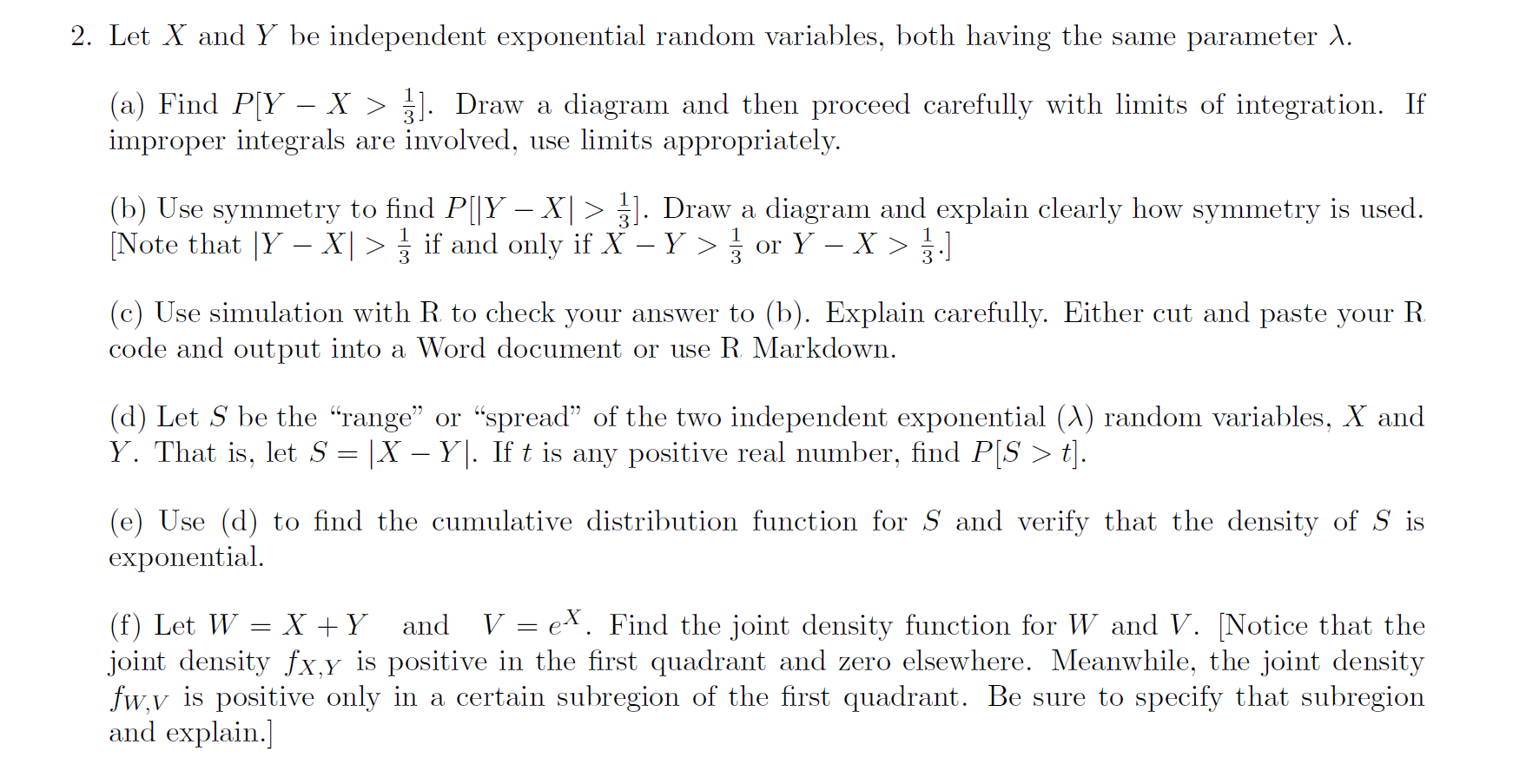
2. Let X and Y be independent exponential random variables, both having the same parameter 1. (a) Find P[Y - X > >]. Draw a diagram and then proceed carefully with limits of integration. If improper integrals are involved, use limits appropriately. (b) Use symmetry to find P[|Y - X| > =]. Draw a diagram and explain clearly how symmetry is used. [Note that [Y - X| > > if and only if X - Y > , or Y - X > .] (c) Use simulation with R to check your answer to (b). Explain carefully. Either cut and paste your R. code and output into a Word document or use R. Markdown. (d) Let S be the "range" or "spread" of the two independent exponential () random variables, X and Y. That is, let S = [X - Y|. If t is any positive real number, find P[S > t]. (e) Use (d) to find the cumulative distribution function for S and verify that the density of S is exponential. (f) Let W = X +Y and V =ex. Find the joint density function for W and V. Notice that the joint density fx,y is positive in the first quadrant and zero elsewhere. Meanwhile, the joint density fw,v is positive only in a certain subregion of the first quadrant. Be sure to specify that subregion and explain.]
Step by Step Solution
There are 3 Steps involved in it

Get step-by-step solutions from verified subject matter experts