







Question: 2. Let X1, X2, ... be i.i.d. random variables, defined on some probability space (0, , P) with P(X1 = 1) = p = 1
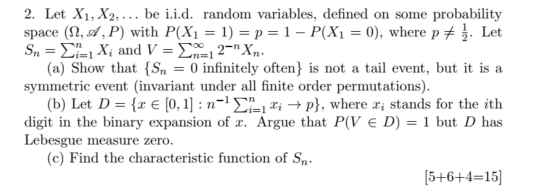
2. Let X1, X2, ... be i.i.d. random variables, defined on some probability space (0, , P) with P(X1 = 1) = p = 1 - P(X1 = 0), where p # 5. Let Sn = E X, and V = _ 2"" X. (a) Show that { S, = 0 infinitely often} is not a tail event, but it is a symmetric event (invariant under all finite order permutations). (b) Let D = {are [0, 1] : n- >_ m, + p), where a; stands for the ith digit in the binary expansion of r. Argue that P(V E D) = 1 but D has Lebesgue measure zero. (c) Find the characteristic function of S. [5+6+4=15]
Step by Step Solution
There are 3 Steps involved in it
1 Expert Approved Answer
Step: 1 Unlock

Question Has Been Solved by an Expert!
Get step-by-step solutions from verified subject matter experts
Step: 2 Unlock
Step: 3 Unlock
 Study Help