







Question: 2. Now consider algorithms based on the divide &conquer paradigm, all using the template SMALLESTDIST(A1..n]) 11 n= return oo else if n 2 return D(A],
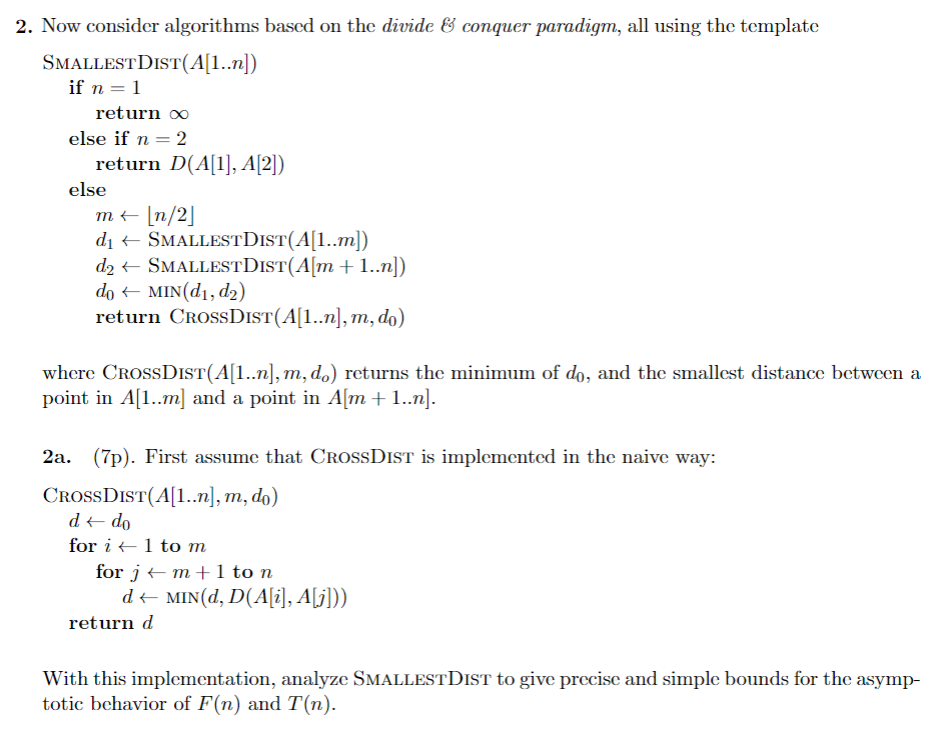
2. Now consider algorithms based on the divide &conquer paradigm, all using the template SMALLESTDIST(A1..n]) 11 n= return oo else if n 2 return D(A], A[2) else m |n/2] di SMALLESTDISTAI.m) do MIN(d1, d2) return CROSsDIST(A..,m, do) where CROSSDIST A[1..n], m, do) returns the minimum of do, and the smallest distance between a point in All ..m] and a point in Alm + l..nl 2a. (7p). First assume that CROSSDIST is implemented in the naive way: CROSsDIST(A1..,m, do) for i 1 to m for j m + 1 to n return d With this implementation, analyze SMALLESTDIST to give precise and simple bounds for the asymp- totic behavior of F(n) and T(n)
Step by Step Solution
There are 3 Steps involved in it
1 Expert Approved Answer
Step: 1 Unlock

Question Has Been Solved by an Expert!
Get step-by-step solutions from verified subject matter experts
Step: 2 Unlock
Step: 3 Unlock
 Study Help