Question: (2) Now we use kernel methods to classify a separate set of n training examples (see figures below). After trying out several methods, we generated
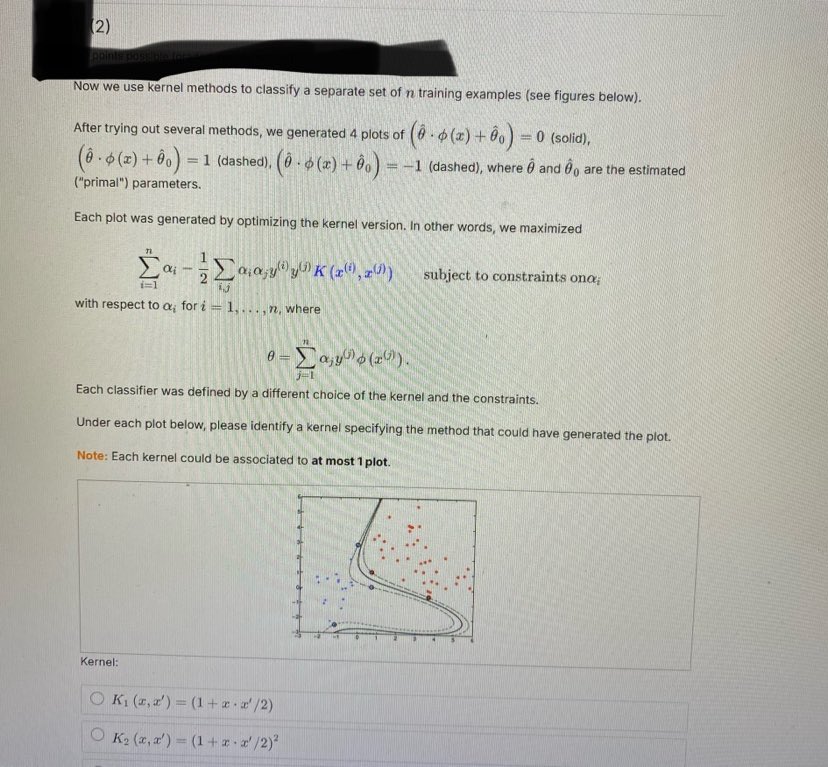
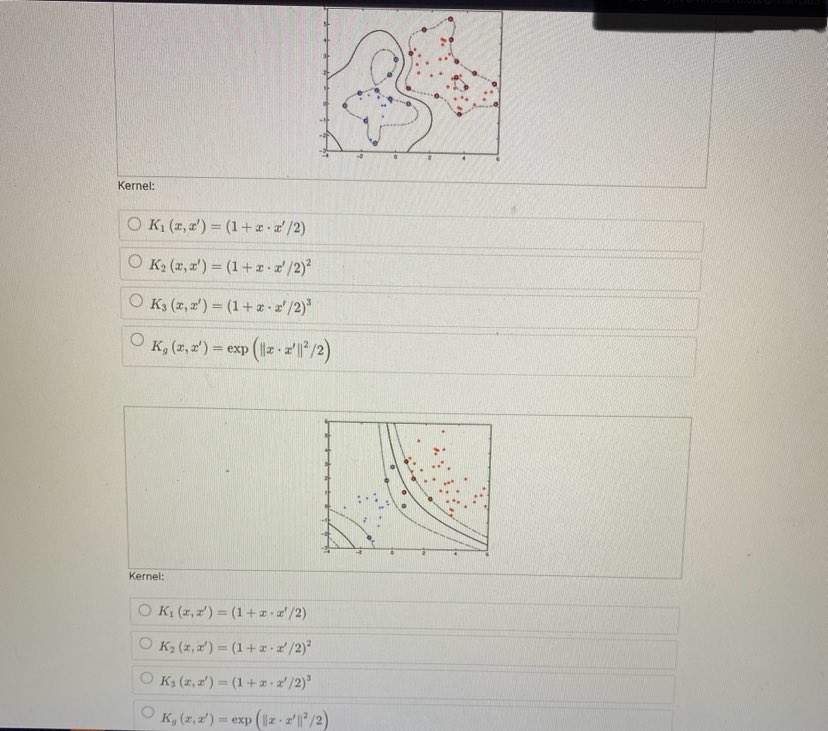
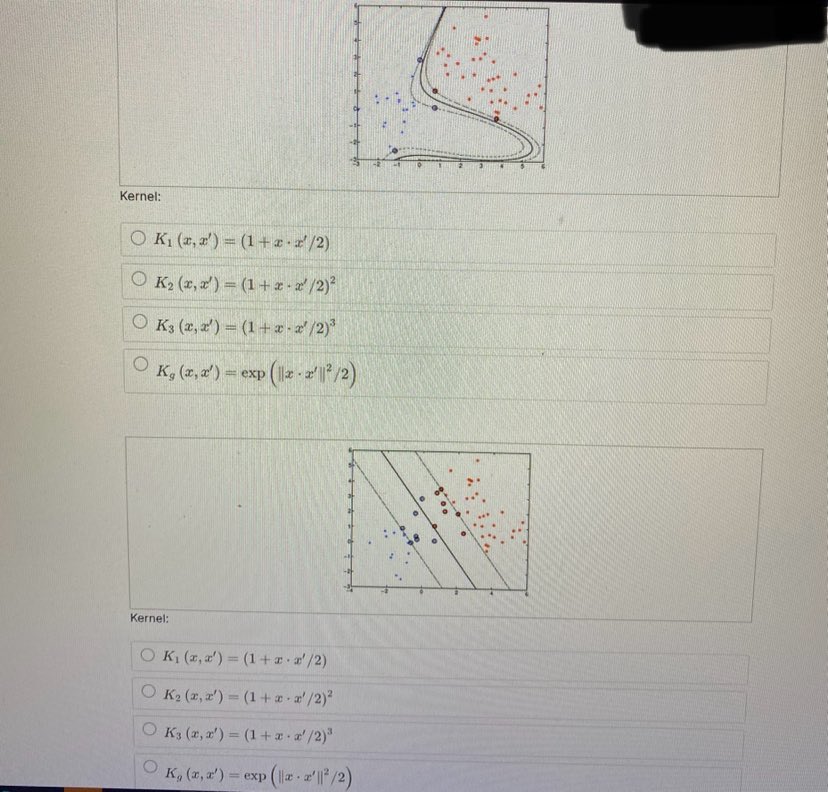
(2) Now we use kernel methods to classify a separate set of n training examples (see figures below). After trying out several methods, we generated 4 plots of (0 - d (x) + 0. ) = 0 (solid), (8 . (x) + 60) = 1 (dashed). (0 - 9 (x) + 60) - -1 (dashed), where 0 and do are the estimated ("primal") parameters. Each plot was generated by optimizing the kernel version. In other words, we maximized subject to constraints ona with respect to of for i - 1,. .., n, where Each classifier was defined by a different choice of the kernel and the constraints. Under each plot below, please identify a kernel specifying the method that could have generated the plot. Note: Each kernel could be associated to at most 1 plot. Kernel: O Ki (z, 2) = (1 +er/2) O K2 (x, a') = (1+2.2/2)\fKernel: O Ki (x, 2) = (1 +2 .2/2) O K2 (r, r) = (1 + 2+2/2) O Ka (z, 2) = (142-2/2) OK, (x, 2') = exp (12 -2'?/2) Kernel: OK, (x, ') = (1 + 2 . 2/2) O K2 (x, 2') = (1+2 -2/2) O K3 (2, r') = (1+2.2/2) OK, (x, 2') = exp (Iz . 2'17/2)
Step by Step Solution
There are 3 Steps involved in it
1 Expert Approved Answer
Step: 1 Unlock
Question Has Been Solved by an Expert!
Get step-by-step solutions from verified subject matter experts
Step: 2 Unlock
Step: 3 Unlock
Students Have Also Explored These Related Mathematics Questions!









 Study Help