







Question: 2. Now we will verify your calculation by checking that the gradient Vf(:z:) is tangent to f (:13) at the point :13. Since we can
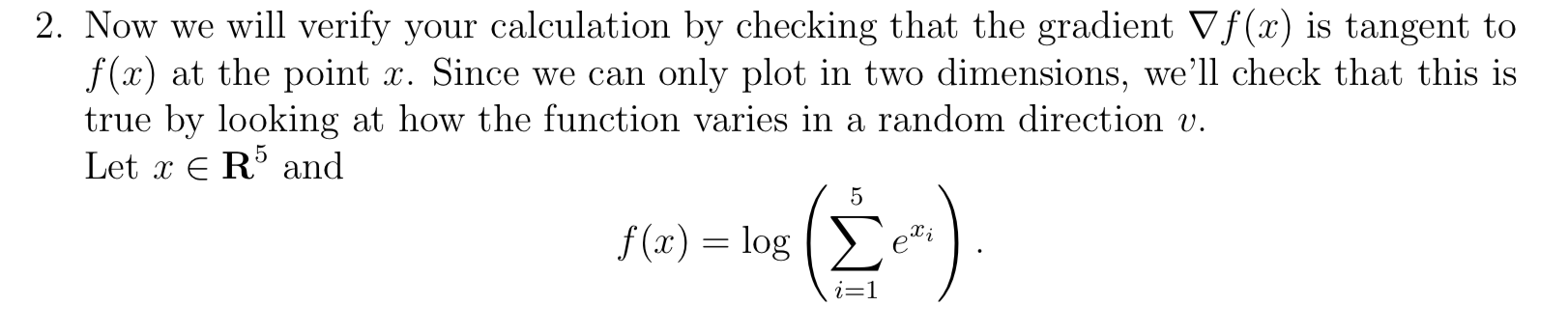
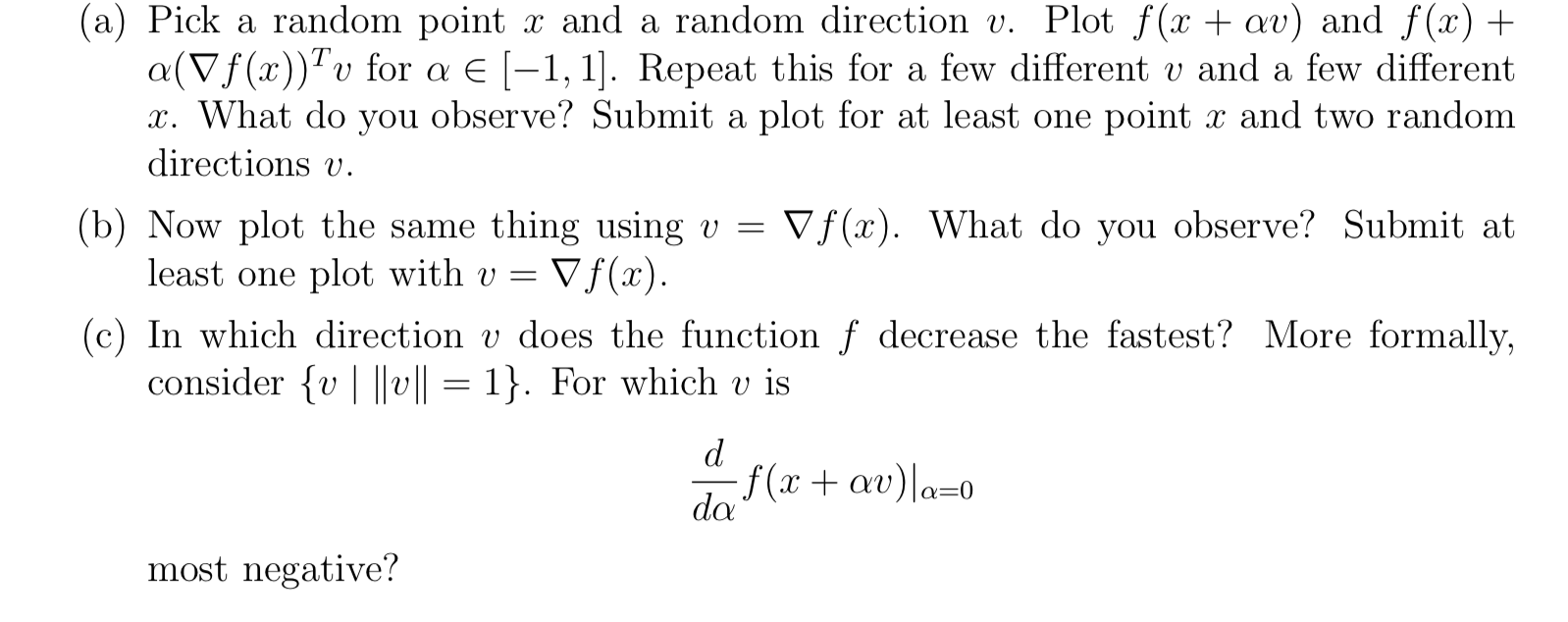
2. Now we will verify your calculation by checking that the gradient Vf(:z:) is tangent to f (:13) at the point :13. Since we can only plot in two dimensions, we'll check that this is true by looking at how the function varies in a random direction '0. Let cc 6 R5 and 5 f(:z:) : log (2 ext) . i=1 (a) Pick a random point a: and a random direction '0. Plot f (:1: + ow) and f (:13) + o:(V f (113))T'v for o: E [1, 1]. Repeat this for a few different 'U and a few different 3:. What do you observe? Submit a plot for at least one point :1: and two random directions '0. (b) Now plot the same thing using 11 = V f (2:) What do you observe? Submit at least one plot with v = Vf(:z:). (c) In which direction '0 does the function f decrease the fastest? More formally, consider {'0 | ||v|l : 1}. For which 71 is d E (113 + 0W)|a=o most negative
Step by Step Solution
There are 3 Steps involved in it

Get step-by-step solutions from verified subject matter experts
 Study Help