







Question: 2. (page 22, Exercise 3, Chapter 1, 25 points) There are many other settings in which we can ask questions related to some type of
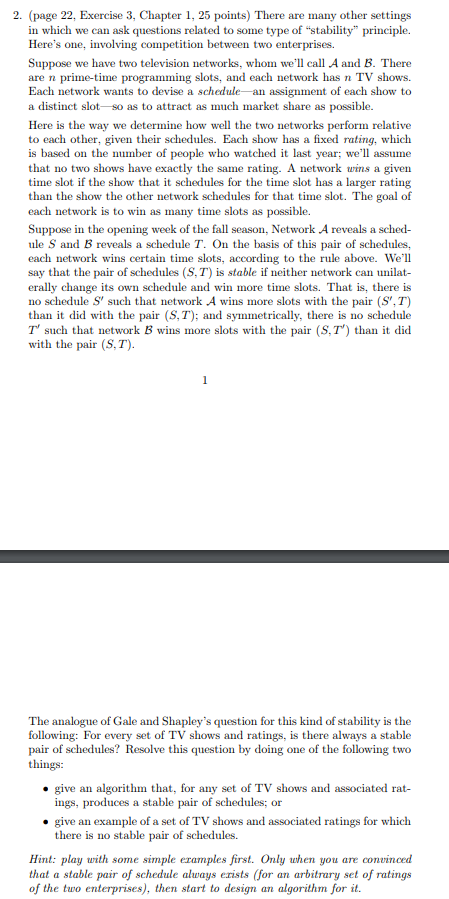
2. (page 22, Exercise 3, Chapter 1, 25 points) There are many other settings in which we can ask questions related to some type of "stability" principle. Here's one, involving competition between two enterprises. Suppose we have two television networks, whom w call A and B. There are n prime-time programming slots, and each network has n TV shows. Each network wants to devise a schedule an assignment of each show to a distinct slot so as to attract as much market share as possible. Here is the way we determine how the two networks perform relative to each other, given their schedules. Each show has a fixed rating, which is based on the number of people who watched it last year; we'll assume that no two shows have exactly the same rating. A network wins a given time slot if the show that it schedules for the time slot has a larger rating than the show the other network schedules for that time slot. The goal of each network is to win as many time slots as possible. ule S and B reveals a schedule T. On the basis of this pair of schedules, each network wins certain time slots, according to the rule above. We'll say that the pair of schedules (S, T) is stable if neither network can unilat- erally change its own schedule and win more time slots. That is, there is no schedule S such that network A wins more slots with the pair (S',T) than it did with the pair (S, T); and symmetrically, there is no schedule T such that network B wins more slots with the pair (S, T) than it did with the pair (S, T) The analogue of Gale and Shapley's question for this kind of stability is the following: For every set of TV shows and ratings, is there always a stable pair of schedules? Resolve this question by doing one of the following two things: .give an algorithm that, for any set of TV shows and associated rat give an example of a set of TV shows and associated ratings for which Hint: play with some simple eramples first. Only when you are convinced ings, produces a stable pair of schedules; or there is no stable pair of schedules that a stable pair of schedule always erists (for an arbitrary set of ratings of the two enterprises), then start to design an algorithm for it
Step by Step Solution
There are 3 Steps involved in it

Get step-by-step solutions from verified subject matter experts
 Study Help