







Question: 2 Perpendicular polarization In the lecture notes (and/or Griffiths 9.3.3), we worked out the case of reflection and transmission at any angle. But we considered
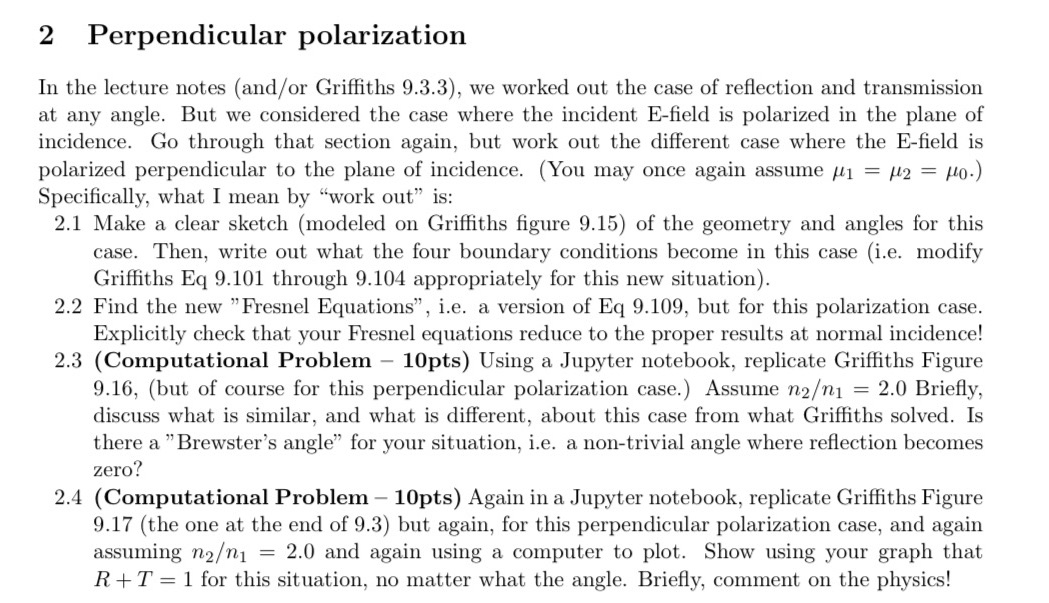
2 Perpendicular polarization In the lecture notes (and/or Griffiths 9.3.3), we worked out the case of reflection and transmission at any angle. But we considered the case where the incident E-field is polarized in the plane of incidence. Go through that section again, but work out the different case where the E-field is polarized perpendicular to the plane of incidence. (You may once again assume (1 = /2 = /0.) Specifically, what I mean by "work out" is: 2.1 Make a clear sketch (modeled on Griffiths figure 9.15) of the geometry and angles for this case. Then, write out what the four boundary conditions become in this case (i.e. modify Griffiths Eq 9.101 through 9.104 appropriately for this new situation). 2.2 Find the new "Fresnel Equations", i.e. a version of Eq 9.109, but for this polarization case. Explicitly check that your Fresnel equations reduce to the proper results at normal incidence! 2.3 (Computational Problem - 10pts) Using a Jupyter notebook, replicate Griffiths Figure 9.16, (but of course for this perpendicular polarization case.) Assume n21 = 2.0 Briefly, discuss what is similar, and what is different, about this case from what Griffiths solved. Is there a " Brewster's angle" for your situation, i.e. a non-trivial angle where reflection becomes zero? 2.4 (Computational Problem - 10pts) Again in a Jupyter notebook, replicate Griffiths Figure 9.17 (the one at the end of 9.3) but again, for this perpendicular polarization case, and again assuming n21 = 2.0 and again using a computer to plot. Show using your graph that R + T = 1 for this situation, no matter what the angle. Briefly, comment on the physics
Step by Step Solution
There are 3 Steps involved in it

Get step-by-step solutions from verified subject matter experts
 Study Help