







Question: 2) Planet Mars has two very small moons, Phobos and Deimos. [Their respective masses are: Mars -6.39 x 10²³ kg, Phobos -10.8 x 10¹⁵
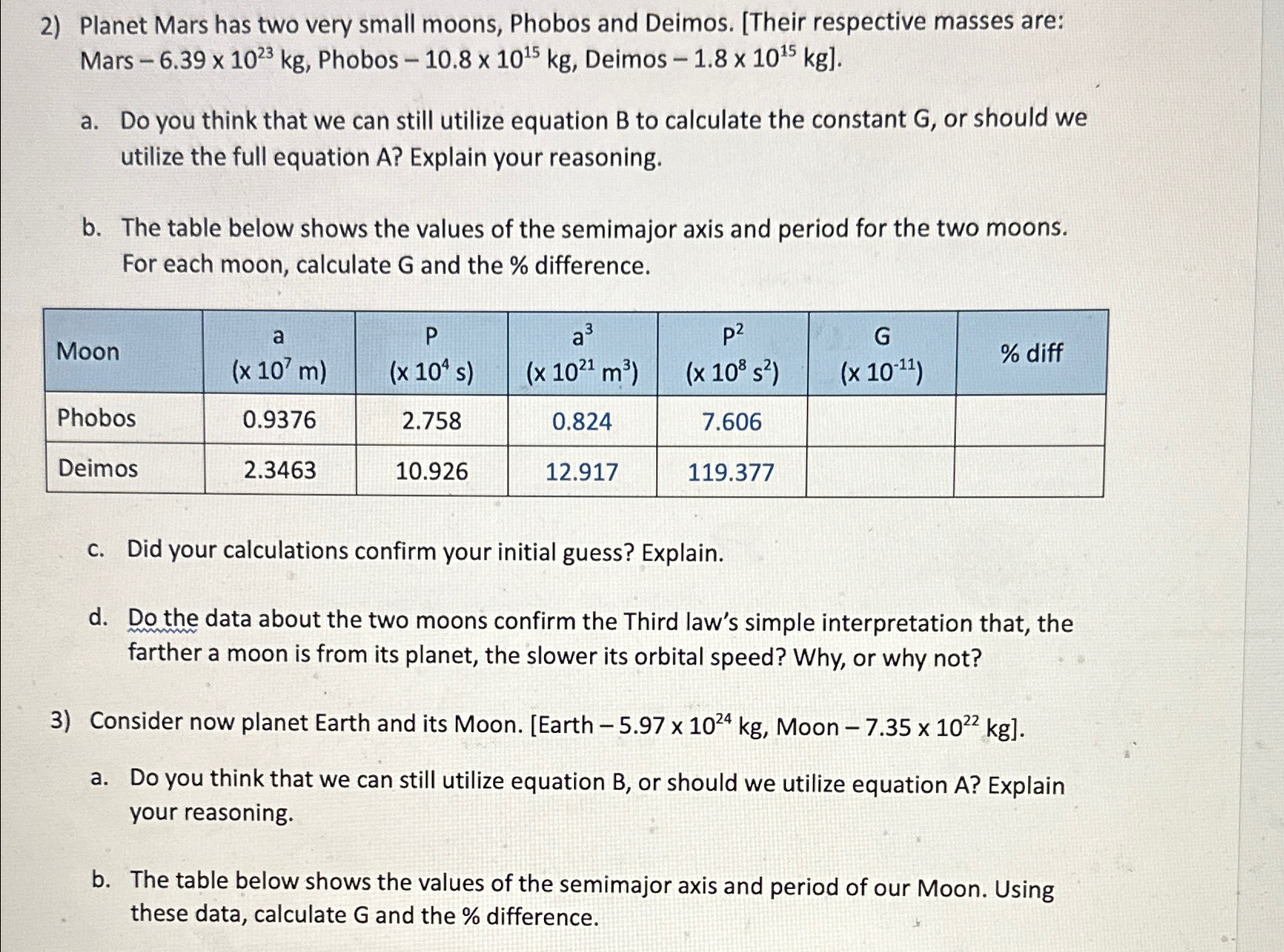
2) Planet Mars has two very small moons, Phobos and Deimos. [Their respective masses are: Mars -6.39 x 10²³ kg, Phobos -10.8 x 10¹⁵ kg, Deimos - 1.8 x 10 15 kg]. a. Do you think that we can still utilize equation B to calculate the constant G, or should we utilize the full equation A? Explain your reasoning. b. The table below shows the values of the semimajor axis and period for the two moons. For each moon, calculate G and the % difference. a P p G Moon % diff (x 107 m) (x 10 s) (x 1021 m) (x 108 s) (x 10-11) Phobos 0.9376 2.758 0.824 7.606 Deimos 2.3463 10.926 12.917 119.377 c. Did your calculations confirm your initial guess? Explain. d. Do the data about the two moons confirm the Third law's simple interpretation that, the farther a moon is from its planet, the slower its orbital speed? Why, or why not? 3) Consider now planet Earth and its Moon. [Earth - 5.97 x 1024 kg, Moon -7.35 x 10 kg]. a. Do you think that we can still utilize equation B, or should we utilize equation A? Explain your reasoning. b. The table below shows the values of the semimajor axis and period of our Moon. Using these data, calculate G and the % difference.
Step by Step Solution
There are 3 Steps involved in it

Get step-by-step solutions from verified subject matter experts
 Study Help