







Question: 2. Plot v vs. t (be sure to label appropriately with correct units) using Graphical Analysis Software. Copy and paste it below. From equation 1
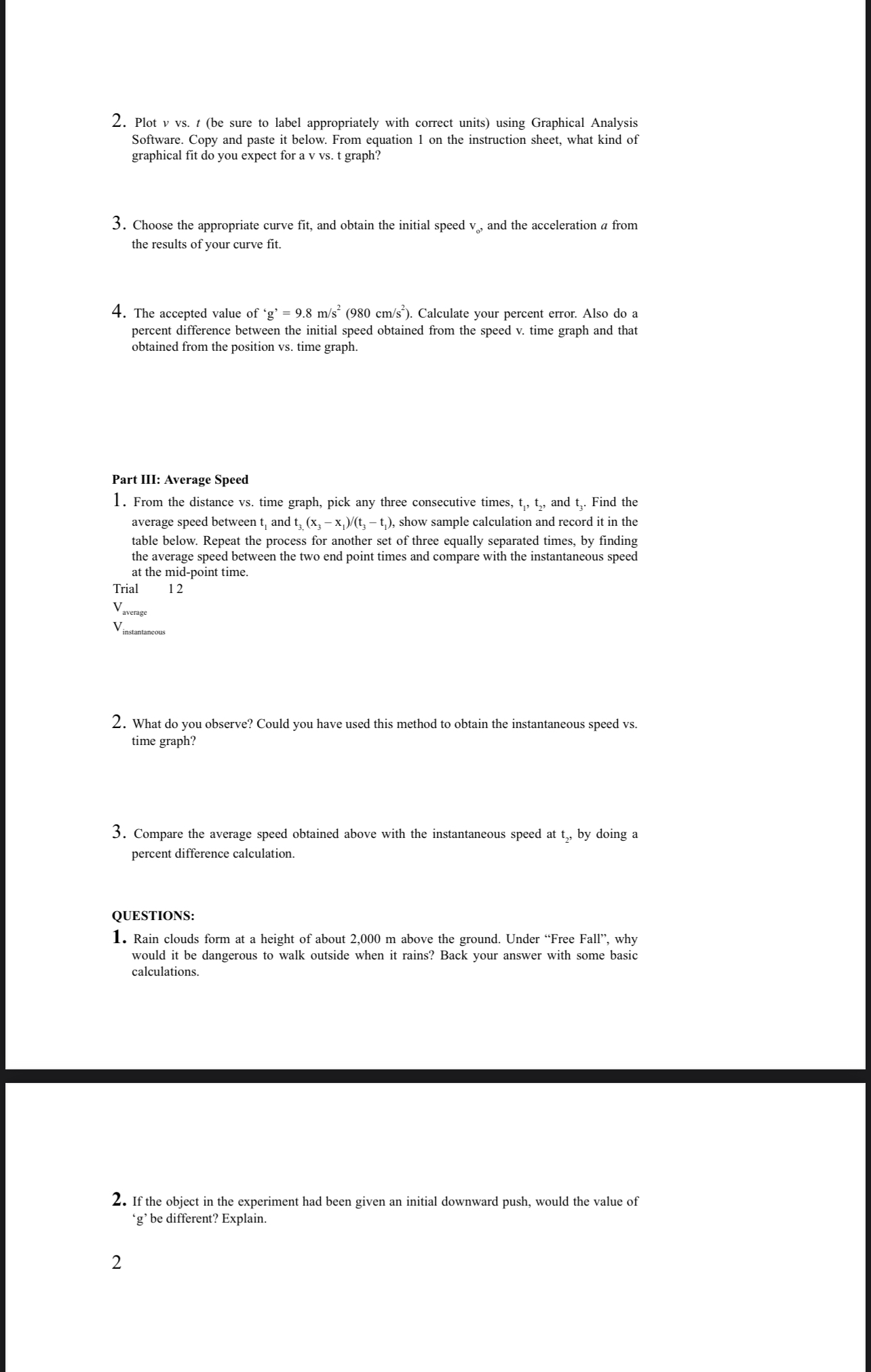
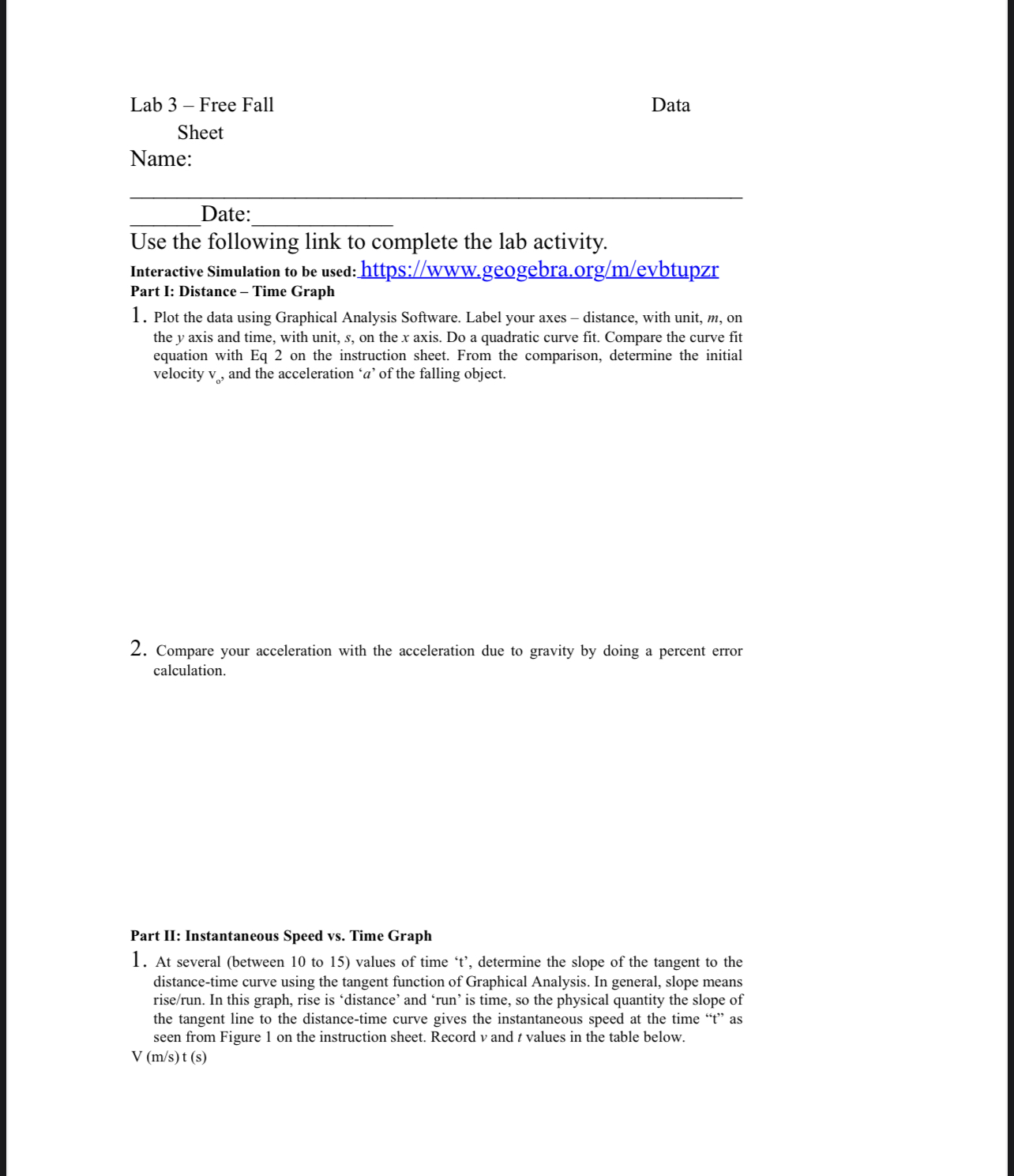
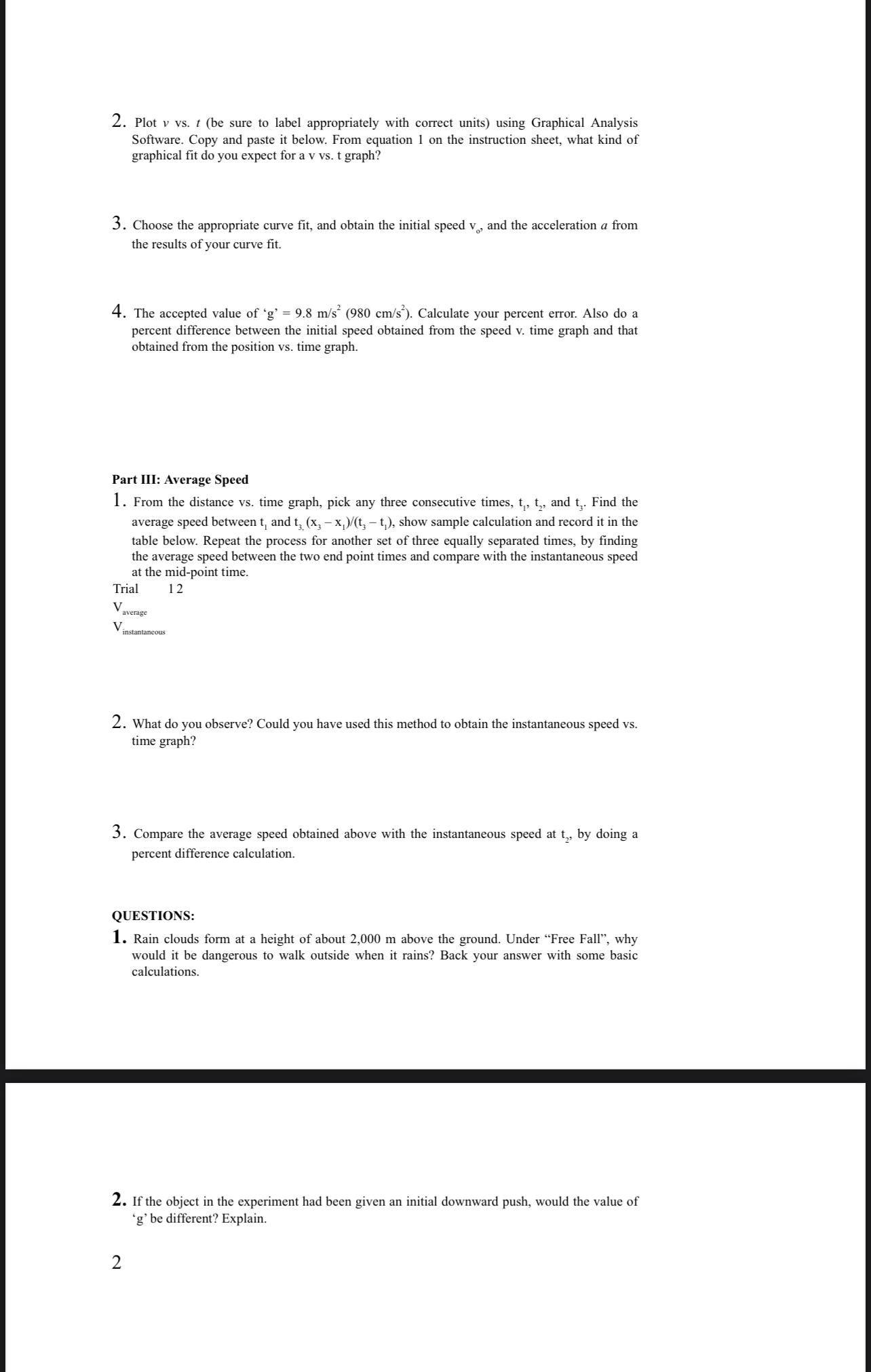
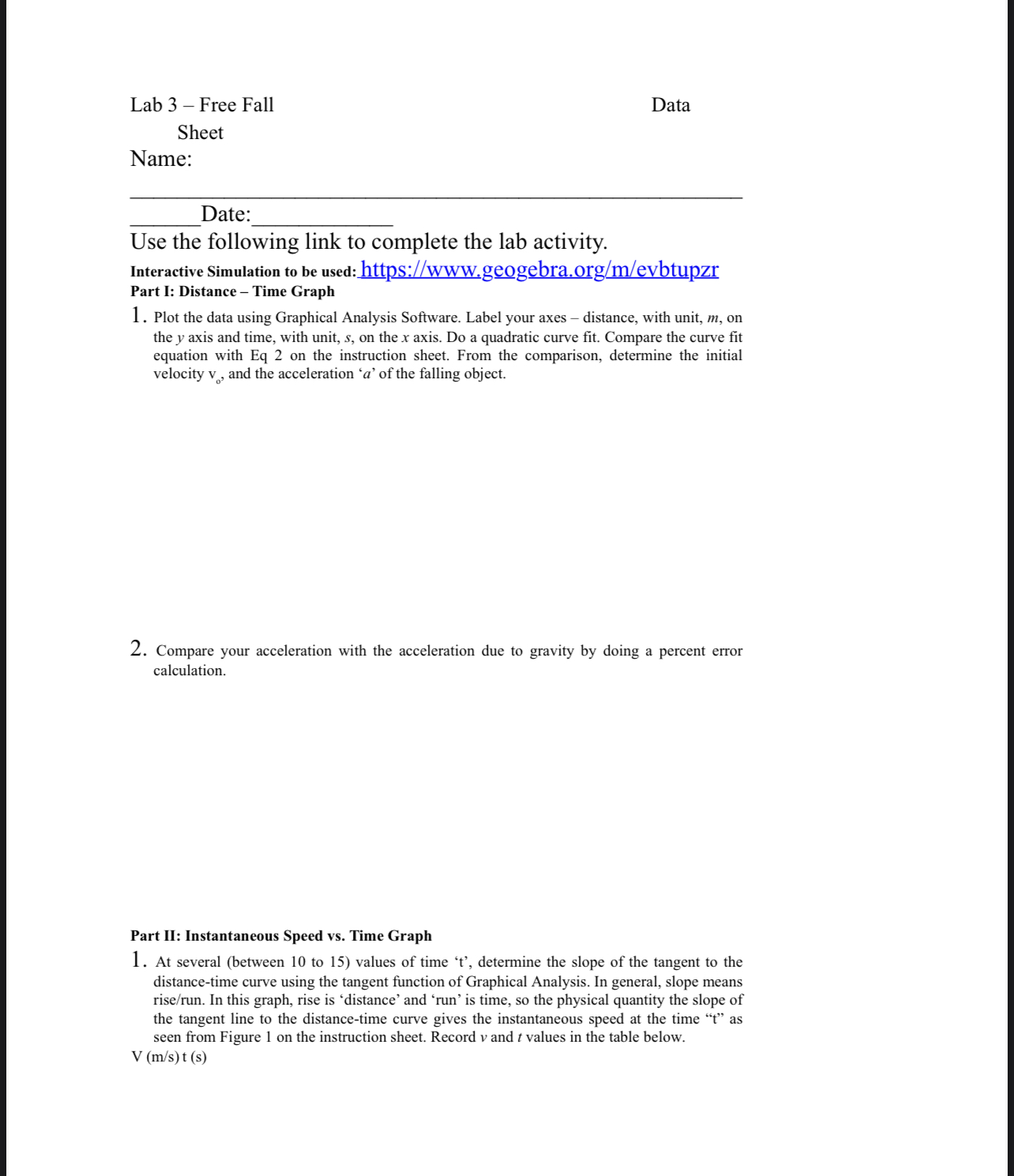
2. Plot v vs. t (be sure to label appropriately with correct units) using Graphical Analysis Software. Copy and paste it below. From equation 1 on the instruction sheet, what kind of graphical fit do you expect for a v vs. t graph 3. Choose the appropriate curve fit, and obtain the initial speed v, and the acceleration a from the results of your curve fit. 4. The accepted value of 'g' = 9.8 m/s (980 cm/s). Calculate your percent error. Also do a percent difference between the initial speed obtained from the speed v. time graph and that obtained from the position vs. time graph. Part III: Average Speed 1. From the distance vs. time graph, pick any three consecutive times, t,, t,, and t,. Find the average speed between t, and t, (X, - X,)/(t, - t,), show sample calculation and record it in the table below. Repeat the process for another set of three equally separated times, by finding the average speed between the two end point times and compare with the instantaneous speed at the mid-point time. Trial 12 Vaverage instantaneous 2. What do you observe? Could you have used this method to obtain the instantaneous speed vs. time graph? 3. Compare the average speed obtained above with the instantaneous speed at to, by doing a percent difference calculation. QUESTIONS: 1. Rain clouds form at a height of about 2,000 m above the ground. Under "Free Fall", why would it be dangerous to walk outside when it rains? Back your answer with some basic calculations 2. If the object in the experiment had been given an initial downward push, would the value of g' be different? Explain. 2Lab 3 Free Fall Data Sheet Name: Date: Use the following link to complete the lab activity. Interactive Simulation to be used:mpI/gWWW.gB_Qgl1fa.l' rn/evlztuer Part I: Distance Time Graph 1 . Plot the data using Graphical Analysis Software. Label your axes distance, with unit, an, on the y axis and time, with unit, 5, on the x axis. Do a quadratic curve t. Compare the curve t equation with Eq 2 on the instruction sheet. Front the comparison, determine the initial velocity v\
Step by Step Solution
There are 3 Steps involved in it

Get step-by-step solutions from verified subject matter experts
 Study Help