







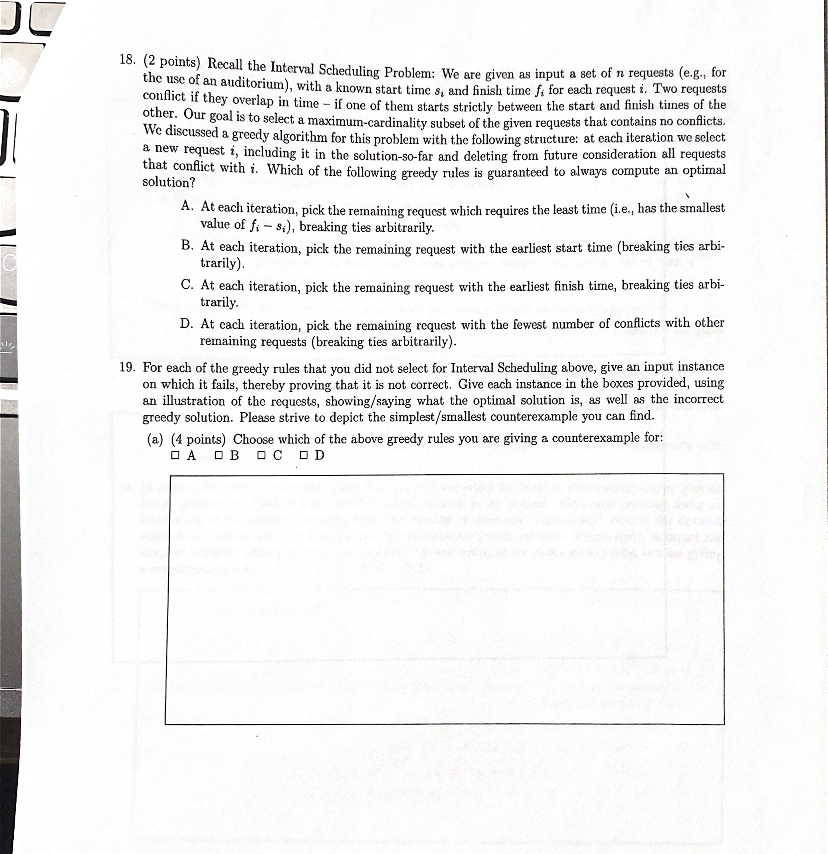
Question: ( 2 points ) Recall the Interval Scheduling Problem: We are given as input a set of n requests ( e . g . ,
points Recall the Interval Scheduling Problem: We are given as input a set of requests eg for
the use of an auditorium with a known start time and finish time for each request Two requests
conflict if they overlap in time if one of them starts strictly between the start and finish times of the
other. Our goal is to select a maximumcardinality subset of the given requests that contains no conflicts.
We discussed a greedy algorithm for this problem with the following structure: at each iteration we sclect.
a new request including it in the solutionsofar and deleting from future consideration all requests
that conflict with Which of the following greedy rules is guaranteed to always compute an optimal
solution?
A At each iteration, pick the remaining request which requires the least time ie has the smallest
value of breaking ties arbitrarily.
B At each iteration, pick the remaining request with the earliest start time breaking ties arbi
trarily
C At each iteration, pick the remaining request with the earliest finish time, breaking ties arbi
trarily.
D At each iteration, pick the remaining request with the fewest number of conflicts with other
remaining requests breaking ties arbitrarily
For each of the greedy rules that you did not select for Interval Scheduling above, give an input instance
on which it fails, thereby proving that it is not correct. Give each instance in the boxes provided, using
an illustration of the requests, showingsaying what the optimal solution is as well as the incorrect
greedy solution. Please strive to depict the simplestsmallest counterexample you can find.
a points Choose which of the above greedy rules you are giving a counterexample for:
b points Choose which of the above greedy rules you are giving a counterexample for: ABCD
c points Choose which of the above greedy rules you are giving a counterexample for: ABCD
Step by Step Solution
There are 3 Steps involved in it
1 Expert Approved Answer
Step: 1 Unlock

Question Has Been Solved by an Expert!
Get step-by-step solutions from verified subject matter experts
Step: 2 Unlock
Step: 3 Unlock
 Study Help