







Question: (2 points) The next few problems deal with second7order linear recurrence relations. When entering the general solution, you must use the arbitrary constants b, 6.
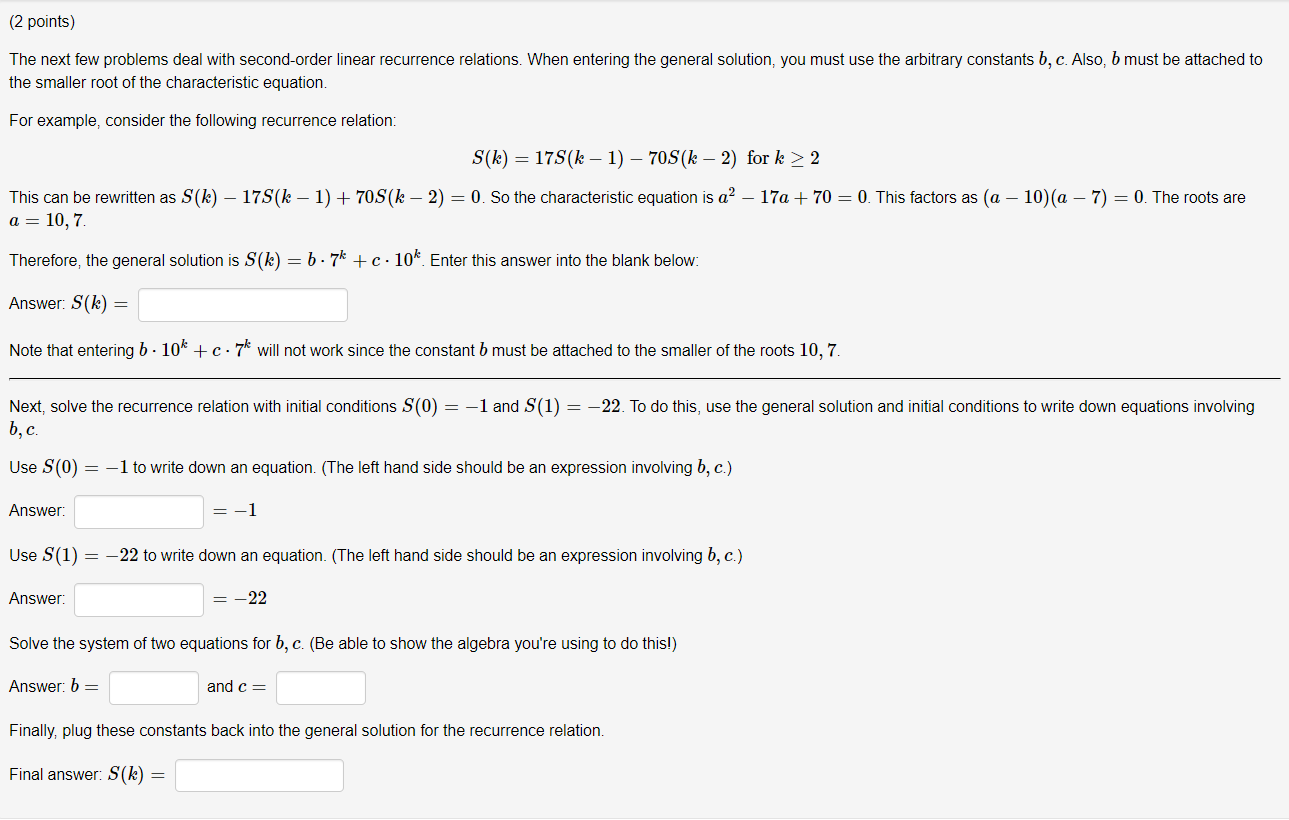
(2 points) The next few problems deal with second7order linear recurrence relations. When entering the general solution, you must use the arbitrary constants b, 6. Also, I) must be attached to the smaller root of the characteristic equation. For example, consider the following recurrence relation: 30;) = 1730: 7 1) 7 7030.: 7 2) for k 2 2 This can be rewritten as S(k) 7 1730: 7 1) + 703(k 7 2] = 0. So the characteristic equation is :12 7 1711 + 70 = t]. This factors as (a. 7 10)(a 7 7] = 0. The roots are a = 10, 7 Therefore, the general solution is S(k) = b- 7" + c - 10*. Enter this answer into the blank below: Answer: 30:] 2 Note that entering b - 10k + c - 7" will not work smoe the constant 5 must be attached to the smaller of the roots 10, 7. Next, solve the recurrence relation with initial conditions S (0) = 71 and S (1) = 722. To do this, use the general solution and initial conditions to write down equations involving b, c. Use 3(0) : 71 to wnte down an equation. (The left hand side should be an expression involwng b, 6.} Answer: : 71 Use 3(1) : 722 to write down an equation. (The left hand side should be an expression involving 5, 0.) Answer: : 722 Solve the system of two equations for b, 6. (Be able to show the algebra you're using to do this!) Answer: I) : and c : Finally: plug these constants back into the general solution for the recurrence relation. Final answer: S (k)
Step by Step Solution
There are 3 Steps involved in it

Get step-by-step solutions from verified subject matter experts
 Study Help