







Question: 2 Problem 2: Space explorers discover an my = 8.7 x 10 kg asteroid A, MA that happens to have a positive charge of qa
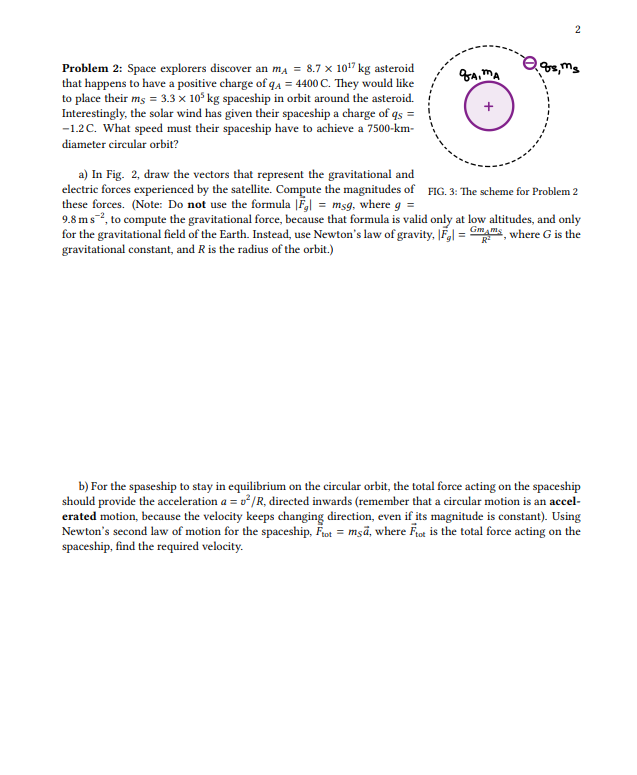
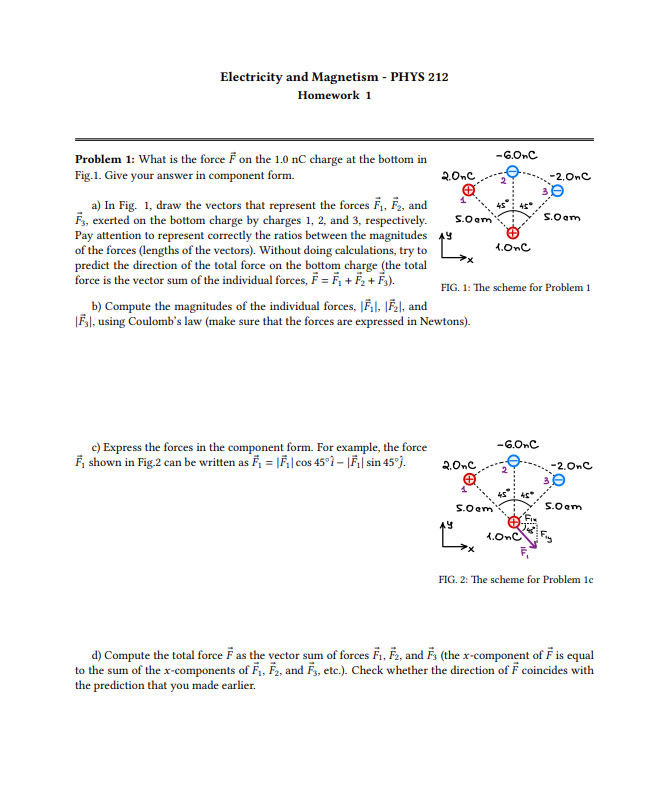
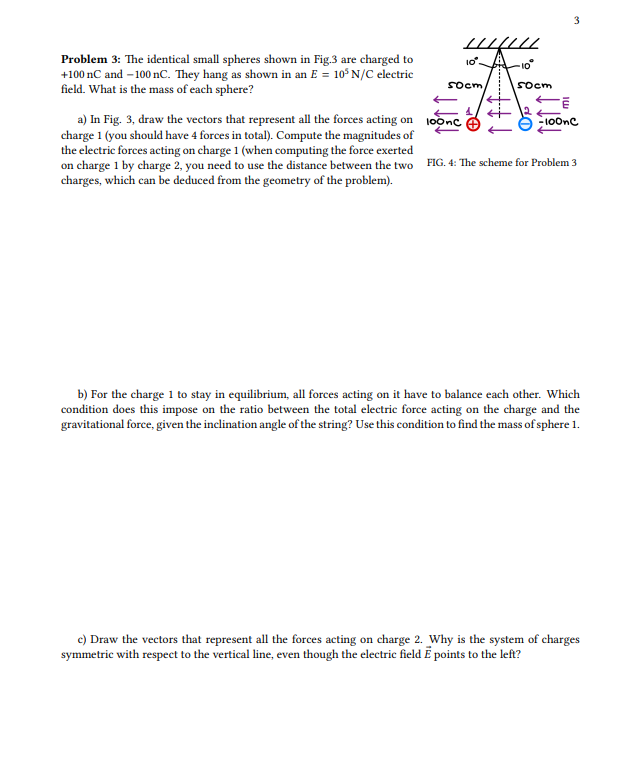
2 Problem 2: Space explorers discover an my = 8.7 x 10" kg asteroid A, MA that happens to have a positive charge of qa = 4400 C. They would like to place their my = 3.3 x 10' kg spaceship in orbit around the asteroid. Interestingly, the solar wind has given their spaceship a charge of qs = + -1.2C. What speed must their spaceship have to achieve a 7500-km- diameter circular orbit? a) In Fig. 2, draw the vectors that represent the gravitational and electric forces experienced by the satellite. Compute the magnitudes of FIG. 3: The scheme for Problem 2 these forces. (Note: Do not use the formula |F,| = msg, where g = 9.8 ms , to compute the gravitational force, because that formula is valid only at low altitudes, and only for the gravitational field of the Earth. Instead, use Newton's law of gravity, IF| = -R." -Gmama, where G is the gravitational constant, and R is the radius of the orbit.) b) For the spaseship to stay in equilibrium on the circular orbit, the total force acting on the spaceship should provide the acceleration a = of/R, directed inwards (remember that a circular motion is an accel- erated motion, because the velocity keeps changing direction, even if its magnitude is constant). Using Newton's second law of motion for the spaceship, Foot = mya, where Foot is the total force acting on the spaceship, find the required velocity.Electricity and Magnetism - PHYS 212 Homework 1 Problem 1: What is the force F on the 1.0 nC charge at the bottom in -G.OnC Fig.1. Give your answer in component form. 2.0nCO 30 a) In Fig. 1, draw the vectors that represent the forces F1, F2, and Fy, exerted on the bottom charge by charges 1, 2, and 3, respectively. S.Dam 5.Dom Pay attention to represent correctly the ratios between the magnitudes of the forces (lengths of the vectors). Without doing calculations, try to 1.OnC predict the direction of the total force on the bottom charge (the total force is the vector sum of the individual forces, F = F, + F2 + F;). FIG. 1: The scheme for Problem 1 b) Compute the magnitudes of the individual forces, [Fil, |Fal, and IFyl, using Coulomb's law (make sure that the forces are expressed in Newtons). c) Express the forces in the component form. For example, the force -G.OnC. F, shown in Fig.2 can be written as F, = [F, | cos 45 1 - [F, | sin 45"]. 2.0nC ....-2.OnC 30 S.Dam 5.Dam FIG. 2: The scheme for Problem ic d) Compute the total force F as the vector sum of forces Fi, F2, and Fy (the x-component of F is equal to the sum of the x-components of F1, F2, and Fy, etc.). Check whether the direction of F coincides with the prediction that you made earlier.3 Problem 3: The identical small spheres shown in Fig.3 are charged to . ID +100 nC and -100 nC. They hang as shown in an E = 10'N/C electric field. What is the mass of each sphere? 50cm SOcm -E a) In Fig. 3, draw the vectors that represent all the forces acting on 10OnC ) -100nC charge 1 (you should have 4 forces in total). Compute the magnitudes of the electric forces acting on charge 1 (when computing the force exerted on charge 1 by charge 2, you need to use the distance between the two FIG. 4: The scheme for Problem 3 charges, which can be deduced from the geometry of the problem). b) For the charge 1 to stay in equilibrium, all forces acting on it have to balance each other. Which condition does this impose on the ratio between the total electric force acting on the charge and the gravitational force, given the inclination angle of the string? Use this condition to find the mass of sphere 1. c) Draw the vectors that represent all the forces acting on charge 2. Why is the system of charges symmetric with respect to the vertical line, even though the electric field E points to the left
Step by Step Solution
There are 3 Steps involved in it

Get step-by-step solutions from verified subject matter experts
 Study Help