Question: 2 Problem 3) Following Problem 1: Let's assume that the cost of producing the two crops is not negligible, and the net benefit function is
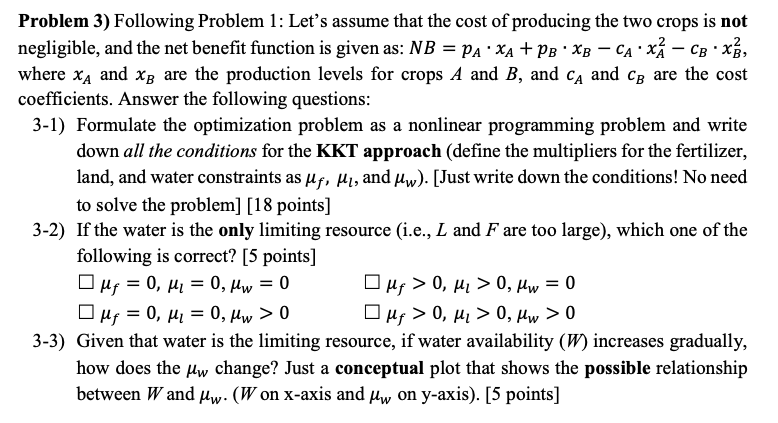
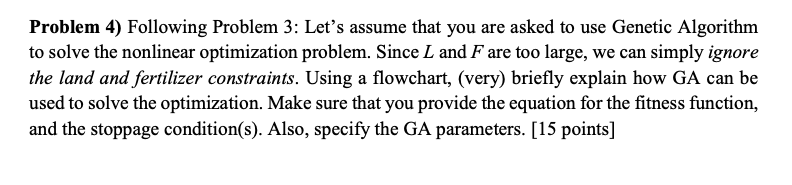
2 Problem 3) Following Problem 1: Let's assume that the cost of producing the two crops is not negligible, and the net benefit function is given as: NB = PA' XA +PB XB CA x Cp x, where xa and Xp are the production levels for crops A and B, and CA and Cp are the cost coefficients. Answer the following questions: 3-1) Formulate the optimization problem as a nonlinear programming problem and write down all the conditions for the KKT approach (define the multipliers for the fertilizer, land, and water constraints as up, Mv, and #w). [Just write down the conditions! No need to solve the problem] [18 points) 3-2) If the water is the only limiting resource (i.e., L and F are too large), which one of the following is correct? [5 points) up = 0, M = 0, Mw 0 O up > 0, H > 0, Mw = 0 up = 0, M = 0, Mw > 0 0 O up > 0, M > 0, Mw > 0 3-3) Given that water is the limiting resource, if water availability (W) increases gradually, how does the Hw change? Just a conceptual plot that shows the possible relationship between W and Mw. (Won x-axis and Uw on y-axis). [5 points) = = = = = = Problem 4) Following Problem 3: Lets assume that you are asked to use Genetic Algorithm to solve the nonlinear optimization problem. Since L and F are too large, we can simply ignore the land and fertilizer constraints. Using a flowchart, (very) briefly explain how GA can be used to solve the optimization. Make sure that you provide the equation for the fitness function, and the stoppage condition(s). Also, specify the GA parameters. [15 points) 2 Problem 3) Following Problem 1: Let's assume that the cost of producing the two crops is not negligible, and the net benefit function is given as: NB = PA' XA +PB XB CA x Cp x, where xa and Xp are the production levels for crops A and B, and CA and Cp are the cost coefficients. Answer the following questions: 3-1) Formulate the optimization problem as a nonlinear programming problem and write down all the conditions for the KKT approach (define the multipliers for the fertilizer, land, and water constraints as up, Mv, and #w). [Just write down the conditions! No need to solve the problem] [18 points) 3-2) If the water is the only limiting resource (i.e., L and F are too large), which one of the following is correct? [5 points) up = 0, M = 0, Mw 0 O up > 0, H > 0, Mw = 0 up = 0, M = 0, Mw > 0 0 O up > 0, M > 0, Mw > 0 3-3) Given that water is the limiting resource, if water availability (W) increases gradually, how does the Hw change? Just a conceptual plot that shows the possible relationship between W and Mw. (Won x-axis and Uw on y-axis). [5 points) = = = = = = Problem 4) Following Problem 3: Lets assume that you are asked to use Genetic Algorithm to solve the nonlinear optimization problem. Since L and F are too large, we can simply ignore the land and fertilizer constraints. Using a flowchart, (very) briefly explain how GA can be used to solve the optimization. Make sure that you provide the equation for the fitness function, and the stoppage condition(s). Also, specify the GA parameters. [15 points)









 Study Help