







Question: 2. Problem 3.10 (from text book 2nd Ed): In postcapillary venules, leukocytes are close to the vessel wall, rolling or moving slowly than the average
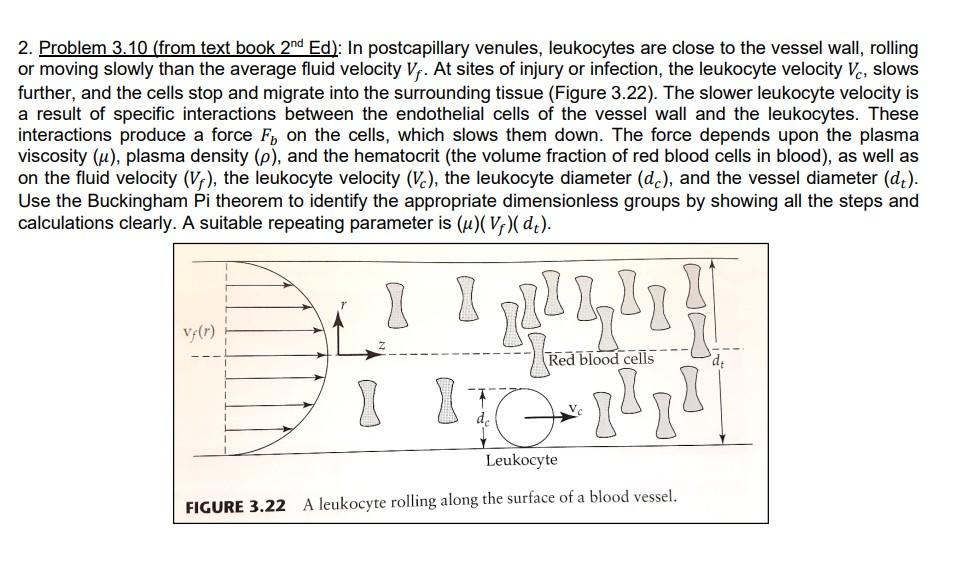
2. Problem 3.10 (from text book 2nd Ed): In postcapillary venules, leukocytes are close to the vessel wall, rolling or moving slowly than the average fluid velocity Vf. At sites of injury or infection, the leukocyte velocity Vc, slows further, and the cells stop and migrate into the surrounding tissue (Figure 3.22). The slower leukocyte velocity is a result of specific interactions between the endothelial cells of the vessel wall and the leukocytes. These interactions produce a force F, on the cells, which slows them down. The force depends upon the plasma viscosity (u), plasma density (p), and the hematocrit (the volume fraction of red blood cells in blood), as well as on the fluid velocity (V), the leukocyte velocity (Vc), the leukocyte diameter (dc), and the vessel diameter (dt). Use the Buckingham Pi theorem to identify the appropriate dimensionless groups by showing all the steps and calculations clearly. A suitable repeating parameter is (u)(V)(dt). [ 1 vf(r) Red blood cells 'd 1 I O 11 Leukocyte FIGURE 3.22 A leukocyte rolling along the surface of a blood vessel
Step by Step Solution
There are 3 Steps involved in it

Get step-by-step solutions from verified subject matter experts
 Study Help