







Question: 2 Problem 4. The spherical pendulum can be described by a mass m that is constrained to move on the surface of a sphere of
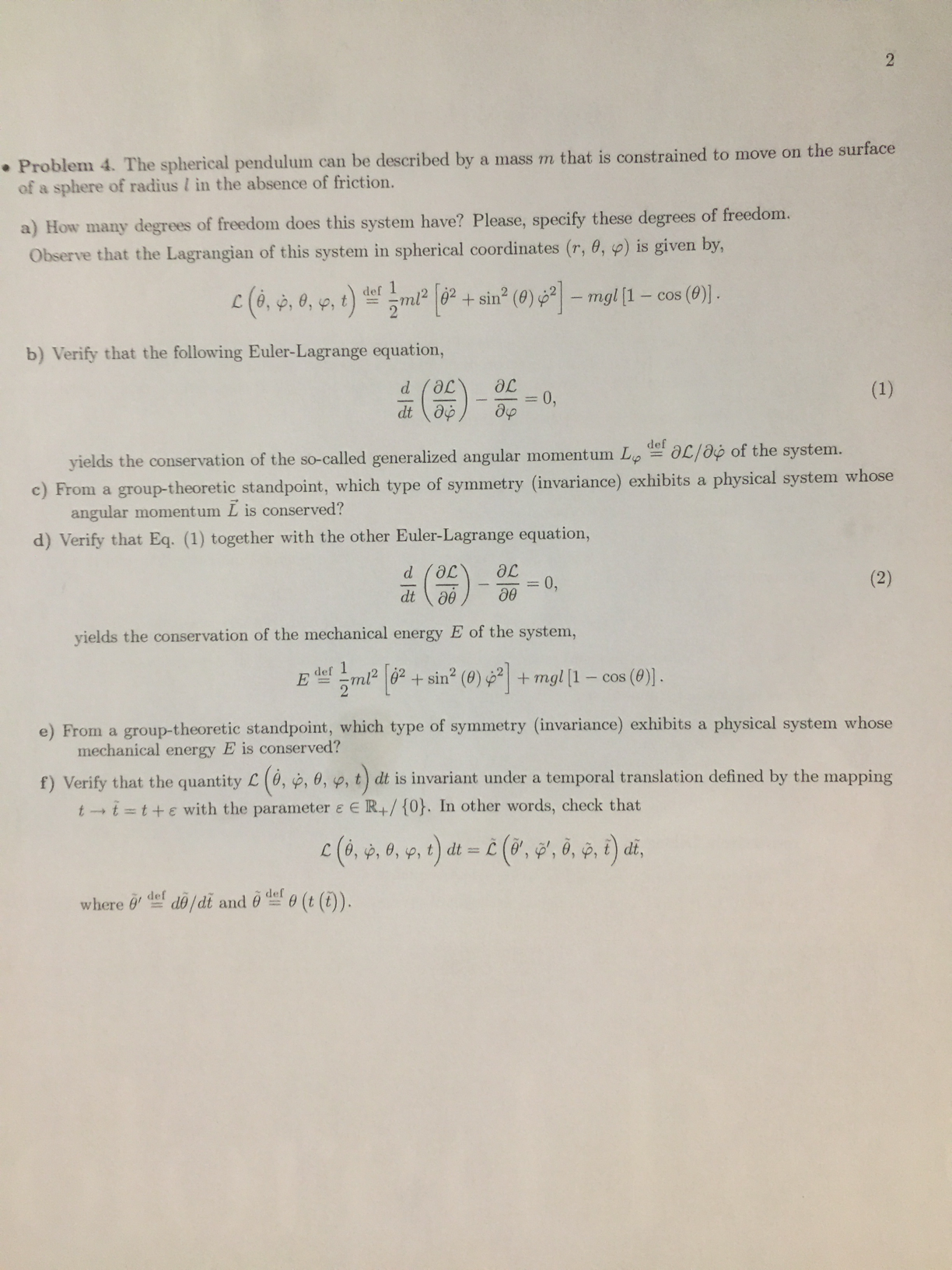
2 Problem 4. The spherical pendulum can be described by a mass m that is constrained to move on the surface of a sphere of radius I in the absence of friction. a) How many degrees of freedom does this system have? Please, specify these degrees of freedom. Observe that the Lagrangian of this system in spherical coordinates (r, 0, 4) is given by, C ( 0 , p , 0 , 4 , t ) dor = m12 02 + sin ? (0 ) $2 - mgl[1 - cos (@ ) ] . b) Verify that the following Euler-Lagrange equation, (ac) ac - = 0, (1) yields the conservation of the so-called generalized angular momentum Lo - OL/Op of the system. c) From a group-theoretic standpoint, which type of symmetry (invariance) exhibits a physical system whose angular momentum L is conserved? d) Verify that Eq. (1) together with the other Euler-Lagrange equation, d ac ac dt = 0, (2) yields the conservation of the mechanical energy E of the system, Ed 5m12 02 + sin? (0) $2 + mal[1 - cos (0) ] . e) From a group-theoretic standpoint, which type of symmetry (invariance) exhibits a physical system whose mechanical energy E is conserved? f) Verify that the quantity C (0, p, 0, p, t) dt is invariant under a temporal translation defined by the mapping t - t = t + e with the parameter & E RR+ / {0}. In other words, check that C ( 0 , 40 , 0 , 4 , t ) at = = (0', $' , 0, 4, t) at, where o' de do / di and 0 0 (t (t))
Step by Step Solution
There are 3 Steps involved in it

Get step-by-step solutions from verified subject matter experts
 Study Help