



Question: 2. Question 2 (taxation and capital structure). This question guides you through thinking about how a company can, through changing its leverage, reduce tax
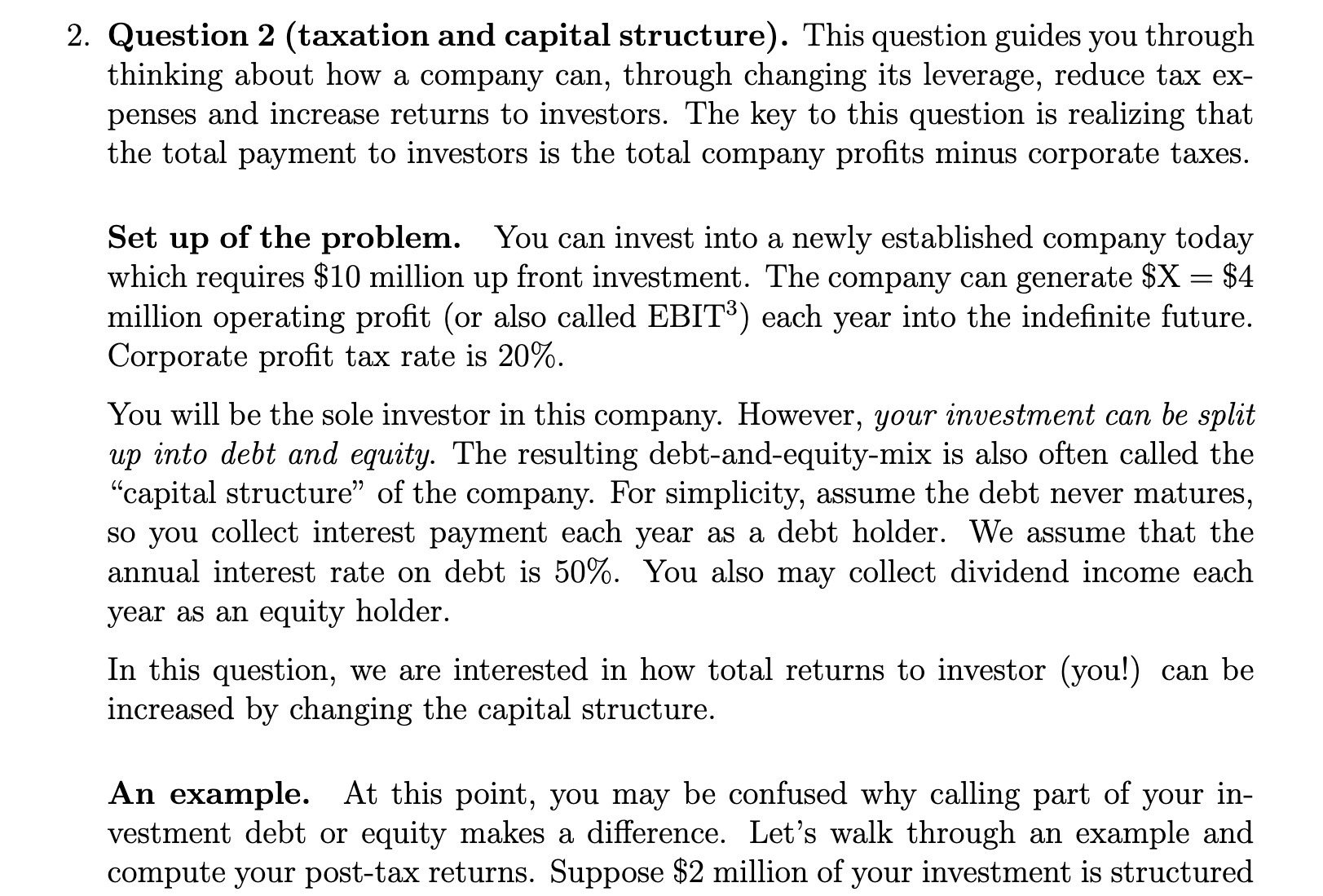
2. Question 2 (taxation and capital structure). This question guides you through thinking about how a company can, through changing its leverage, reduce tax ex- penses and increase returns to investors. The key to this question is realizing that the total payment to investors is the total company profits minus corporate taxes. Set up of the problem. You can invest into a newly established company today which requires $10 million up front investment. The company can generate $X = $4 million operating profit (or also called EBIT) each year into the indefinite future. Corporate profit tax rate is 20%. You will be the sole investor in this company. However, your investment can be split up into debt and equity. The resulting debt-and-equity-mix is also often called the capital structure of the company. For simplicity, assume the debt never matures, so you collect interest payment each year as a debt holder. We assume that the annual interest rate on debt is 50%. You also may collect dividend income each year as an equity holder. In this question, we are interested in how total returns to investor (you!) can be increased by changing the capital structure. An example. At this point, you may be confused why calling part of your in- vestment debt or equity makes a difference. Let's walk through an example and compute your post-tax returns. Suppose $2 million of your investment is structured
Step by Step Solution
There are 3 Steps involved in it
Lets consider how adjusting the capital structure of ... View full answer

Get step-by-step solutions from verified subject matter experts