







Question: 2 Questions 1. Worth 40 points. Solve problem 1 or problem 2 only. Consider an economic agent with instantaneous utility function given by 1 ct
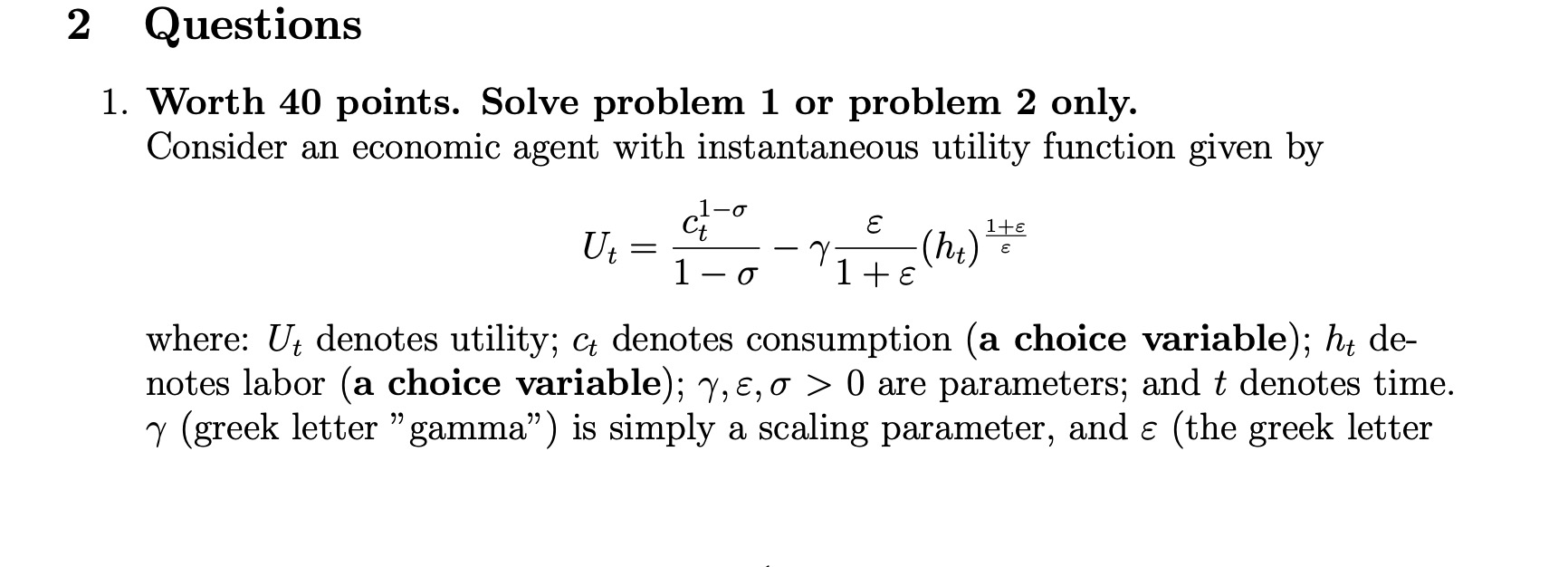
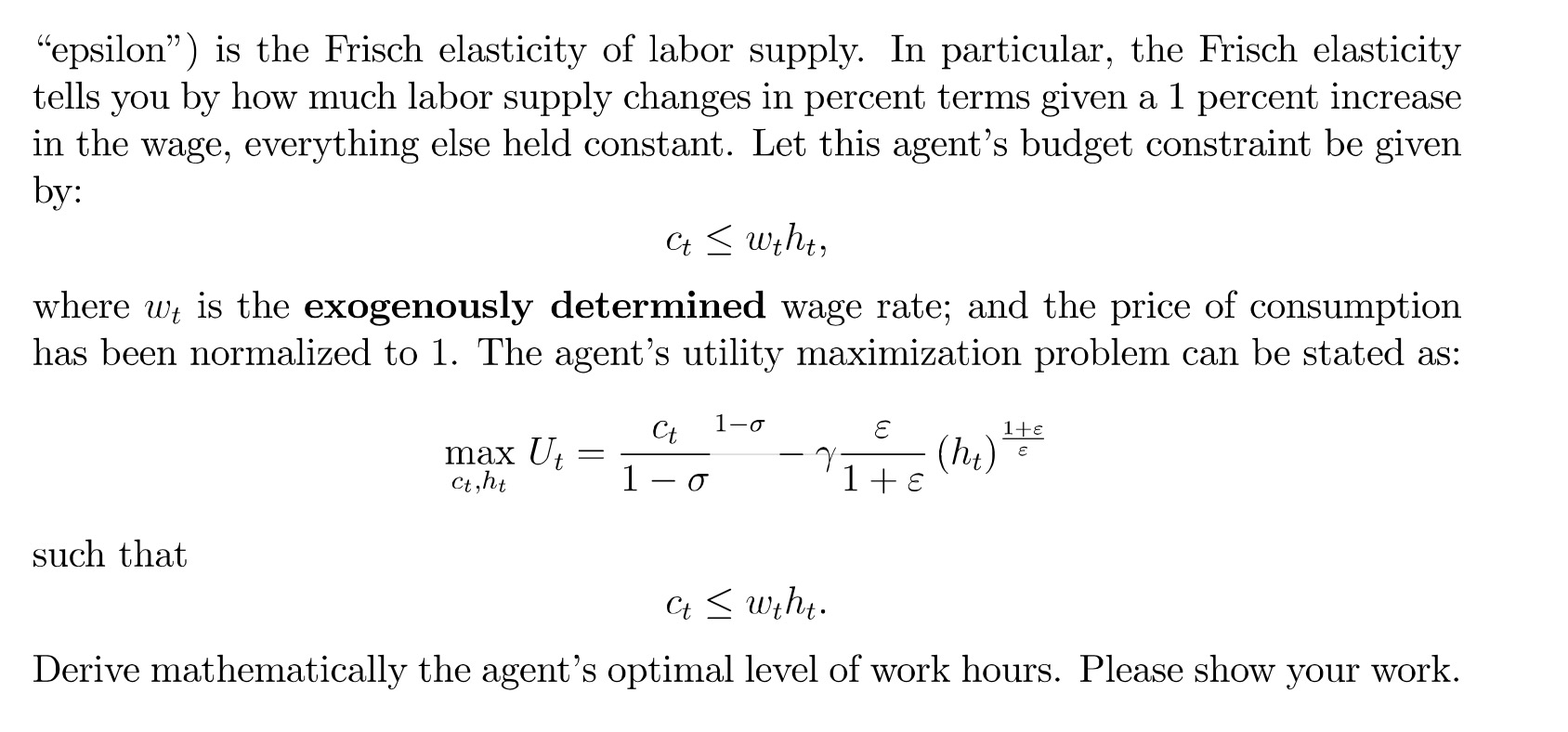
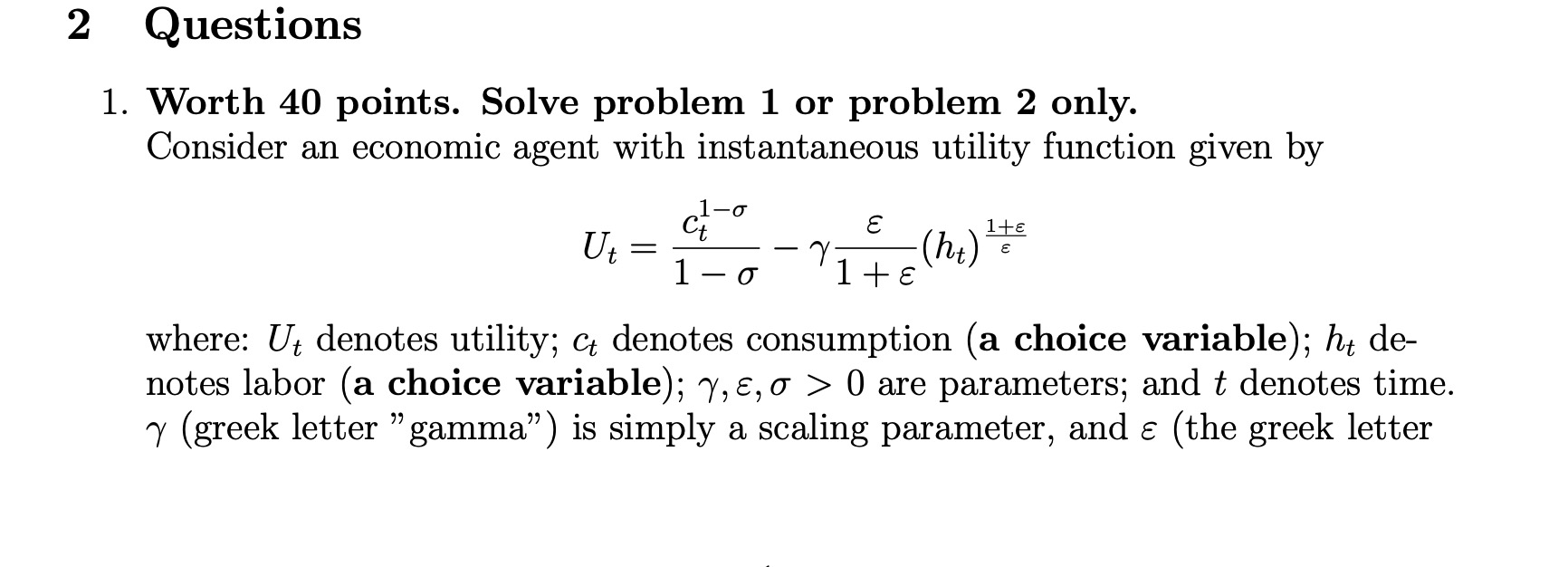
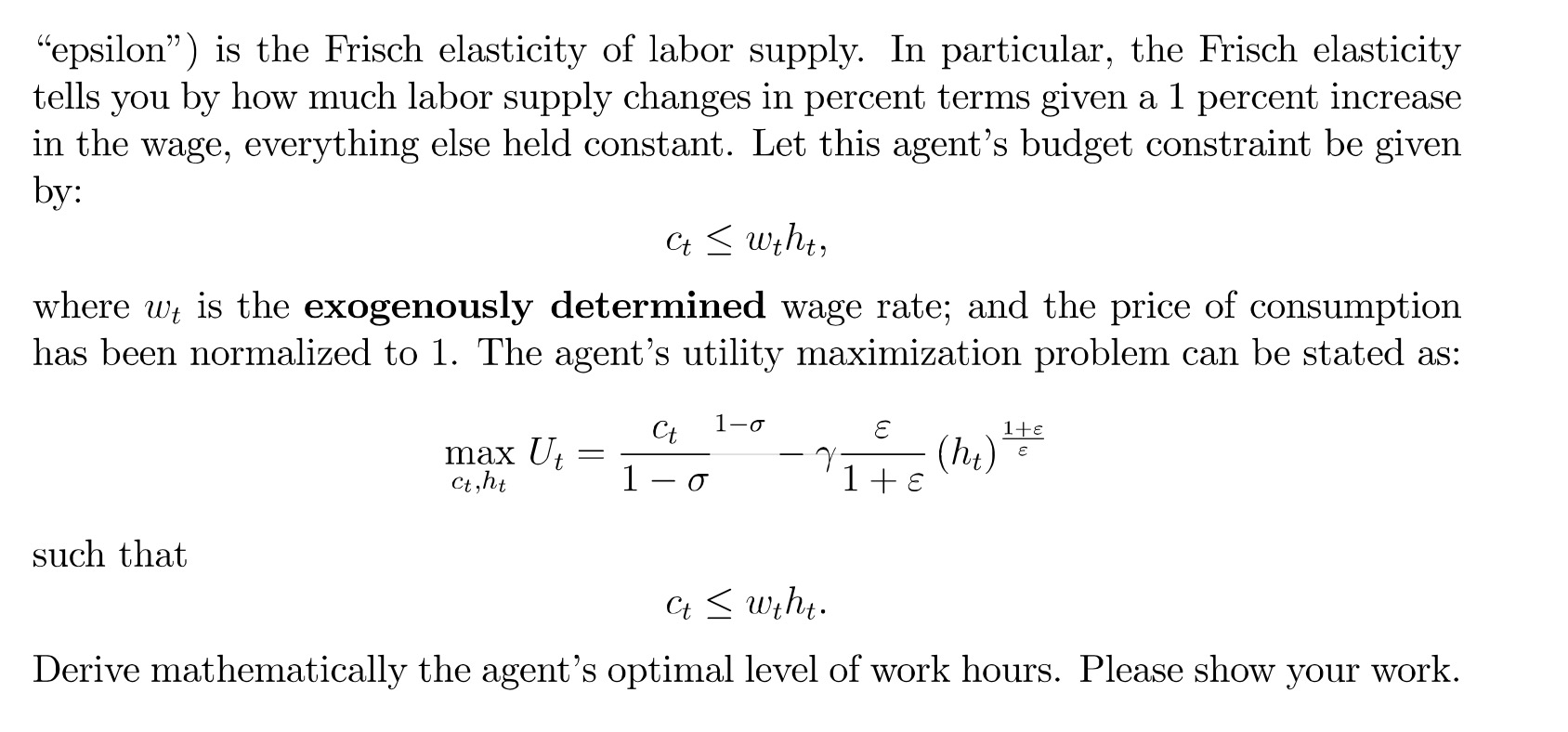
2 Questions 1. Worth 40 points. Solve problem 1 or problem 2 only. Consider an economic agent with instantaneous utility function given by 1 ct \" 8 1+5 = _ h? Ut 10 Wild-6(1) Where: Ut denotes utility; ct denotes consumption (a choice variable); ht de- notes labor (a choice variable); '7; 5; U > 0 are parameters; and t denotes time. *7 (greek letter \" gamma\") is simply a scaling parameter, and 5 (the greek letter \"'epsilon\") is the Frisch elasticity of labor supply. In particular, the Frisch elasticity tells you by how much labor supply changes in percent terms given a 1 percent increase in the wage, everything else held constant. Let this agent's budget constraint be given by: Ct S 10th:, where wt is the exogenously determined wage rate; and the price of consumption has been normalized to 1. The agent's utility maximization problem can be stated as: Ct 10 5 1+5 maXU= h 5 Chht t 10 71+( t) such that Ct S "(Uth/t. Derive mathematically the agent's optimal level of work hours. Please show your work
Step by Step Solution
There are 3 Steps involved in it

Get step-by-step solutions from verified subject matter experts
 Study Help