Question: 2 questions. complete answers please a b none Given the following activities for a plant expansion project, find the minimum cost schedules using normal and
2 questions. complete answers please
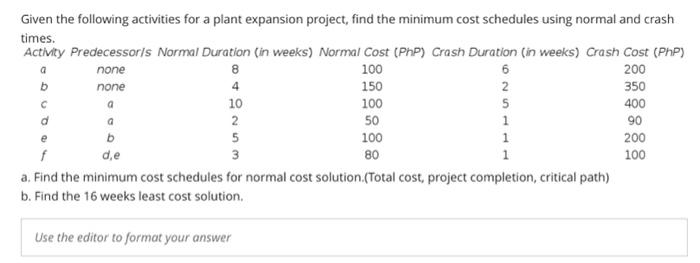
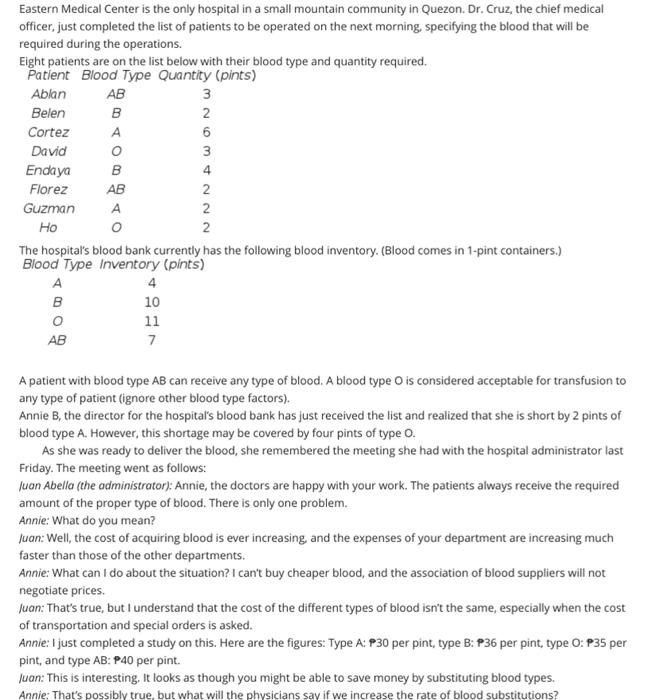
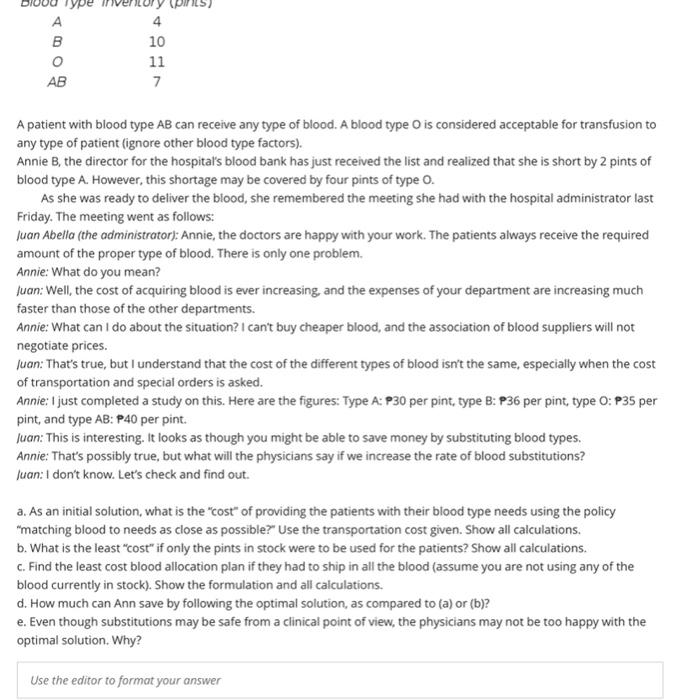
a b none Given the following activities for a plant expansion project, find the minimum cost schedules using normal and crash times. Activity Predecessoris Normal Duration (in weeks) Normal Cost (Php) Crash Duration (in weeks) Crash Cost (Php) none 8 100 6 200 4 150 2 350 a 10 100 5 2 50 1 90 b 5 1 200 de 3 80 1 100 a. Find the minimum cost schedules for normal cost solution (Total cost, project completion, critical path) b. Find the 16 weeks least cost solution. 400 a e 100 Use the editor to format your answer Eastern Medical Center is the only hospital in a small mountain community in Quezon. Dr. Cruz, the chief medical officer, just completed the list of patients to be operated on the next morning specifying the blood that will be required during the operations. Eight patients are on the list below with their blood type and quantity required. Patient Blood Type Quantity (pints) Ablan 3 Belen B 2 Cortez A 6 David o 3 Endaya B 4. Florez AB 2 Guzman 2 o 2 The hospital's blood bank currently has the following blood inventory. (Blood comes in 1-pint containers.) Blood Type Inventory (pints) 4 B 10 o 11 AB 7 NNNA ON A patient with blood type AB can receive any type of blood. A blood type O is considered acceptable for transfusion to any type of patient (ignore other blood type factors). Annie B, the director for the hospital's blood bank has just received the list and realized that she is short by 2 pints of blood type A. However, this shortage may be covered by four pints of type 0. As she was ready to deliver the blood, she remembered the meeting she had with the hospital administrator last Friday. The meeting went as follows: Juan Abella (the administrator): Annie, the doctors are happy with your work. The patients always receive the required amount of the proper type of blood. There is only one problem. Annie: What do you mean? Juan: Well, the cost of acquiring blood is ever increasing and the expenses of your department are increasing much faster than those of the other departments. Annie: What can I do about the situation? I can't buy cheaper blood, and the association of blood suppliers will not negotiate prices. luan: That's true, but I understand that the cost of the different types of blood isn't the same, especially when the cost of transportation and special orders is asked. Annie: I just completed a study on this. Here are the figures: Type A: P30 per pint, type B: P36 per pint, type O: P35 per pint, and type AB: P40 per pint. Juan: This is interesting. It looks as though you might be able to save money by substituting blood types. Annie: That's possibly true, but what will the physicians say if we increase the rate of blood substitutions? TO B 4 10 11 7 AB A patient with blood type AB can receive any type of blood. A blood type O is considered acceptable for transfusion to any type of patient (ignore other blood type factors). Annie B, the director for the hospitals blood bank has just received the list and realized that she is short by 2 pints of blood type A. However, this shortage may be covered by four pints of type 0. As she was ready to deliver the blood, she remembered the meeting she had with the hospital administrator last Friday. The meeting went as follows: Juan Abella (the administrator): Annie, the doctors are happy with your work. The patients always receive the required amount of the proper type of blood. There is only one problem. Annie: What do you mean? Juan: Well, the cost of acquiring blood is ever increasing, and the expenses of your department are increasing much faster than those of the other departments. Annie: What can I do about the situation? I can't buy cheaper blood, and the association of blood suppliers will not negotiate prices. Juan: That's true, but I understand that the cost of the different types of blood isn't the same, especially when the cost of transportation and special orders is asked. Annie: I just completed a study on this. Here are the figures: Type A: P30 per pint, type B: P36 per pint, type O: P35 per pint, and type AB: P40 per pint. Juan: This is interesting. It looks as though you might be able to save money by substituting blood types. Annie: That's possibly true, but what will the physicians say if we increase the rate of blood substitutions? Juan: I don't know. Let's check and find out. a. As an initial solution, what is the "cost of providing the patients with their blood type needs using the policy matching blood to needs as close as possible?" Use the transportation cost given. Show all calculations. b. What is the least "cost" if only the pints in stock were to be used for the patients? Show all calculations. C. Find the least cost blood allocation plan if they had to ship in all the blood (assume you are not using any of the blood currently in stock). Show the formulation and all calculations. d. How much can Ann save by following the optimal solution, as compared to (a) or (b)? e. Even though substitutions may be safe from a clinical point of view, the physicians may not be too happy with the optimal solution. Why? Use the editor to format your









 Study Help