







Question: 2 Questions in image/attachment below Entered Answer Preview Result (-infinity, 1.5708) U (1.5708,infinity) (- 0o. 2 ) U ( 2,00) incorrect The answer above is
2 Questions in image/attachment below
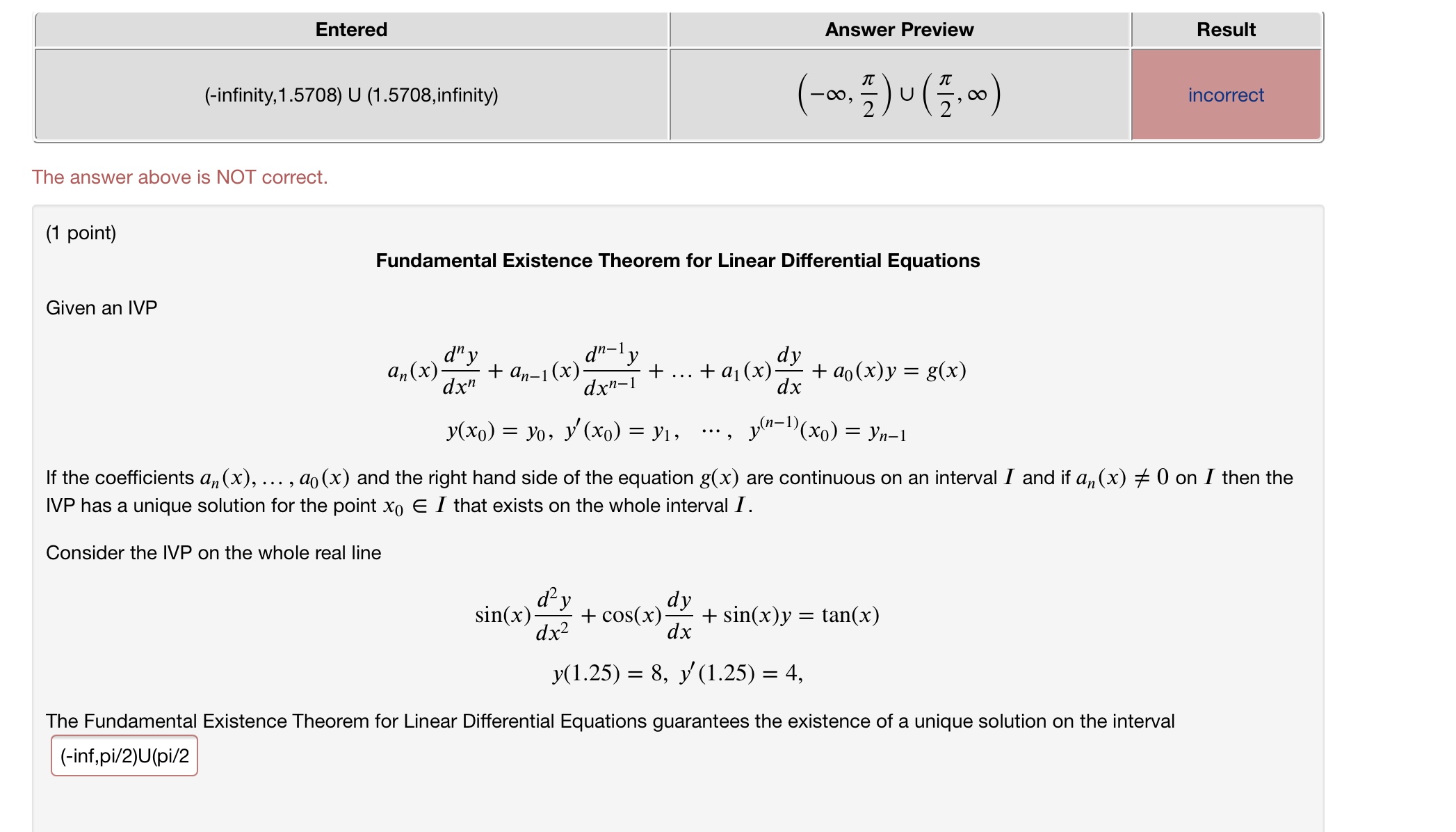
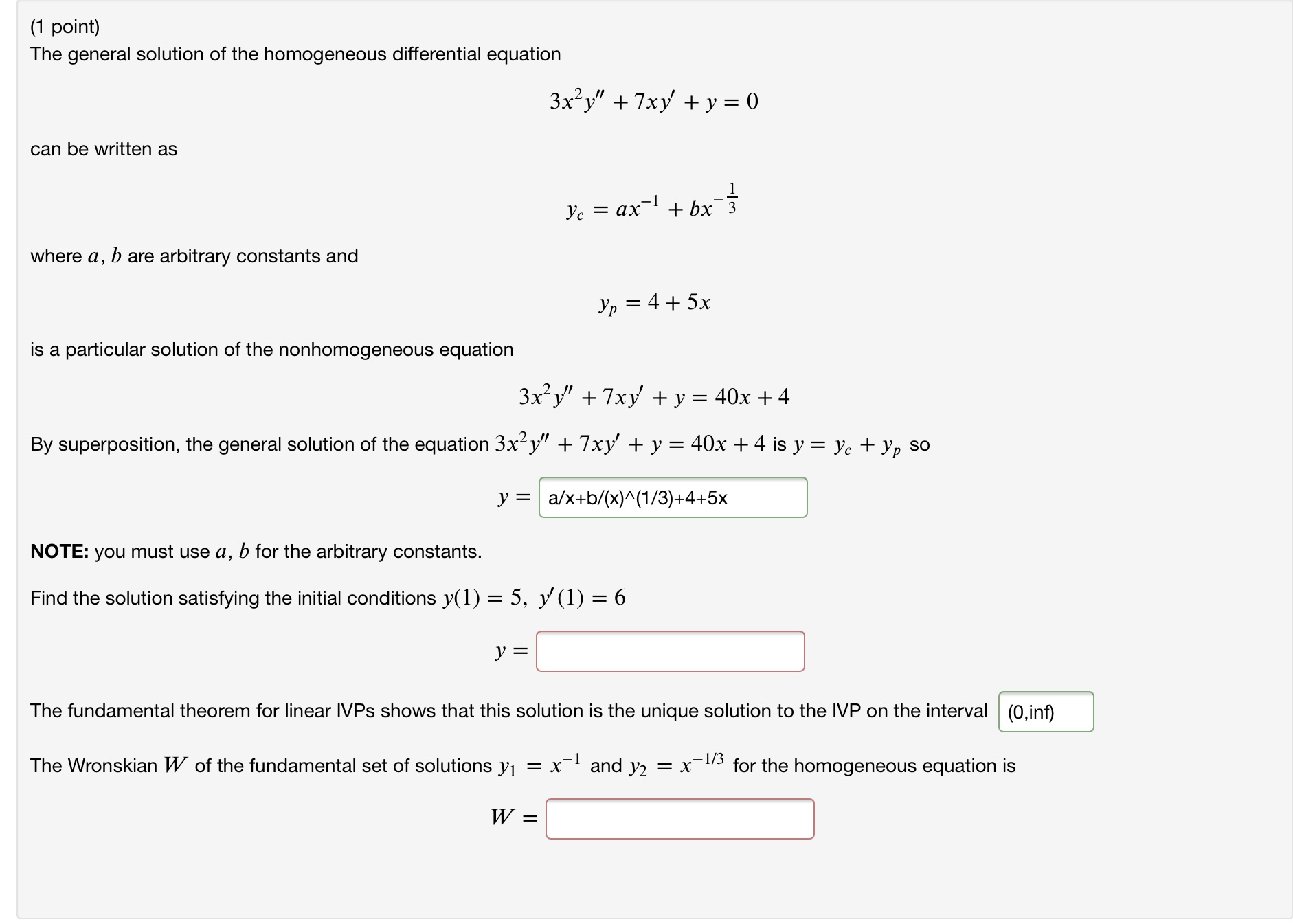
Entered Answer Preview Result (-infinity, 1.5708) U (1.5708,infinity) (- 0o. 2 ) U ( 2,00) incorrect The answer above is NOT correct. (1 point) Fundamental Existence Theorem for Linear Differential Equations Given an IVP an (x) - dy+ an - ( x )dy dan + dxn- It ...+ al (x)- dy + do (x)y = g(x) y(xo) = yo, y (xo) = y1, ..., y("-"(xo) = yn-1 If the coefficients an (x), ... , do (x) and the right hand side of the equation g(x) are continuous on an interval I and if an (x) # 0 on I then the IVP has a unique solution for the point xo E I that exists on the whole interval I. Consider the IVP on the whole real line sin (x ) dy - + cos(x) dx dy + sin(x)y = tan(x) dx2 y(1.25) = 8, y' (1.25) = 4, The Fundamental Existence Theorem for Linear Differential Equations guarantees the existence of a unique solution on the interval (-inf,pi/2)U(pi/2(1 point) The general solution of the homogeneous differential equation 3x2y" + 7xy' + y = 0 can be written as ye = ax'l + bx_% where a, b are arbitrary constants and yp = 4 + 5x is a particular solution of the nonhomogeneous equation 3x2y" + 7xy' + y = 40x + 4 By superposition, the general solution of the equation 3x2y\" + 7xy' + y = 40x + 4 is y = yC + yp so y = a/X+b/(x)/\\(1/3)+4+5x NOTE: you must use a, b for the arbitrary constants. Find the solution satisfying the initial conditions y(1) = 5, y'(1) = 6 The fundamental theorem for linear lVPs shows that this solution is the unique solution to the NP on the interval The Wronskian W of the fundamental set of solutions y1 = x'1 and y; = 361/3 for the homogeneous equation is W=l:l
Step by Step Solution
There are 3 Steps involved in it

Get step-by-step solutions from verified subject matter experts
 Study Help