



Question: 2 Queues and Space Allocation This is very similar to the first exam (with the key difference coming in question nine). An auto parts company
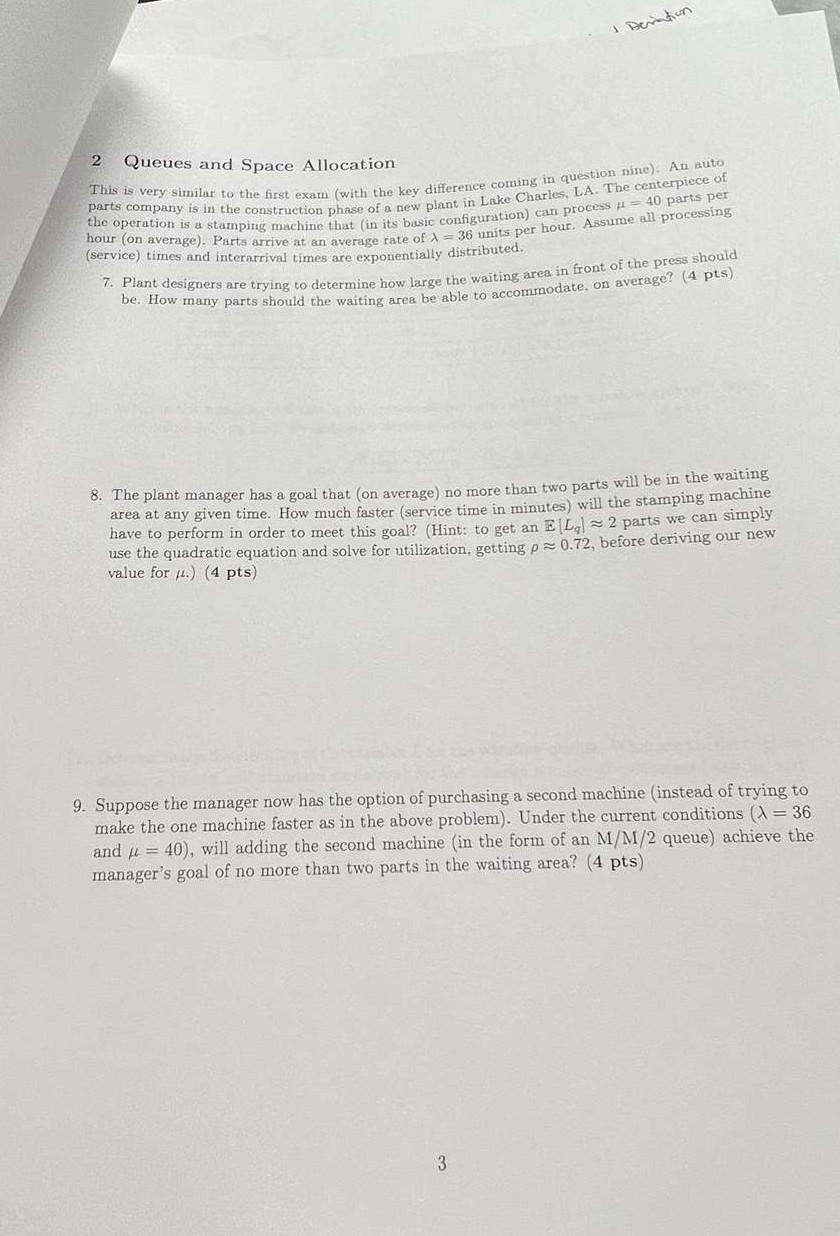
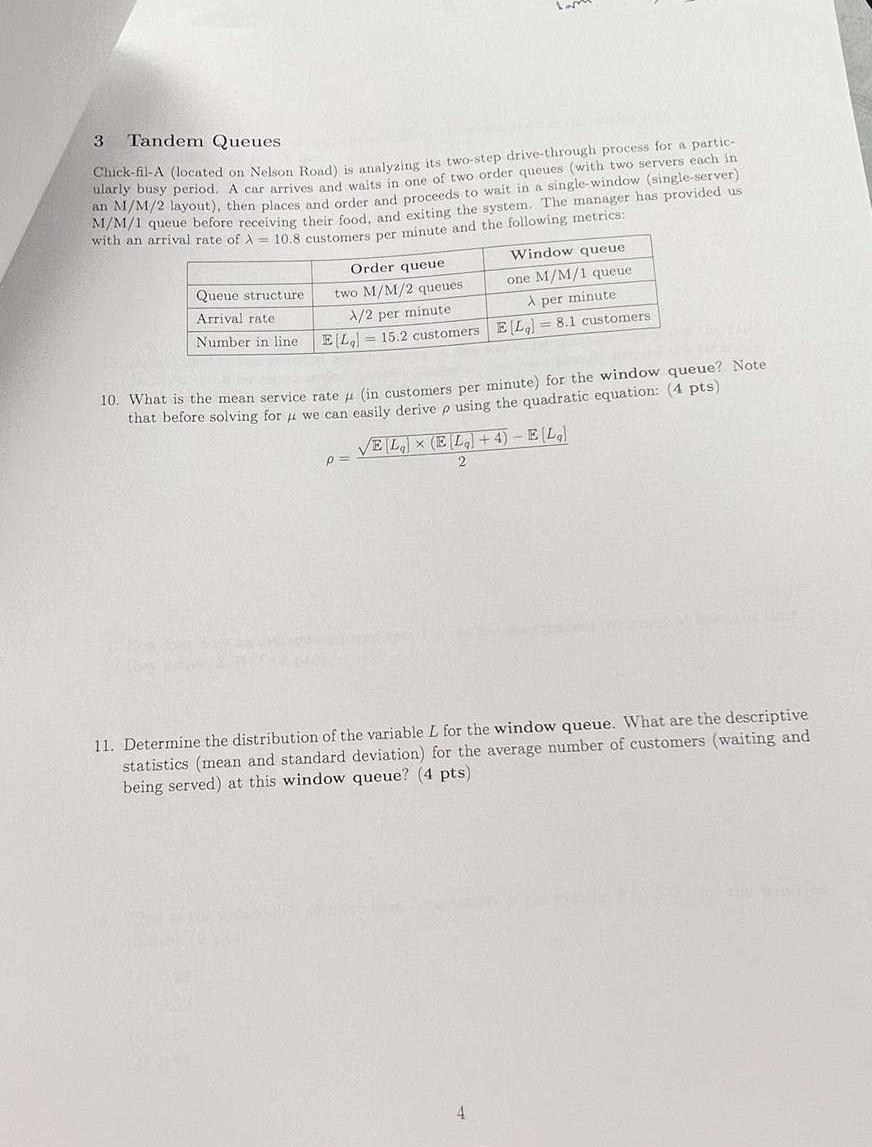
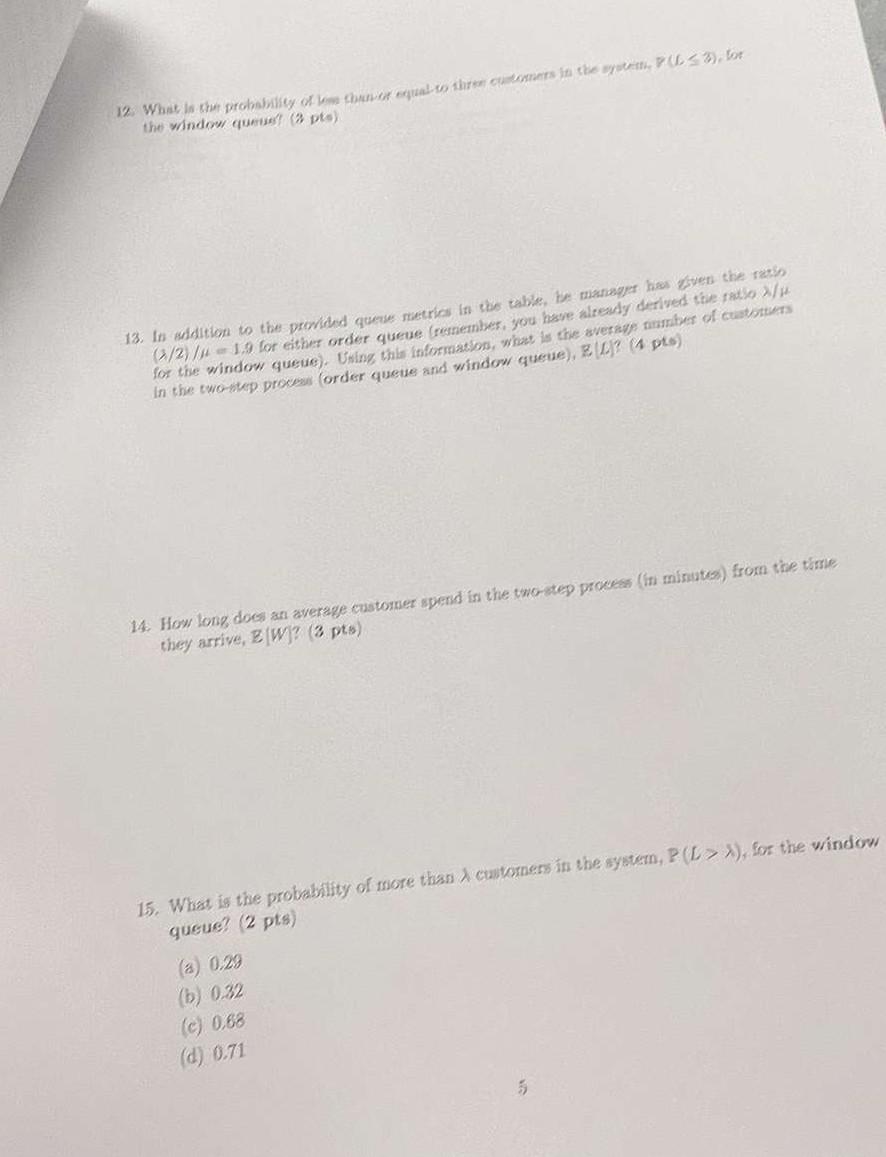
2 Queues and Space Allocation This is very similar to the first exam (with the key difference coming in question nine). An auto parts company is in the construction phase of a new plant in Lake Charles, LA. The centerpiece of the operation is a stamping machine that (in its busic configuration) can proces =40 parts per hour (on average). Parts arrive at an average rate of =36 units per hour. Assume all processing (service) times and interarrival times are exponentially distributed. 7. Plant designers are trying to determine how large the waiting area in front of the press should be. How many parts should the waiting area be able to accommodate, on average? (4 pts) 8. The plant manager has a goal that (on average) no more than two parts will be in the waiting area at any given time. How much faster (service time in minutes) will the stamping machine use the quadratic equation and solve for utilization, getting p0.72, before deriving our new value for 2) ( 4 pts) 9. Suppose the manager now has the option of purchasing a second machine (instead of trying to make the one machine faster as in the above problem). Under the current conditions (=36 and =40 ), will adding the second machine (in the form of an M/M/2 queue) achieve the manager's goal of no more than two parts in the waiting area? ( 4 pts) 3 Tandem Queues Chick-fil-A (located on Nelson Road) is unalyzing its two-step drive-through process for a particularly busy period. A car arrives and waits in one of two order queues (with two servers each in an M/M/2 layout), then places and order and proceeds to wait in a single-window (single-server) M/M/1 queue before receiving their food, and exiting the system. The manager has provided us 10. What is the mean service rate (in customers per minute) for the window queue? Note that before solving for we can easily derive using the quadratic equation: ( 4 pts) =2E[Lq](E[Lq]+4)E[Lq] 11. Determine the distribution of the variable L for the window queue. What are the descriptive statistics (mean and standard deviation) for the average number of customers (waiting and being served) at this window queue? (4 pts) the window quense! (i pte) 13. In addittion to the provided queve mecries in the table, to manaqes has gyen the rain (/2)/=1.9 for either order queue (remember, you hase aleady derived the ratha /1/ for the window queue). Using this information, what is the sveraqy ramber of cuatomers In the two-ktep prowes (order queue and window queve), z L ? (4 pto) 14. How long, dows an average customer spend in the tho-des prowas (in minutes) from the tirme: they arrive, Z[W] ? (3 pts) 15. What is the probability of nore than cunternem in the system, P(L>), for the window queus? ( 2 pt.s) (a) 0.29 (b) 0.32 (c) 0,68 (d) 0.71
Step by Step Solution
There are 3 Steps involved in it
1 Expert Approved Answer
Step: 1 Unlock

Question Has Been Solved by an Expert!
Get step-by-step solutions from verified subject matter experts
Step: 2 Unlock
Step: 3 Unlock