Question: 2) Read the Cunningham case and answer the following: Should the Defendant, Farmer, been held as a Merchant? What would have changed had he not
2) Read the Cunningham case and answer the following:
Should the Defendant, Farmer, been held as a Merchant? What would have changed had he not been deemed a merchant?
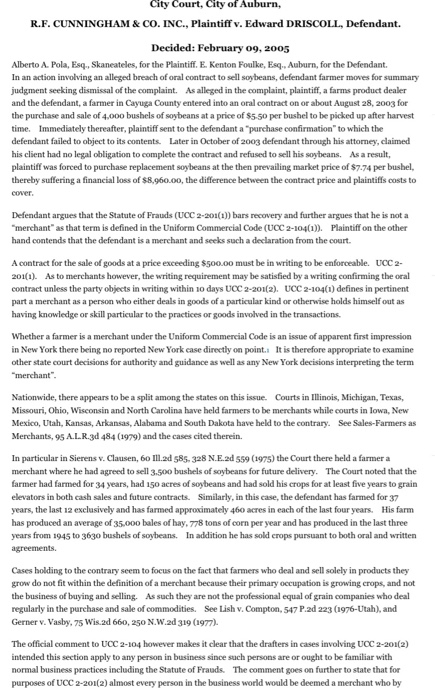
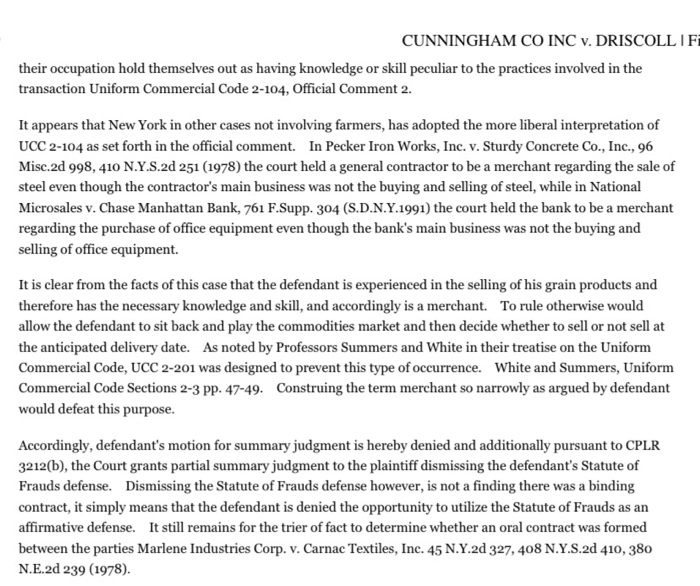
City Court, City of Auburn, R.F. CUNNINGHAM & CO. INC., Plaintiff v. Edward DRISCOLL, Defendant. Decided: February 09, 2005 Alberto A. Pola, Esq., Skaneateles, for the Plaintiff. E. Kenton Foulke, Esq., Auburn, for the Defendant In an action involving an alleged breach of oral contract to sell soybeans, defendant farmer moves for summary judgment seeking dismissal of the complaint. As alleged in the complaint, plaintiff, a farms product dealer and the defendant, a farmer in Cayuga County entered into an oral contract on or about August 28, 2003 for the purchase and sale of 4,000 bushels of soybeans at a price of $550 per bushel to be picked up after harvest time. Immediately thereafter, plaintiff sent to the defendant a "purchase confirmation to which the defendant failed to object to its contents. Later in October of 2003 defendant through his attorney, claimed his client had no legal obligation to complete the contract and refused to sell his soybeans. As a result, plaintiff was forced to purchase replacement soybeans at the then prevailing market price of $7.74 per bushel, thereby suffering a financial loss of $8.960.00, the difference between the contract price and plaintiffs costs to Defendant argues that the Statute of Frauds (UCC2-201(1)) bars recovery and further argues that he is not a "merchant" as that term is defined in the Uniform Commercial Code (UOC 2-104(1)). Plaintiff on the other hand contends that the defendant is a merchant and seeks such a declaration from the court. A contract for the sale of goods at a price exceeding $500.00 must be in writing to be enforceable. UCC 2- 201(1). As to merchants however, the writing requirement may be satisfied by a writing confirming the oral contract unless the party objects in writing within 10 days UCC 2-2012). UCC 2-104(1) defines in pertinent part a merchant as a person who either deals in goods of a particular kind or otherwise holds himself out as having knowledge or skill particular to the practices or goods involved in the transactions Whether a farmer is a merchant under the Uniform Commercial Code is an issue of apparent first impression in New York there being no reported New York case directly on point. It is therefore appropriate to examine other state court decisions for authority and guidance as well as any New York decisions interpreting the term "merchant". Nationwide, there appears to be a split among the states on this issue. Courts in Illinois, Michigan, Texas Missouri, Ohio, Wisconsin and North Carolina have held farmers to be merchants while courts in lowa, New Mexico, Utah, Kansas, Arkansas, Alabama and South Dakota have held to the contrary. See Sales-Farmers as Merchants, 95 A.L.R.3d 484 (1979) and the cases cited therein. In particular in Sierens v. Clausen, 6o Ill.ad 585.328 NE2d 559 (1975) the Court there held a farmer a merchant where he had agreed to sell 3.500 bushels of soybeans for future delivery. The Court noted that the farmer had farmed for 34 years, had 150 acres of soybeans and had sold his crops for at least five years to grain elevators in both cash sales and future contracts. Similarly, in this case, the defendant has farmed for 37 years, the last 12 exclusively and has farmed approximately 460 acres in each of the last four years. His farm has produced an average of 35.000 bales of hay.778 tons of corn per year and has produced in the last three years from 1945 to 3630 bushels of soybeans. In addition he has sold crops pursuant to both oral and written agreements Cases holding to the contrary seem to focus on the fact that farmers who deal and sell solely in products they grow do not fit within the definition of a merchant because their primary occupation is growing crops, and not the business of buying and selling As such they are not the professional equal of grain companies who deal regularly in the purchase and sale of commodities. See Lish v. Compton, 547 Pad 223 (1976-Utah), and Gerner v. Vasby. 75 Wis.ad 660, 250 N.W.2d 319 (1977). The official comment to UCC 2-104 however makes it clear that the drafters in cases involving UOC 2-2012) intended this section apply to any person in business since such persons are or ought to be familiar with normal business practices including the Statute of Frauds. The comment goes on further to state that for purposes of UOC 2-201(a) almost every person in the business world would be deemed a merchant who by CUNNINGHAM CO INC v. DRISCOLL I Fi their occupation hold themselves out as having knowledge or skill peculiar to the practices involved in the transaction Uniform Commercial Code 2-104, Official Comment 2. It appears that New York in other cases not involving farmers, has adopted the more liberal interpretation of UCC 2-104 as set forth in the official comment. In Pecker Iron Works, Inc. v. Sturdy Concrete Co., Inc., 96 Misc.2d 998, 410 N.Y.S.2d 251 (1978) the court held a general contractor to be a merchant regarding the sale of steel even though the contractor's main business was not the buying and selling of steel, while in National Microsales v. Chase Manhattan Bank, 761 F.Supp. 304 (S.D.N.Y.1991) the court held the bank to be a merchant regarding the purchase of office equipment even though the bank's main business was not the buying and selling of office equipment. It is clear from the facts of this case that the defendant is experienced in the selling of his grain products and therefore has the necessary knowledge and skill, and accordingly is a merchant. To rule otherwise would allow the defendant to sit back and play the commodities market and then decide whether to sell or not sell at the anticipated delivery date. As noted by Professors Summers and White in their treatise on the Uniform Commercial Code, UCC 2-201 was designed to prevent this type of occurrence. White and Summers, Uniform Commercial Code Sections 2-3 pp. 47-49. Construing the term merchant so narrowly as argued by defendant would defeat this purpose. Accordingly, defendant's motion for summary judgment is hereby denied and additionally pursuant to CPLR 3212(b), the Court grants partial summary judgment to the plaintiff dismissing the defendant's Statute of Frauds defense. Dismissing the Statute of Frauds defense however, is not a finding there was a binding contract, it simply means that the defendant is denied the opportunity to utilize the Statute of Frauds as an affirmative defense. It still remains for the trier of fact to determine whether an oral contract was formed between the parties Marlene Industries Corp. v. Carnac Textiles, Inc. 45 N.Y.2d 327, 408 N.Y.S.2d 410, 380 N.E.2d 239 (1978). City Court, City of Auburn, R.F. CUNNINGHAM & CO. INC., Plaintiff v. Edward DRISCOLL, Defendant. Decided: February 09, 2005 Alberto A. Pola, Esq., Skaneateles, for the Plaintiff. E. Kenton Foulke, Esq., Auburn, for the Defendant In an action involving an alleged breach of oral contract to sell soybeans, defendant farmer moves for summary judgment seeking dismissal of the complaint. As alleged in the complaint, plaintiff, a farms product dealer and the defendant, a farmer in Cayuga County entered into an oral contract on or about August 28, 2003 for the purchase and sale of 4,000 bushels of soybeans at a price of $550 per bushel to be picked up after harvest time. Immediately thereafter, plaintiff sent to the defendant a "purchase confirmation to which the defendant failed to object to its contents. Later in October of 2003 defendant through his attorney, claimed his client had no legal obligation to complete the contract and refused to sell his soybeans. As a result, plaintiff was forced to purchase replacement soybeans at the then prevailing market price of $7.74 per bushel, thereby suffering a financial loss of $8.960.00, the difference between the contract price and plaintiffs costs to Defendant argues that the Statute of Frauds (UCC2-201(1)) bars recovery and further argues that he is not a "merchant" as that term is defined in the Uniform Commercial Code (UOC 2-104(1)). Plaintiff on the other hand contends that the defendant is a merchant and seeks such a declaration from the court. A contract for the sale of goods at a price exceeding $500.00 must be in writing to be enforceable. UCC 2- 201(1). As to merchants however, the writing requirement may be satisfied by a writing confirming the oral contract unless the party objects in writing within 10 days UCC 2-2012). UCC 2-104(1) defines in pertinent part a merchant as a person who either deals in goods of a particular kind or otherwise holds himself out as having knowledge or skill particular to the practices or goods involved in the transactions Whether a farmer is a merchant under the Uniform Commercial Code is an issue of apparent first impression in New York there being no reported New York case directly on point. It is therefore appropriate to examine other state court decisions for authority and guidance as well as any New York decisions interpreting the term "merchant". Nationwide, there appears to be a split among the states on this issue. Courts in Illinois, Michigan, Texas Missouri, Ohio, Wisconsin and North Carolina have held farmers to be merchants while courts in lowa, New Mexico, Utah, Kansas, Arkansas, Alabama and South Dakota have held to the contrary. See Sales-Farmers as Merchants, 95 A.L.R.3d 484 (1979) and the cases cited therein. In particular in Sierens v. Clausen, 6o Ill.ad 585.328 NE2d 559 (1975) the Court there held a farmer a merchant where he had agreed to sell 3.500 bushels of soybeans for future delivery. The Court noted that the farmer had farmed for 34 years, had 150 acres of soybeans and had sold his crops for at least five years to grain elevators in both cash sales and future contracts. Similarly, in this case, the defendant has farmed for 37 years, the last 12 exclusively and has farmed approximately 460 acres in each of the last four years. His farm has produced an average of 35.000 bales of hay.778 tons of corn per year and has produced in the last three years from 1945 to 3630 bushels of soybeans. In addition he has sold crops pursuant to both oral and written agreements Cases holding to the contrary seem to focus on the fact that farmers who deal and sell solely in products they grow do not fit within the definition of a merchant because their primary occupation is growing crops, and not the business of buying and selling As such they are not the professional equal of grain companies who deal regularly in the purchase and sale of commodities. See Lish v. Compton, 547 Pad 223 (1976-Utah), and Gerner v. Vasby. 75 Wis.ad 660, 250 N.W.2d 319 (1977). The official comment to UCC 2-104 however makes it clear that the drafters in cases involving UOC 2-2012) intended this section apply to any person in business since such persons are or ought to be familiar with normal business practices including the Statute of Frauds. The comment goes on further to state that for purposes of UOC 2-201(a) almost every person in the business world would be deemed a merchant who by CUNNINGHAM CO INC v. DRISCOLL I Fi their occupation hold themselves out as having knowledge or skill peculiar to the practices involved in the transaction Uniform Commercial Code 2-104, Official Comment 2. It appears that New York in other cases not involving farmers, has adopted the more liberal interpretation of UCC 2-104 as set forth in the official comment. In Pecker Iron Works, Inc. v. Sturdy Concrete Co., Inc., 96 Misc.2d 998, 410 N.Y.S.2d 251 (1978) the court held a general contractor to be a merchant regarding the sale of steel even though the contractor's main business was not the buying and selling of steel, while in National Microsales v. Chase Manhattan Bank, 761 F.Supp. 304 (S.D.N.Y.1991) the court held the bank to be a merchant regarding the purchase of office equipment even though the bank's main business was not the buying and selling of office equipment. It is clear from the facts of this case that the defendant is experienced in the selling of his grain products and therefore has the necessary knowledge and skill, and accordingly is a merchant. To rule otherwise would allow the defendant to sit back and play the commodities market and then decide whether to sell or not sell at the anticipated delivery date. As noted by Professors Summers and White in their treatise on the Uniform Commercial Code, UCC 2-201 was designed to prevent this type of occurrence. White and Summers, Uniform Commercial Code Sections 2-3 pp. 47-49. Construing the term merchant so narrowly as argued by defendant would defeat this purpose. Accordingly, defendant's motion for summary judgment is hereby denied and additionally pursuant to CPLR 3212(b), the Court grants partial summary judgment to the plaintiff dismissing the defendant's Statute of Frauds defense. Dismissing the Statute of Frauds defense however, is not a finding there was a binding contract, it simply means that the defendant is denied the opportunity to utilize the Statute of Frauds as an affirmative defense. It still remains for the trier of fact to determine whether an oral contract was formed between the parties Marlene Industries Corp. v. Carnac Textiles, Inc. 45 N.Y.2d 327, 408 N.Y.S.2d 410, 380 N.E.2d 239 (1978)









 Study Help