





Question: 2. Read the following case study to answer question 2a and 2b. Case No 2 Michael Dell started his career from assembling PCs in his
2. Read the following case study to answer
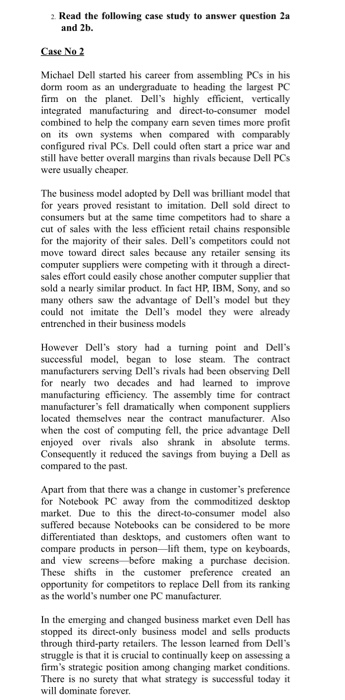
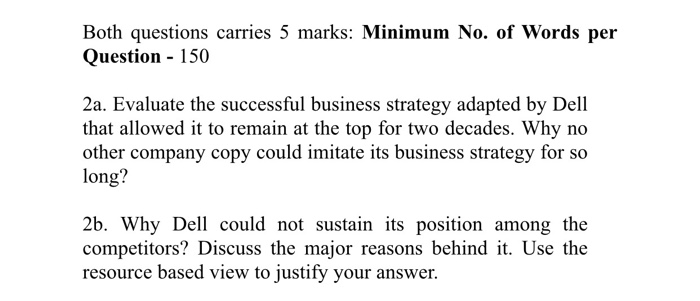
2. Read the following case study to answer question 2a and 2b. Case No 2 Michael Dell started his career from assembling PCs in his dorm room as an undergraduate to heading the largest PC firm on the planet. Dell's highly efficient, vertically integrated manufacturing and direct-to-consumer model combined to help the company cam seven times more profit on its own systems when compared with comparably configured rival PCs. Dell could often start a price war and still have better overall margins than rivals because Dell PCs were usually cheaper. The business model adopted by Dell was brilliant model that for years proved resistant to imitation. Dell sold direct to consumers but at the same time competitors had to share a cut of sales with the less efficient retail chains responsible for the majority of their sales. Dell's competitors could not move toward direct sales because any retailer sensing its computer suppliers were competing with it through a direct- sales effort could easily chose another computer supplier that sold a nearly similar product. In fact HP, IBM, Sony, and so many others saw the advantage of Dell's model but they could not imitate the Dell's model they were already entrenched in their business models However Dell's story had a turning point and Dell's successful model, began to lose steam. The contract manufacturers serving Dell's rivals had been observing Dell for nearly two decades and had leamed to improve manufacturing efficiency. The assembly time for contract manufacturer's fell dramatically when component suppliers located themselves near the contract manufacturer. Also when the cost of computing fell, the price advantage Dell enjoyed over rivals also shrank in absolute terms. Consequently it reduced the savings from buying a Dell as compared to the past. Apart from that there was a change in customer's preference for Notebook PC away from the commoditized desktop market. Due to this the direct-to-consumer model also suffered because Notebooks can be considered to be more differentiated than desktops, and customers often want to compare products in person lift them, type on keyboards, and view screens before making a purchase decision These shifts in the customer preference created an opportunity for competitors to replace Dell from its ranking as the world's number one PC manufacturer. In the emerging and changed business market even Dell has stopped its direct-only business model and sells products through third-party retailers. The lesson learned from Dell's struggle is that it is crucial to continually keep on assessing a firm's strategic position among changing market conditions. There is no surety that what strategy is successful today it will dominate forever. Both questions carries 5 marks: Minimum No. of Words per Question - 150 2a. Evaluate the successful business strategy adapted by Dell that allowed it to remain at the top for two decades. Why no other company copy could imitate its business strategy for so long? 2b. Why Dell could not sustain its position among the competitors? Discuss the major reasons behind it. Use the resource based view to justify your

Step by Step Solution

There are 3 Steps involved in it

1 Expert Approved Answer
Step: 1 Unlock blur-text-image

Question Has Been Solved by an Expert!

Get step-by-step solutions from verified subject matter experts

Step: 2 Unlock
Step: 3 Unlock

Students Have Also Explored These Related General Management Questions!