Question: 2. Recall that the infringing sales data involved a case where Firm A had a patent that it used to produce a consumer product, and
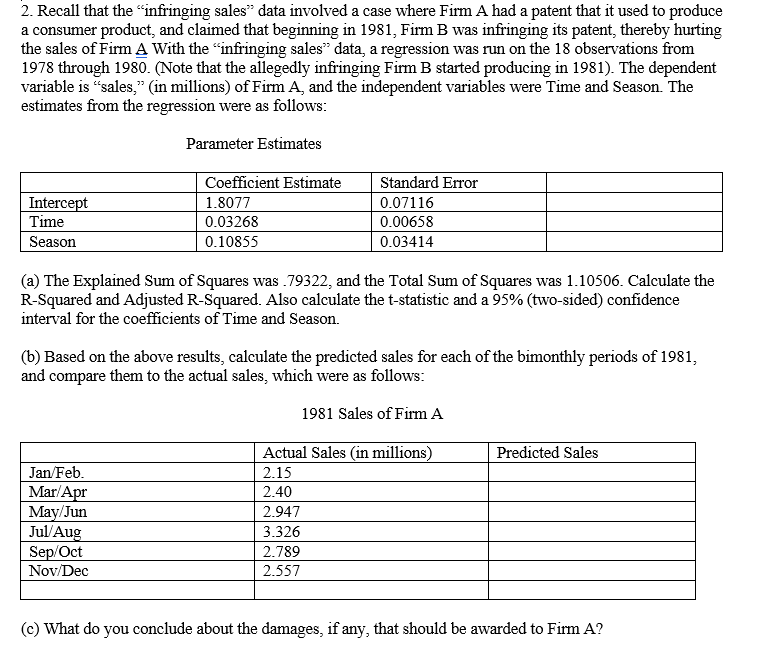
2. Recall that the infringing sales data involved a case where Firm A had a patent that it used to produce a consumer product, and claimed that beginning in 1981, Firm B was infringing its patent, thereby hurting the sales of Firm A With the infringing sales" data, a regression was run on the 18 observations from 1978 through 1980. (Note that the allegedly infringing Firm B started producing in 1981). The dependent variable is "sales." (in millions) of Firm A, and the independent variables were Time and Season. The estimates from the regression were as follows: Parameter Estimates Intercept Time Season Coefficient Estimate 1.8077 0.03268 0.10855 Standard Error 0.07116 0.00658 0.03414 (a) The Explained Sum of Squares was 79322, and the Total Sum of Squares was 1.10506. Calculate the R-Squared and Adjusted R-Squared. Also calculate the t-statistic and a 95% (two-sided) confidence interval for the coefficients of Time and Season. (b) Based on the above results, calculate the predicted sales for each of the bimonthly periods of 1981, and compare them to the actual sales, which were as follows: 1981 Sales of Firm A Predicted Sales Jan/Feb. Mar Apr May/Jun Jul/Aug Sep/Oct Nov/Dec Actual Sales (in millions) 2.15 2.40 2.947 3.326 2.789 2.557 (c) What do you conclude about the damages, if any, that should be awarded to Firm A? 2. Recall that the infringing sales data involved a case where Firm A had a patent that it used to produce a consumer product, and claimed that beginning in 1981, Firm B was infringing its patent, thereby hurting the sales of Firm A With the infringing sales" data, a regression was run on the 18 observations from 1978 through 1980. (Note that the allegedly infringing Firm B started producing in 1981). The dependent variable is "sales." (in millions) of Firm A, and the independent variables were Time and Season. The estimates from the regression were as follows: Parameter Estimates Intercept Time Season Coefficient Estimate 1.8077 0.03268 0.10855 Standard Error 0.07116 0.00658 0.03414 (a) The Explained Sum of Squares was 79322, and the Total Sum of Squares was 1.10506. Calculate the R-Squared and Adjusted R-Squared. Also calculate the t-statistic and a 95% (two-sided) confidence interval for the coefficients of Time and Season. (b) Based on the above results, calculate the predicted sales for each of the bimonthly periods of 1981, and compare them to the actual sales, which were as follows: 1981 Sales of Firm A Predicted Sales Jan/Feb. Mar Apr May/Jun Jul/Aug Sep/Oct Nov/Dec Actual Sales (in millions) 2.15 2.40 2.947 3.326 2.789 2.557 (c) What do you conclude about the damages, if any, that should be awarded to Firm A




