







Question: 2. Reconsider the above problem with U (C)/(1-), but now assume that the return on savings is uncertain. Specifically, the gross-return on savings (1 +r)
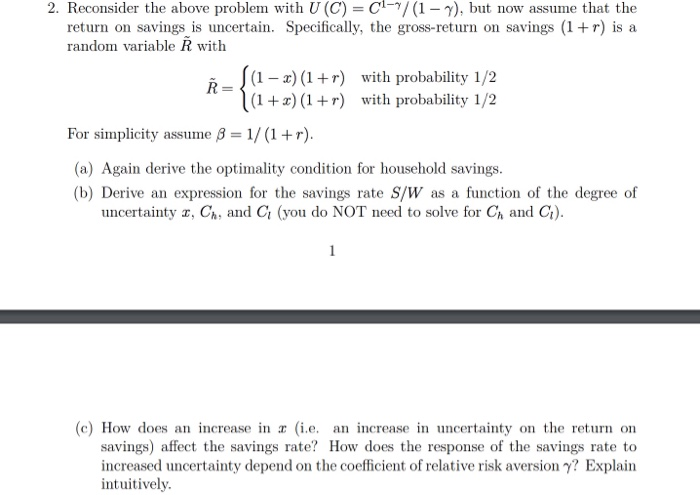
2. Reconsider the above problem with U (C)/(1-), but now assume that the return on savings is uncertain. Specifically, the gross-return on savings (1 +r) is a random variable R with J(-z(1+r) with probability 1/2 (1 x) (1r) with probability 1/2 For simplicity assume = 1/ (1 + r). (a) Again derive the optimality condition for household savings. (b) Derive an expression for the savings rate S/W as a function of the degree of uncertainty a, Ch, and C (you do NOT need to solve for Ch and C (c) How does an increase in r (i.e. an increase in uncertainty on the return on savings) affect the savings rate? How does the response of the savings rate to increased uncertainty depend on the coefficient of relative risk aversion ? Explain intuitively. 2. Reconsider the above problem with U (C)/(1-), but now assume that the return on savings is uncertain. Specifically, the gross-return on savings (1 +r) is a random variable R with J(-z(1+r) with probability 1/2 (1 x) (1r) with probability 1/2 For simplicity assume = 1/ (1 + r). (a) Again derive the optimality condition for household savings. (b) Derive an expression for the savings rate S/W as a function of the degree of uncertainty a, Ch, and C (you do NOT need to solve for Ch and C (c) How does an increase in r (i.e. an increase in uncertainty on the return on savings) affect the savings rate? How does the response of the savings rate to increased uncertainty depend on the coefficient of relative risk aversion ? Explain intuitively
Step by Step Solution
There are 3 Steps involved in it

Get step-by-step solutions from verified subject matter experts
 Study Help