







Question: 2. Repeat question 1 for the same endowments, but with preferences now represented by the following utility functions: uA(x1A,x2A)=2(x1A)+4(x2A)uB(x1B,x2B)=(x1B)(x2B) (i) Draw an Edgeworth box describing
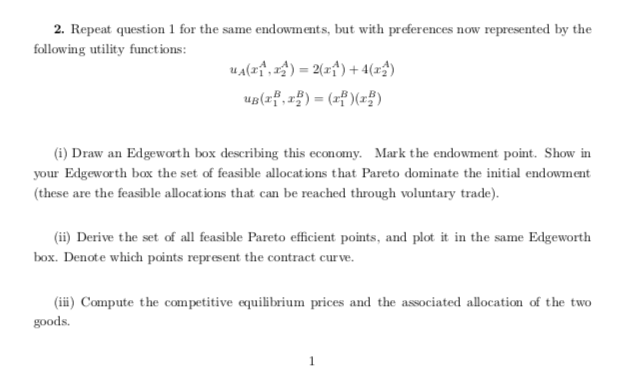
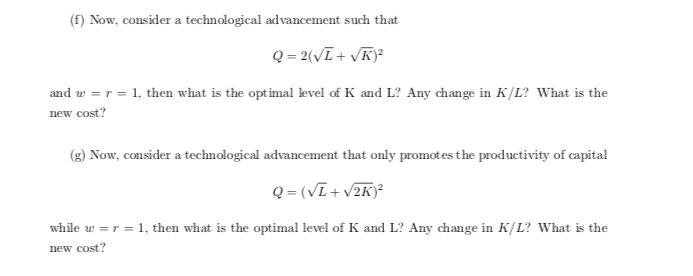
2. Repeat question 1 for the same endowments, but with preferences now represented by the following utility functions: uA(x1A,x2A)=2(x1A)+4(x2A)uB(x1B,x2B)=(x1B)(x2B) (i) Draw an Edgeworth box describing this economy. Mark the endowment point. Show in your Edgeworth box the set of feasible allocations that Pareto dominate the initial endowment (these are the feasible allocations that can be reached through voluntary trade). (ii) Derive the set of all feasible Pareto efficient points, and plot it in the same Edgeworth box. Denote which points represent the contract curve. (iii) Compute the competitive equilibrium prices and the associated allocation of the two goods. (f) Now, consider a technological advancement such that Q=2(L+K)2 and w=r=1, then what is the optimal level of K and L ? Any change in K/L ? What is the new cost? (g) Now, consider a technological advancement that only promotes the productivity of capital Q=(L+2K)2 while w=r=1, then what is the optimal level of K and L ? Any change in K/L ? What is the new cost? 2. Repeat question 1 for the same endowments, but with preferences now represented by the following utility functions: uA(x1A,x2A)=2(x1A)+4(x2A)uB(x1B,x2B)=(x1B)(x2B) (i) Draw an Edgeworth box describing this economy. Mark the endowment point. Show in your Edgeworth box the set of feasible allocations that Pareto dominate the initial endowment (these are the feasible allocations that can be reached through voluntary trade). (ii) Derive the set of all feasible Pareto efficient points, and plot it in the same Edgeworth box. Denote which points represent the contract curve. (iii) Compute the competitive equilibrium prices and the associated allocation of the two goods. (f) Now, consider a technological advancement such that Q=2(L+K)2 and w=r=1, then what is the optimal level of K and L ? Any change in K/L ? What is the new cost? (g) Now, consider a technological advancement that only promotes the productivity of capital Q=(L+2K)2 while w=r=1, then what is the optimal level of K and L ? Any change in K/L ? What is the new cost
Step by Step Solution
There are 3 Steps involved in it

Get step-by-step solutions from verified subject matter experts
 Study Help