







Question: 2 Retirement Analysis The following joint probability distribution is based on survey data collected by a major financial publication in 2002. For a randomly selected
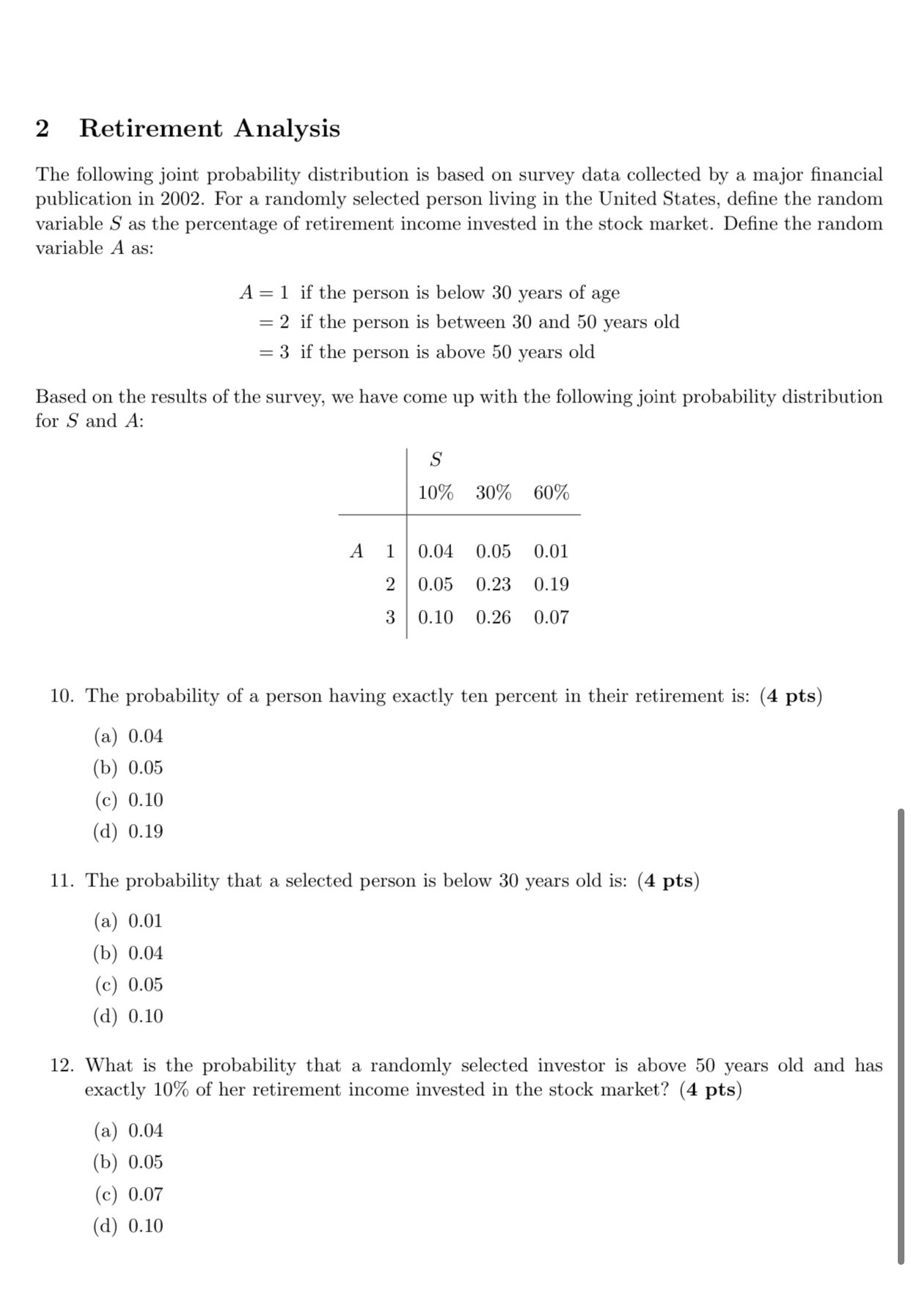
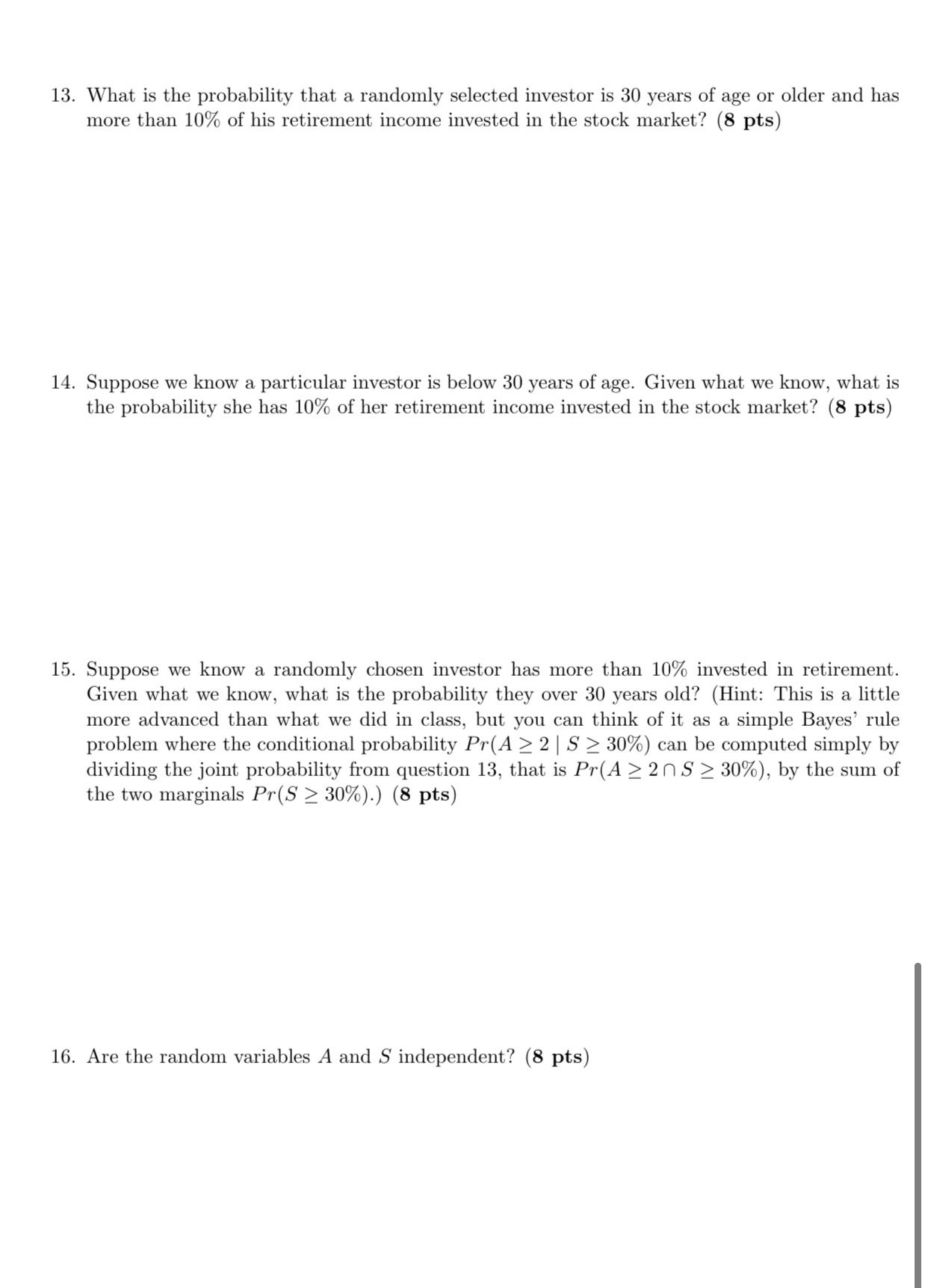
2 Retirement Analysis The following joint probability distribution is based on survey data collected by a major financial publication in 2002. For a randomly selected person living in the United States, define the random variable S as the percentage of retirement income invested in the stock market. Define the random variable A as: A = 1 if the person is below 30 years of age = 2 if the person is between 30 and 50 years old = 3 if the person is above 50 years old Based on the results of the survey, we have come up with the following joint probability distribution for S and A: S 10% 30% 60% A 1 0.04 0.05 0.01 2 0.05 0.23 0.19 3 0.10 0.26 0.07 10. The probability of a person having exactly ten percent in their retirement is: (4 pts) (a) 0.04 (b) 0.05 (c) 0.10 (d) 0.19 11. The probability that a selected person is below 30 years old is: (4 pts) (a) 0.01 (b) 0.04 (c) 0.05 (d) 0.10 12. What is the probability that a randomly selected investor is above 50 years old and has exactly 10% of her retirement income invested in the stock market? (4 pts) (a) 0.04 (b) 0.05 C) 0.07 (d) 0.1013. What is the probability that a randomiy selected investor is 30 years of age or older and has more than 10% of his retirement income invested in the stock market? (8 pts) 14. Suppose we know a particular investor is below 30 years of age. Given what we know, what is the probability she has 10% of her retirement income invested in the stock market? (8 pts) 15. Suppose we know a randomly chosen investor has more than 10% invested in retirement. Given what we know, what is the probability they over 30 years old? (Hint: This is a little more advanced than what we did in class, but you can think of it as a simple Bayes' rule problem where the conditional probability Pr(A Z 2 | S 2 30%) can be computed simply by dividing the joint probability from question 13, that is Pr(A 2 2 n S 2 30%), by the sum of the two marginals Pr(S 2 30%).) (8 pts) 16. Are the random variables A and S independent? (8 pts)
Step by Step Solution
There are 3 Steps involved in it

Get step-by-step solutions from verified subject matter experts
 Study Help