Question: 2. Scientists often use experimental data to infer a mathematical relationship between measured variables. The most common form of this is linear regression, where scientists
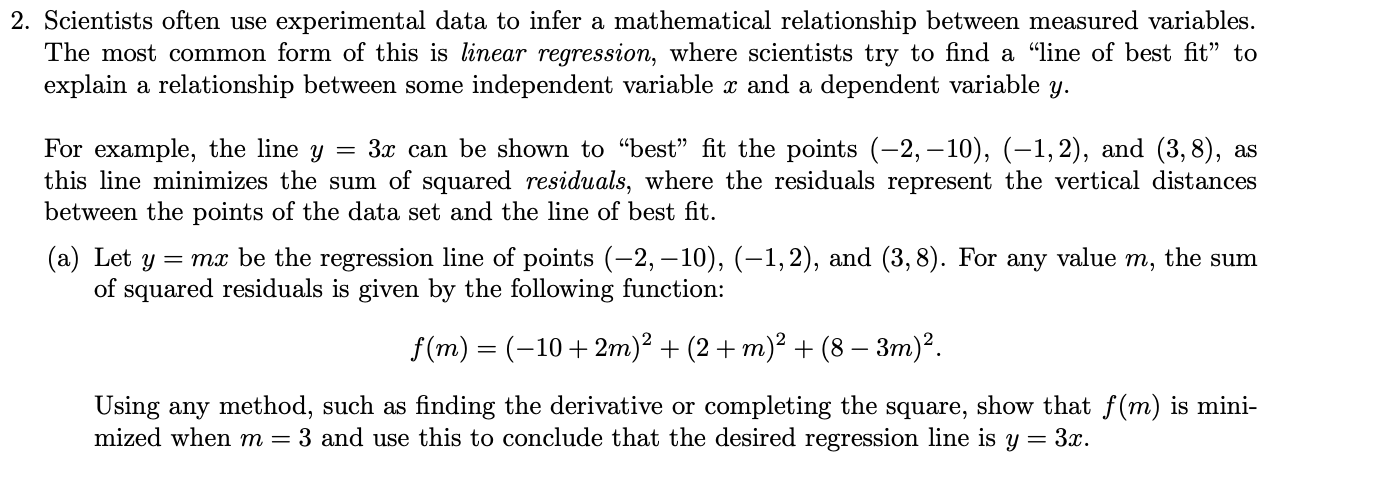
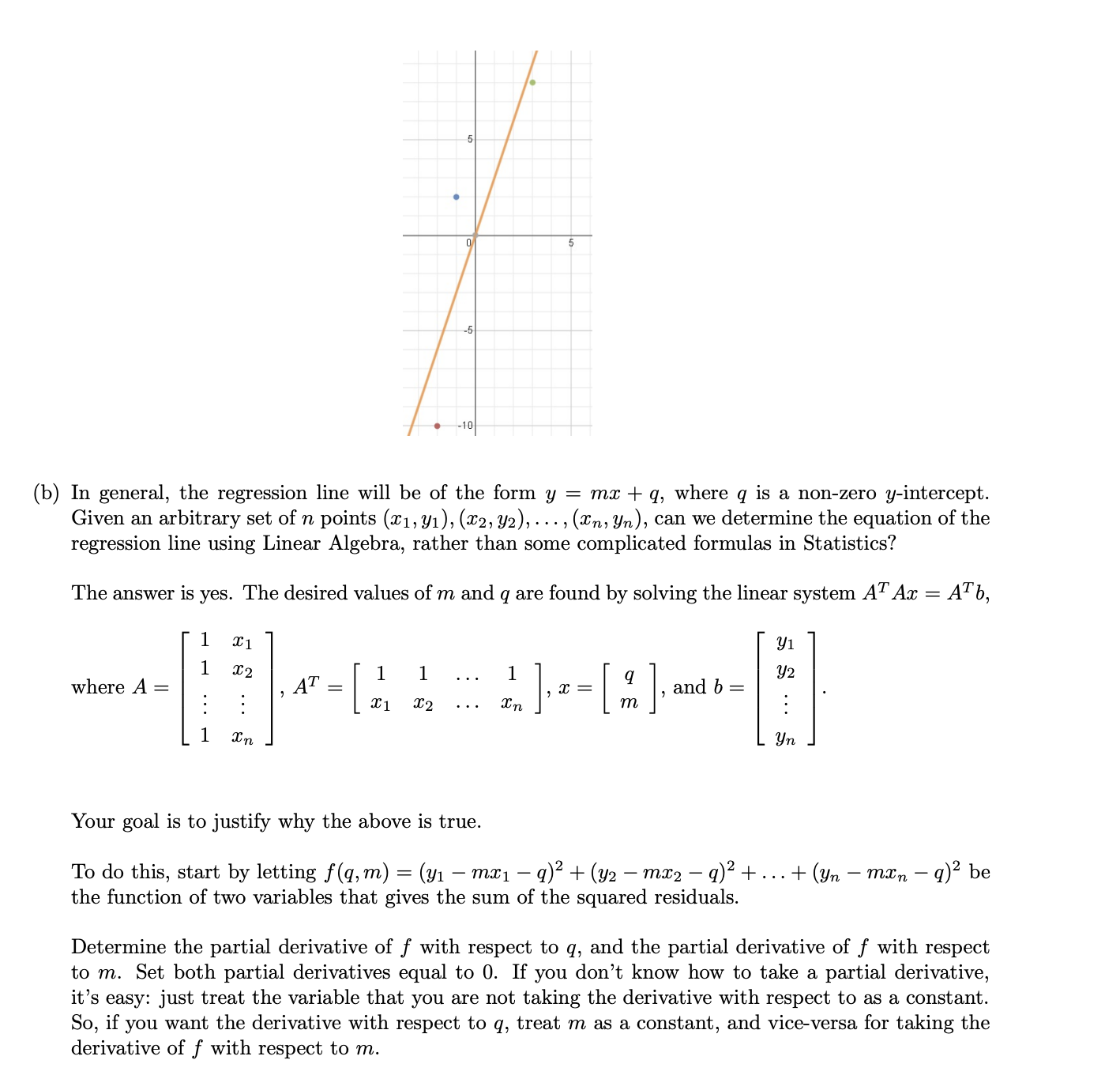
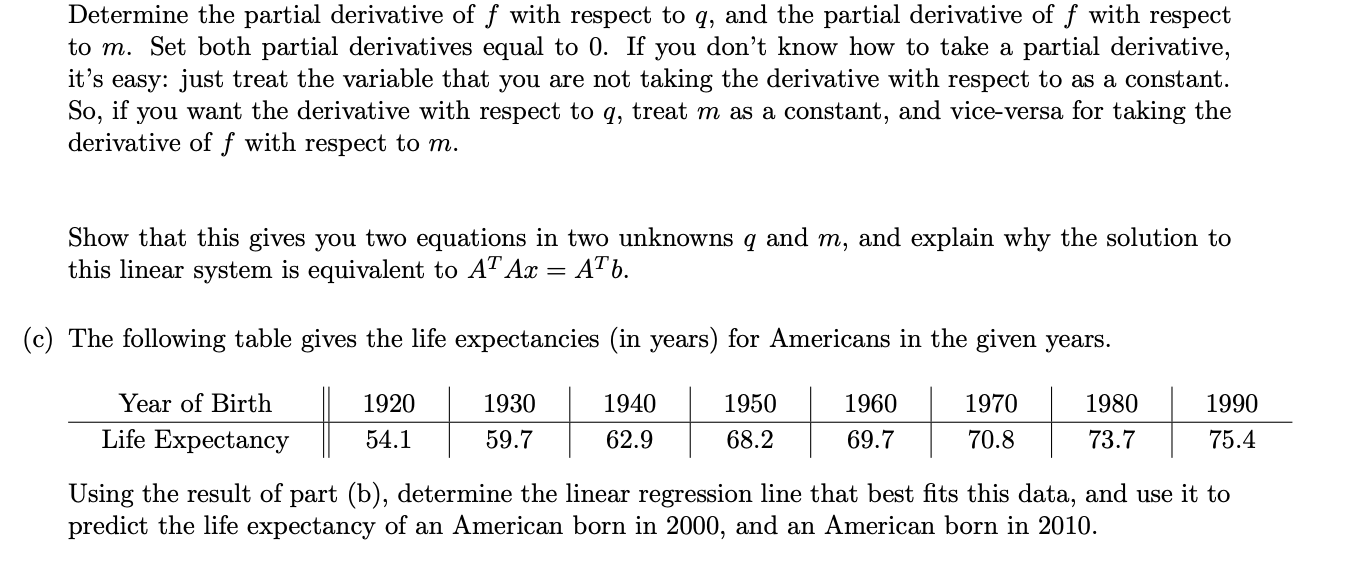
2. Scientists often use experimental data to infer a mathematical relationship between measured variables. The most common form of this is linear regression, where scientists try to nd a \"line of best t\" to explain a relationship between some independent variable a: and a dependent variable 3;. For example, the line y = 3:5 can be shown to \"best\" t the points (2,10), (1,2), and (3,8), as this line minimizes the sum of squared residuals, where the residuals represent the vertical distances between the points of the data set and the line of best t. (a) Let y 2 ma: be the regression line of points (2, 10), (1,2), and (3, 8). For any value m, the sum of squared residuals is given by the following function: f(m) : (10 + 2m)2 + (2 + m)2 + (8 3m)2. Using any method, such as nding the derivative or completing the square, show that f(m) is mini mized when m = 3 and use this to conclude that the desired regression line is y = 3x. (b) In general, the regression line will be of the form y : ma: + q, where q is a non-zero yintercept. Given an arbitrary set of n. points (3:1, yl), (132,3;2), . . . , (3371,3171), can we determine the equation of the regression line using Linear Algebra, rather than some complicated formulas in Statistics? The answer is yes. The desired values of m and q are found by solving the linear system ATAIE : ATE), 1 $1 yl 1 332 3J2 whereA: . . ,AT2 1 1 1],$=|:q],andb= _ : : 581 $2 $71 m : 1 33\" yr}, Your goal is to justify why the above is true. To do this, start by letting f(q,m) : (yl mml (1)2 + (yg mmg (1)2 + . . . + (yn mm\" (1)2 be the function of two variables that gives the sum of the squared residuals. Determine the partial derivative of f with respect to q, and the partial derivative of f with respect to m. Set both partial derivatives equal to D. If you don't know how to take a partial derivative, it's easy: just treat the variable that you are not taking the derivative with respect to as a constant. So, if you want the derivative with respect to q, treat m as a constant, and viceversa for taking the derivative of f with respect to m. (C) Determine the partial derivative of f with respect to q, and the partial derivative of f with respect to m. Set both partial derivatives equal to 0. If you don't know how to take a partial derivative, it's easy: just treat the variable that you are not taking the derivative with respect to as a constant. So, if you want the derivative with respect to q, treat m as a constant, and vice-versa for taking the derivative of f with respect to 771. Show that this gives you two equations in two unknowns q and m, and explain why the solution to this linear system is equivalent to ATALE = ATE). The following table gives the life expectancies (in years) for Americans in the given years. Year ofBirth \\ 1920 l 1930 l 1940 l 1950 l 1960 l 1970 l 1980 1990 Life Expectancy \\ 54.1 i 59.7 i 02.9 i 68.2 i 69.7 i 70.8 i 73.7 75.4 Using the result of part (b), determine the linear regression line that best ts this data, and use it to predict the life expectancy of an American born in 2000, and an American born in 2010
Step by Step Solution
There are 3 Steps involved in it
1 Expert Approved Answer
Step: 1 Unlock
Question Has Been Solved by an Expert!
Get step-by-step solutions from verified subject matter experts
Step: 2 Unlock
Step: 3 Unlock
Students Have Also Explored These Related Mathematics Questions!









 Study Help