



Question: 2. Show that f(n) = n 2 + n is Q(n 2 ) by applying the definition of Q-complexity from Chapter 3 of Cormen (reproduced
2. Show that f(n) = n2 + n is Q(n2) by applying the definition of Q-complexity from Chapter 3 of Cormen (reproduced below).
Definition: (g(n)) = { f(n) : there exists positive constants c1, c2, n0 such that 0 c1g(n) f(n) c2g(n) , for n n0 }. Prove that you can find a (c1, c2, n0) triple that meets the criteria.
3. What is the worst-case asymptotic running time of the following method mthd, assuming that the parameter n is a positive integer? Assume doLogTimeWork() does O(lg n) work. Briefly explain your reasoning.
void mthd( int n ) {
for ( int i = 1; i
for ( int k = 1; k
doLogTimeWork();
}
}
}
4. We defined an anytime algorithm as one that can give its current best answer at any time, but can produce a better answer the more time it has.
Give one example of a practical situation in which an anytime algorithm would be appropriate. Justify your answer.
Give one example of a practical situation in which an anytime algorithm would be inappropriate. Justify your answer.
5. Consider a self-driving car as an example of an intelligent agent. I mean a fully autonomous car, which is capable of operating without any human intervention.
What is an example of a problem to which a self-driving car should seek an optimal solution?
What is an example of a problem to which a self-driving car should seek an approximately optimal solution?
What is an example of a problem to which a self-driving car may be satisfied with a probable solution?
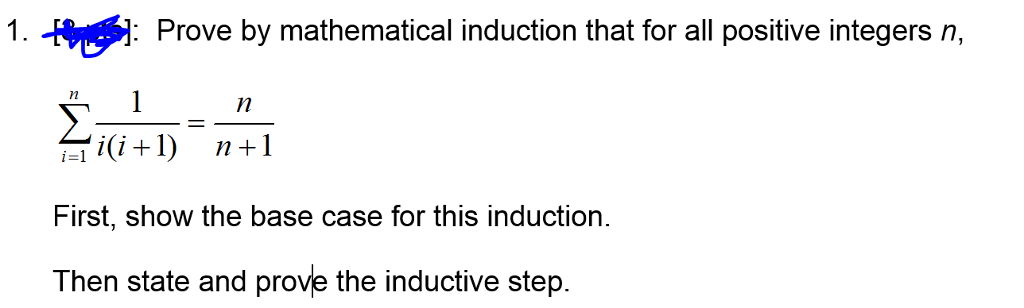
S]: Prove by mathematical induction that for all positive integers n, i+1) n+1 First, show the base case for this induction. Then state and prove the inductive step
Step by Step Solution
There are 3 Steps involved in it

Get step-by-step solutions from verified subject matter experts