







Question: 2. Show the search tree produced by a regression planner using a breadth-first search for the following planning problem Fluents to describe states RLoc: Rob's
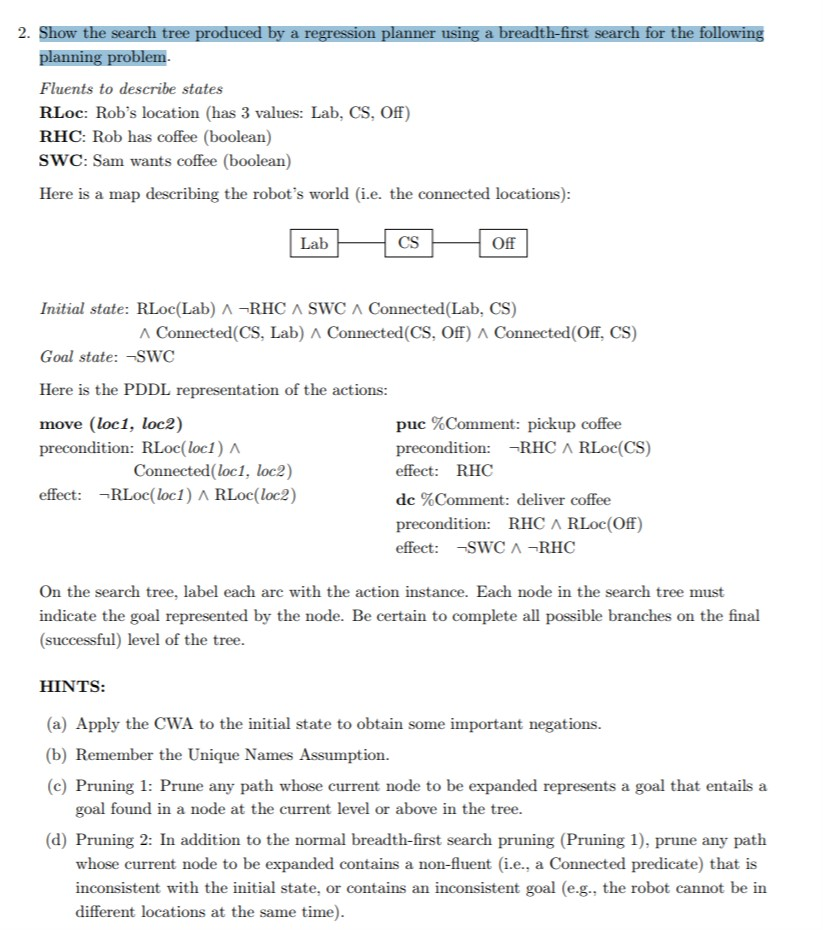
2. Show the search tree produced by a regression planner using a breadth-first search for the following planning problem Fluents to describe states RLoc: Rob's location (has 3 values: Lab, CS, Off) RHC: Rob has coffee (boolean) SWC: Sam wants coffee (boolean) Here is a map describing the robot's world (i.e. the connected locations) Lab CS Off Initial state: RLoc(Lab) -EHC SWC Connected(Lab, CS) Connected(CS. Lab) Connected(CS. Off) Connected(Off. CS) Goal state:-SWC Here is the PDDL representation of the actions move (loc1, loc2) precondition: RLoc(10c1) puc %Comment: pickup coffee precondition: - RLoc(CS) effect: RHC dc %Comm ent: deliver coffee precondition: RHC RLoe(Off) effect: --SwC -EPIC Connected(loc1, loc2) -RLoc(loc!) RLoc(loe2) effect: On the search tree, label each are with the action instance. Each node in the search tree must indicate the goal represented by the node. Be certain to complete all possible branches on the final (successful) level of the tree HINTS: (a) Apply the CWA to the initial state to obtain some important negations. (b) Remember the Unique Names Assumption. (c) Pruning 1: Prune any path whose current node to be expanded represents a goal that entails a goal found in a node at the current level or above in the tree (d) Pruning 2: In addition to the normal breadth-first search pruning (Pruning 1), prune any path whose current node to be expanded contains a non-fluent (i.e., a Connected predicate) that is inconsistent with the initial state, or contains an inconsistent goal (e.g., the robot cannot be in different locations at the same time) 2. Show the search tree produced by a regression planner using a breadth-first search for the following planning problem Fluents to describe states RLoc: Rob's location (has 3 values: Lab, CS, Off) RHC: Rob has coffee (boolean) SWC: Sam wants coffee (boolean) Here is a map describing the robot's world (i.e. the connected locations) Lab CS Off Initial state: RLoc(Lab) -EHC SWC Connected(Lab, CS) Connected(CS. Lab) Connected(CS. Off) Connected(Off. CS) Goal state:-SWC Here is the PDDL representation of the actions move (loc1, loc2) precondition: RLoc(10c1) puc %Comment: pickup coffee precondition: - RLoc(CS) effect: RHC dc %Comm ent: deliver coffee precondition: RHC RLoe(Off) effect: --SwC -EPIC Connected(loc1, loc2) -RLoc(loc!) RLoc(loe2) effect: On the search tree, label each are with the action instance. Each node in the search tree must indicate the goal represented by the node. Be certain to complete all possible branches on the final (successful) level of the tree HINTS: (a) Apply the CWA to the initial state to obtain some important negations. (b) Remember the Unique Names Assumption. (c) Pruning 1: Prune any path whose current node to be expanded represents a goal that entails a goal found in a node at the current level or above in the tree (d) Pruning 2: In addition to the normal breadth-first search pruning (Pruning 1), prune any path whose current node to be expanded contains a non-fluent (i.e., a Connected predicate) that is inconsistent with the initial state, or contains an inconsistent goal (e.g., the robot cannot be in different locations at the same time)
Step by Step Solution
There are 3 Steps involved in it

Get step-by-step solutions from verified subject matter experts
 Study Help