







Question: 2. Suppose a teaching methods study was designed to test a hypothesis of equal means on the final examination scores for an experimental teaching method
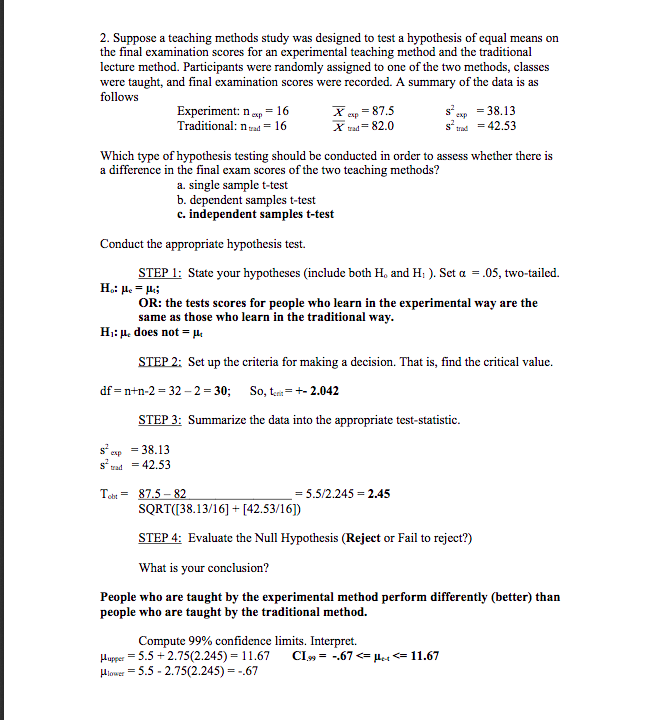
2. Suppose a teaching methods study was designed to test a hypothesis of equal means on the final examination scores for an experimental teaching method and the traditional lecture method. Participants were randomly assigned to one of the two methods, classes were taught, and final examination scores were recorded. A summary of the data is as follows Experiment: nexp = 16 X exp = 87.5 S exp = 38.13 Traditional: n rad = 16 A trad = 82.0 " trad = 42.53 Which type of hypothesis testing should be conducted in order to assess whether there is a difference in the final exam scores of the two teaching methods? a. single sample t-test b. dependent samples t-test c. independent samples t-test Conduct the appropriate hypothesis test. STEP 1: State your hypotheses (include both H. and Hi ). Set a = .05, two-tailed. Ha: He = Hu; OR: the tests scores for people who learn in the experimental way are the same as those who learn in the traditional way. Hi: p. does not = [ STEP 2: Set up the criteria for making a decision. That is, find the critical value. df = n+n-2 =32 - 2 =30; So, tem = +- 2.042 STEP 3: Summarize the data into the appropriate test-statistic. 5 exp = 38.13 S trad = 42.53 Tom = 87.5 - 82 =5.5/2.245 = 2.45 SQRT([38.13/16] + [42.53/16]) STEP 4: Evaluate the Null Hypothesis (Reject or Fail to reject?) What is your conclusion? People who are taught by the experimental method perform differently (better) than people who are taught by the traditional method. Compute 99% confidence limits. Interpret. Hupper = 5.5 + 2.75(2.245) = 11.67 CI.s = -.67
Step by Step Solution
There are 3 Steps involved in it

Get step-by-step solutions from verified subject matter experts
 Study Help