







Question: 2. Suppose that you are provided with a data set D = {r:} , sampled independently from a Gaussian distribution with an unknown mean parameter
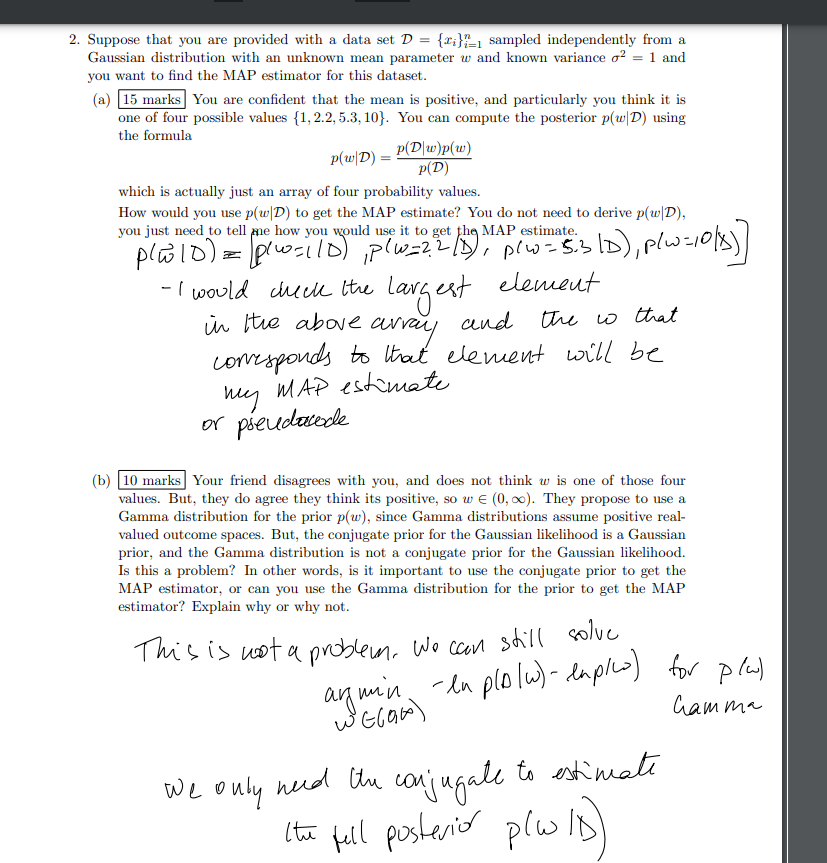
2. Suppose that you are provided with a data set D = {r:} , sampled independently from a Gaussian distribution with an unknown mean parameter w and known variance o? = 1 and you want to find the MAP estimator for this dataset. (a) 15 marks You are confident that the mean is positive, and particularly you think it is one of four possible values {1, 2.2, 5.3, 10}. You can compute the posterior p(w|D) using the formula p(w|D) = P(D w)p(w) P(D) which is actually just an array of four probability values. How would you use p(w|D) to get the MAP estimate? You do not need to derive p(w|D), you just need to tell me how you would use it to get the MAP estimate. P ( WID ) = P (w= 1/D) , P( W= 2 2 /D), p(w= 5:3 /D), plw=10/)/ - I would duck the largest element in the above array and the w that corresponds to that element will be my MAP estimate or pseudocode (b) 10 marks Your friend disagrees with you, and does not think w is one of those four values. But, they do agree they think its positive, so we (0, co). They propose to use a Gamma distribution for the prior p(w), since Gamma distributions assume positive real- valued outcome spaces. But, the conjugate prior for the Gaussian likelihood is a Gaussian prior, and the Gamma distribution is not a conjugate prior for the Gaussian likelihood. Is this a problem? In other words, is it important to use the conjugate prior to get the MAP estimator, or can you use the Gamma distribution for the prior to get the MAP estimator? Explain why or why not. This is not a problem . we can still solve arjun - en plolw) - emple) for pla) Gamma We only need the conjugate to estimate Ithe full posteris plw / D)
Step by Step Solution
There are 3 Steps involved in it

Get step-by-step solutions from verified subject matter experts
 Study Help