



Question: 2 . Suppose there are two people ( A and B ) , each of whom as an income level of ( $
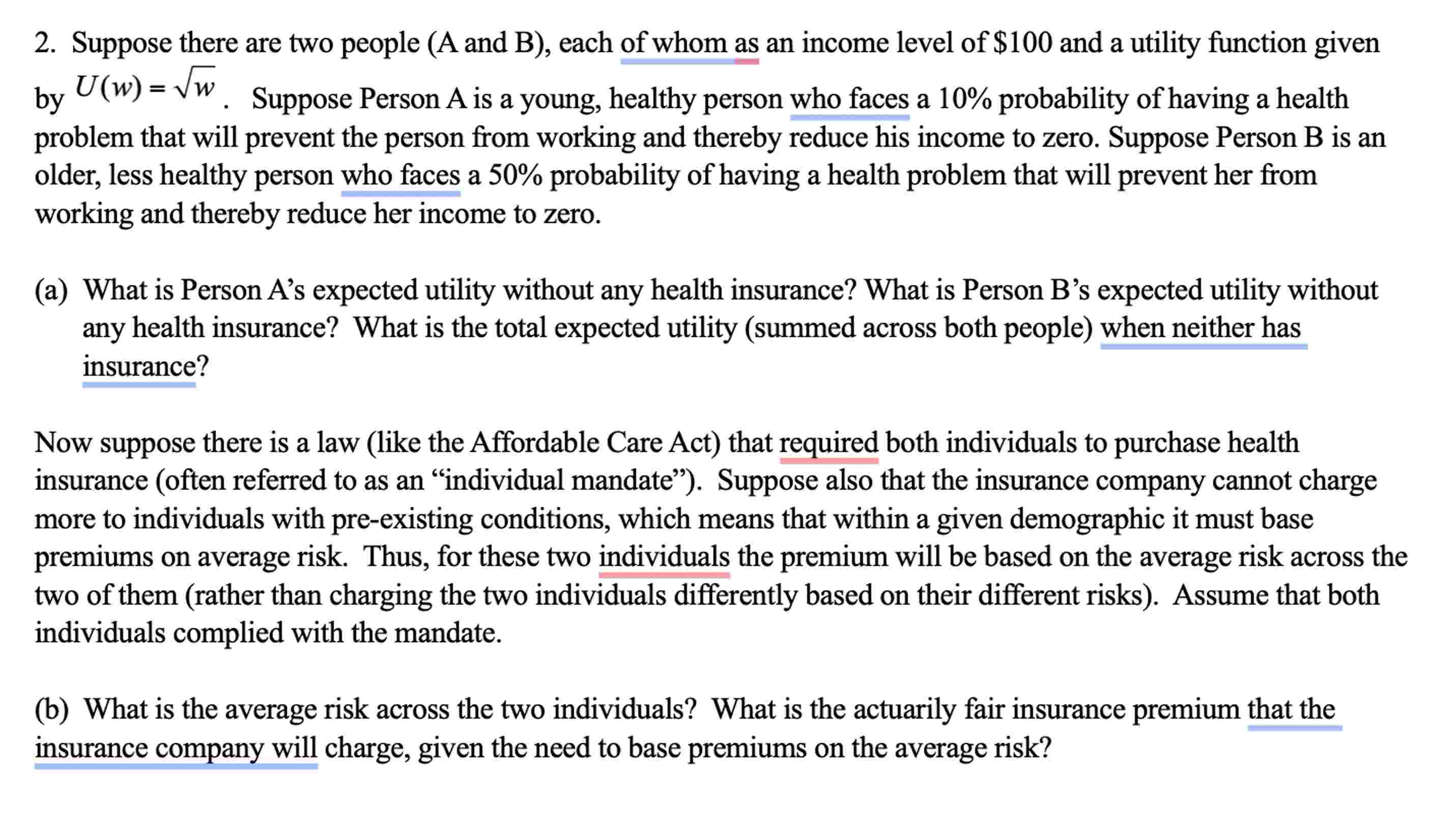
Suppose there are two people A and B each of whom as an income level of $ and a utility function given by Uwsqrtw Suppose Person A is a young, healthy person who faces a probability of having a health problem that will prevent the person from working and thereby reduce his income to zero. Suppose Person B is an older, less healthy person who faces a probability of having a health problem that will prevent her from working and thereby reduce her income to zero.
a What is Person As expected utility without any health insurance? What is Person Bs expected utility without any health insurance? What is the total expected utility summed across both people when neither has insurance?
Now suppose there is a law like the Affordable Care Act that required both individuals to purchase health insurance often referred to as an "individual mandate" Suppose also that the insurance company cannot charge more to individuals with preexisting conditions, which means that within a given demographic it must base premiums on average risk. Thus, for these two individuals the premium will be based on the average risk across the two of them rather than charging the two individuals differently based on their different risks Assume that both individuals complied with the mandate.
b What is the average risk across the two individuals? What is the actuarily fair insurance premium that the insurance company will charge, given the need to base premiums on the average risk? c What is the expected utility for Person A given the individual mandate to buy insurance at the premium calculated in e What is the expected utility for Person B under the mandate? What is the total expected utility summed across both people when both buy the insurance?
d Does the law increase total expected utility? Does it increase expected utility for each of the individuals? Explain.
e Now suppose the individual mandate is repealed, but insurance companies are still required to base premiums on the average risk of those who buy the insurance. Would Person A buy health insurance in this case? Explain why or why not.
f Given your answer to e what is the premium that the insurance company would end up charging if the individual mandate is repealed? Would Person B buy health insurance at this premium? Explain why or why not.
g What is Person As expected utility if the mandate is repealed? What is Person Bs expected utility if the mandate is repealed? What is total expected utility if the mandate is repealed?
h Does repeal of the mandate increase expected utility for Person A Does it increase expected utility for Person B Does it increase total expected utility?
Step by Step Solution
There are 3 Steps involved in it
1 Expert Approved Answer
Step: 1 Unlock

Question Has Been Solved by an Expert!
Get step-by-step solutions from verified subject matter experts
Step: 2 Unlock
Step: 3 Unlock