





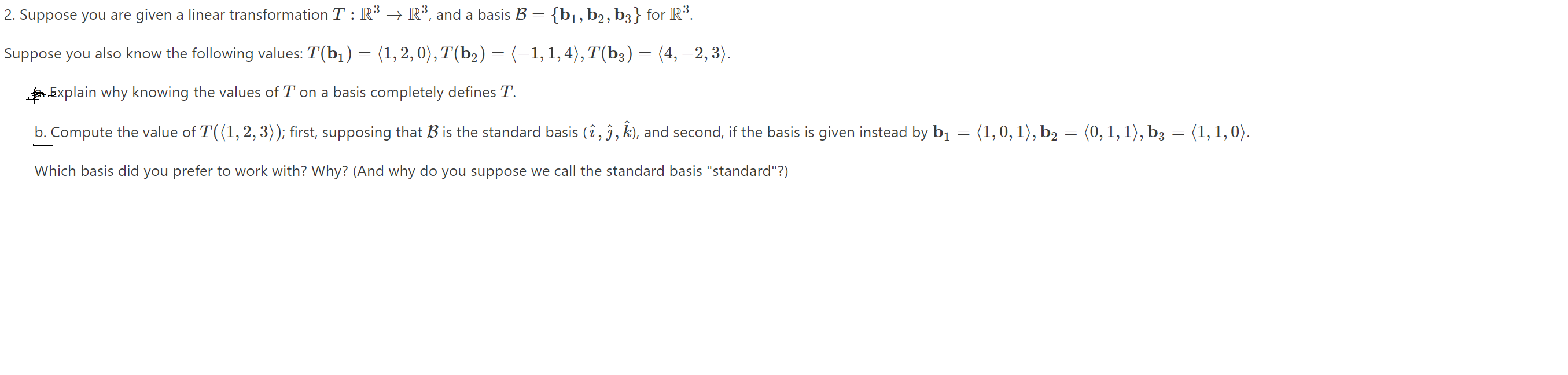
Question: 2. Suppose you are given a linear transformation T : RS - RS, and a basis B = {b1, b2, b3 } for R3 Suppose
2. Suppose you are given a linear transformation
2. Suppose you are given a linear transformation T : RS - RS, and a basis B = {b1, b2, b3 } for R3 Suppose you also know the following values: T(b] ) = (1, 2, 0), T(b2) = (-1, 1, 4), T(b3) = (4, -2, 3). Explain why knowing the values of T on a basis completely defines T. b. Compute the value of T( (1, 2, 3) ); first, supposing that B is the standard basis (2, j, k), and second, if the basis is given instead by b1 = (1, 0, 1), b2 = (0, 1, 1), b3 = (1, 1, 0). Which basis did you prefer to work with? Why? (And why do you suppose we call the standard basis "standard"?)

Step by Step Solution

There are 3 Steps involved in it

1 Expert Approved Answer
Step: 1 Unlock blur-text-image

Question Has Been Solved by an Expert!

Get step-by-step solutions from verified subject matter experts

Step: 2 Unlock
Step: 3 Unlock

Students Have Also Explored These Related Mathematics Questions!