







Question: -2 Take the acceleration due to gravity as g = 9.8 m s Question 7 A cricket ball is thrown upward at an angle from
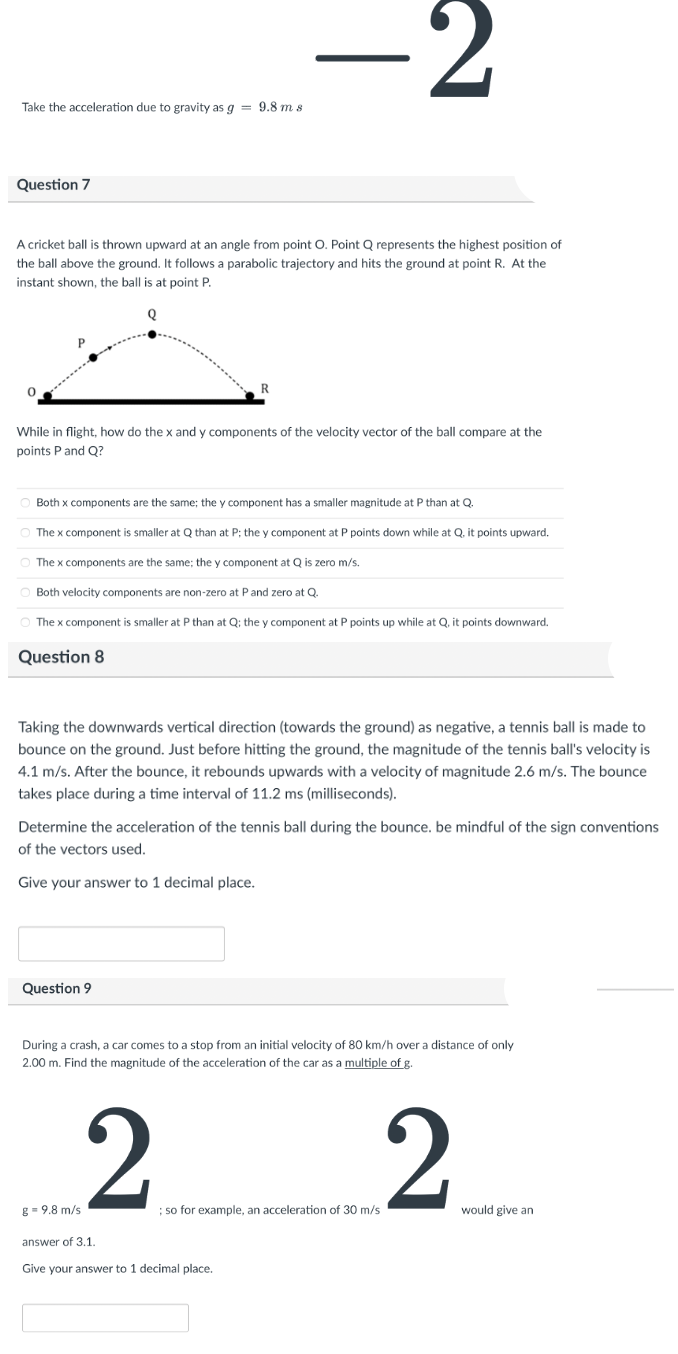
-2 Take the acceleration due to gravity as g = 9.8 m s Question 7 A cricket ball is thrown upward at an angle from point O. Point Q represents the highest position of the ball above the ground. It follows a parabolic trajectory and hits the ground at point R. At the instant shown, the ball is at point P. Q While in flight, how do the x and y components of the velocity vector of the ball compare at the points P and Q? O Both x components are the same; the y component has a smaller magnitude at P than at Q. O The x component is smaller at Q than at P; the y component at P points down while at Q, it points upward. O The x components are the same; the y component at Q is zero m/s. O Both velocity components are non-zero at P and zero at Q. O The x component is smaller at P than at Q: the y component at P points up while at Q, it points downward. Question 8 Taking the downwards vertical direction (towards the ground) as negative, a tennis ball is made to bounce on the ground. Just before hitting the ground, the magnitude of the tennis ball's velocity is 4.1 m/s. After the bounce, it rebounds upwards with a velocity of magnitude 2.6 m/s. The bounce takes place during a time interval of 11.2 ms (milliseconds). Determine the acceleration of the tennis ball during the bounce. be mindful of the sign conventions of the vectors used. Give your answer to 1 decimal place. Question 9 During a crash, a car comes to a stop from an initial velocity of 80 km/h over a distance of only 2.00 m. Find the magnitude of the acceleration of the car as a multiple of g. 2 2 g = 9.8 m/s ; so for example, an acceleration of 30 m/s would give an answer of 3.1. Give your answer to 1 decimal place
Step by Step Solution
There are 3 Steps involved in it

Get step-by-step solutions from verified subject matter experts
 Study Help