







Question: 2 The banking industry 2a Reading Read the text below and write short headings (one or two words) for each paragraph TYPES OF BANK 1
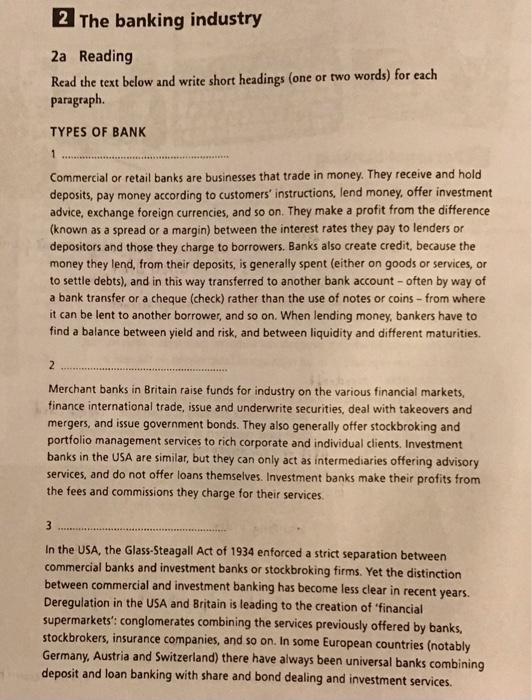
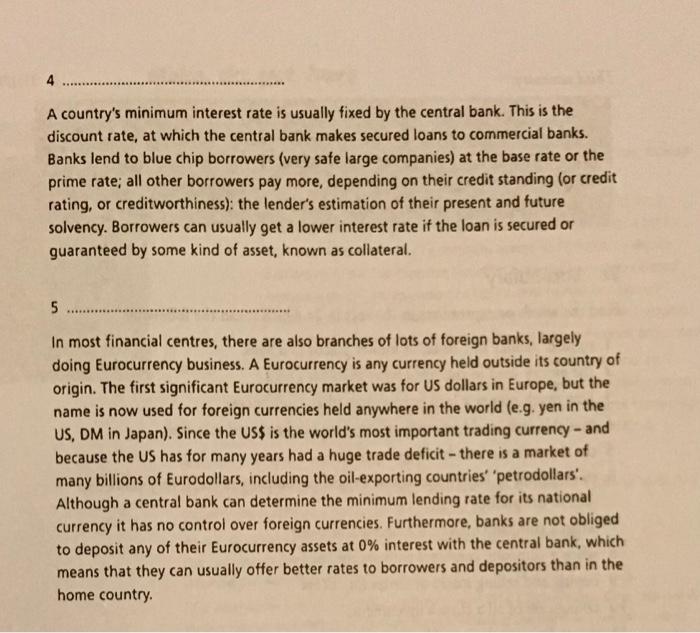
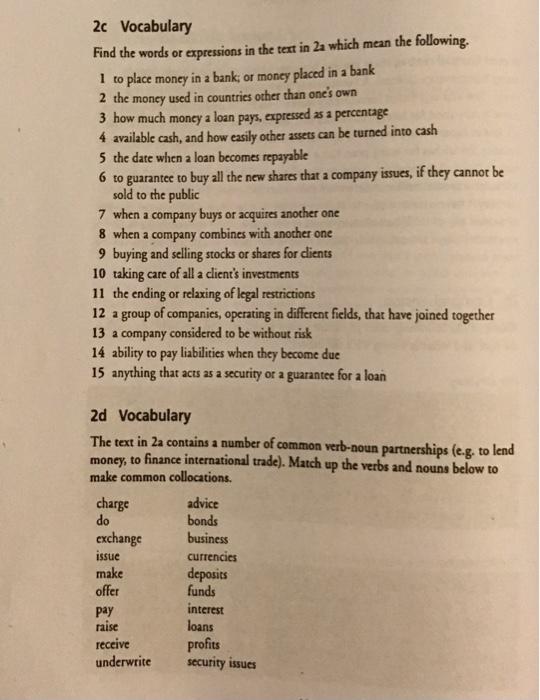
2 The banking industry 2a Reading Read the text below and write short headings (one or two words) for each paragraph TYPES OF BANK 1 Commercial or retail banks are businesses that trade in money. They receive and hold deposits, pay money according to customers' instructions, lend money offer investment advice, exchange foreign currencies, and so on. They make a profit from the difference (known as a spread or a margin) between the interest rates they pay to lenders or depositors and those they charge to borrowers. Banks also create credit, because the money they lend, from their deposits, is generally spent (either on goods or services, or to settle debts), and in this way transferred to another bank account - often by way of a bank transfer or a cheque (check) rather than the use of notes or coins - from where it can be lent to another borrower, and so on. When lending money, bankers have to find a balance between yield and risk, and between liquidity and different maturities. 2 Merchant banks in Britain raise funds for industry on the various financial markets, finance international trade, issue and underwrite securities, deal with takeovers and mergers, and issue government bonds. They also generally offer stockbroking and portfolio management services to rich corporate and individual clients. Investment banks in the USA are similar, but they can only act as intermediaries offering advisory services, and do not offer loans themselves. Investment banks make their profits from the fees and commissions they charge for their services 3 In the USA, the Glass-Steagall Act of 1934 enforced a strict separation between commercial banks and investment banks or stockbroking firms. Yet the distinction between commercial and investment banking has become less clear in recent years. Deregulation in the USA and Britain is leading to the creation of 'financial supermarkets: conglomerates combining the services previously offered by banks, stockbrokers, insurance companies, and so on. In some European countries (notably Germany, Austria and Switzerland) there have always been universal banks combining deposit and loan banking with share and bond dealing and investment services. A country's minimum interest rate is usually fixed by the central bank. This is the discount rate, at which the central bank makes secured loans to commercial banks. Banks lend to blue chip borrowers (very safe large companies) at the base rate or the prime rate; all other borrowers pay more, depending on their credit standing (or credit rating, or creditworthiness): the lender's estimation of their present and future solvency. Borrowers can usually get a lower interest rate if the loan is secured or guaranteed by some kind of asset, known as collateral. 5 In most financial centres, there are also branches of lots of foreign banks, largely doing Eurocurrency business. A Eurocurrency is any currency held outside its country of origin. The first significant Eurocurrency market was for US dollars in Europe, but the name is now used for foreign currencies held anywhere in the world (e.g. yen in the US, DM in Japan). Since the US$ is the world's most important trading currency - and because the US has for many years had a huge trade deficit - there is a market of many billions of Eurodollars, including the oil-exporting countries' 'petrodollars'. Although a central bank can determine the minimum lending rate for its national currency it has no control over foreign currencies. Furthermore, banks are not obliged to deposit any of their Eurocurrency assets at 0% interest with the central bank, which means that they can usually offer better rates to borrowers and depositors than in the home country. 2 2c Vocabulary Find the words or expressions in the text in 2a which mean the following. 1 to place money in a bank; or money placed in a bank 2 the money used in countries other than one's own 3 how much money a loan pays, expressed as a percentage 4 available cash, and how easily other assets can be turned into cash 5 the date when a loan becomes repayable 6 to guarantee to buy all the new shares that a company issues, if they cannot be sold to the public 7 when a company buys or acquires another one 8 when a company combines with another one 9 buying and selling stocks or shares for dients 10 taking care of all a dient's investments 11 the ending or relaxing of legal restrictions 12 a group of companies, operating in different fields, that have joined together 13 a company considered to be without risk 14 ability to pay liabilities when they become due 15 anything that acts as a security or a guarantee for a loan 2d Vocabulary The text in 2a contains a number of common verb-noun partnerships (e.g. to lend money, to finance international trade). Match up the verbs and nouns below to make common collocations. charge advice do bonds exchange business issue currencies make deposits offer funds interest raise loans receive profits underwrite security issues pay 2 The banking industry 2a Reading Read the text below and write short headings (one or two words) for each paragraph TYPES OF BANK 1 Commercial or retail banks are businesses that trade in money. They receive and hold deposits, pay money according to customers' instructions, lend money offer investment advice, exchange foreign currencies, and so on. They make a profit from the difference (known as a spread or a margin) between the interest rates they pay to lenders or depositors and those they charge to borrowers. Banks also create credit, because the money they lend, from their deposits, is generally spent (either on goods or services, or to settle debts), and in this way transferred to another bank account - often by way of a bank transfer or a cheque (check) rather than the use of notes or coins - from where it can be lent to another borrower, and so on. When lending money, bankers have to find a balance between yield and risk, and between liquidity and different maturities. 2 Merchant banks in Britain raise funds for industry on the various financial markets, finance international trade, issue and underwrite securities, deal with takeovers and mergers, and issue government bonds. They also generally offer stockbroking and portfolio management services to rich corporate and individual clients. Investment banks in the USA are similar, but they can only act as intermediaries offering advisory services, and do not offer loans themselves. Investment banks make their profits from the fees and commissions they charge for their services 3 In the USA, the Glass-Steagall Act of 1934 enforced a strict separation between commercial banks and investment banks or stockbroking firms. Yet the distinction between commercial and investment banking has become less clear in recent years. Deregulation in the USA and Britain is leading to the creation of 'financial supermarkets: conglomerates combining the services previously offered by banks, stockbrokers, insurance companies, and so on. In some European countries (notably Germany, Austria and Switzerland) there have always been universal banks combining deposit and loan banking with share and bond dealing and investment services. A country's minimum interest rate is usually fixed by the central bank. This is the discount rate, at which the central bank makes secured loans to commercial banks. Banks lend to blue chip borrowers (very safe large companies) at the base rate or the prime rate; all other borrowers pay more, depending on their credit standing (or credit rating, or creditworthiness): the lender's estimation of their present and future solvency. Borrowers can usually get a lower interest rate if the loan is secured or guaranteed by some kind of asset, known as collateral. 5 In most financial centres, there are also branches of lots of foreign banks, largely doing Eurocurrency business. A Eurocurrency is any currency held outside its country of origin. The first significant Eurocurrency market was for US dollars in Europe, but the name is now used for foreign currencies held anywhere in the world (e.g. yen in the US, DM in Japan). Since the US$ is the world's most important trading currency - and because the US has for many years had a huge trade deficit - there is a market of many billions of Eurodollars, including the oil-exporting countries' 'petrodollars'. Although a central bank can determine the minimum lending rate for its national currency it has no control over foreign currencies. Furthermore, banks are not obliged to deposit any of their Eurocurrency assets at 0% interest with the central bank, which means that they can usually offer better rates to borrowers and depositors than in the home country. 2 2c Vocabulary Find the words or expressions in the text in 2a which mean the following. 1 to place money in a bank; or money placed in a bank 2 the money used in countries other than one's own 3 how much money a loan pays, expressed as a percentage 4 available cash, and how easily other assets can be turned into cash 5 the date when a loan becomes repayable 6 to guarantee to buy all the new shares that a company issues, if they cannot be sold to the public 7 when a company buys or acquires another one 8 when a company combines with another one 9 buying and selling stocks or shares for dients 10 taking care of all a dient's investments 11 the ending or relaxing of legal restrictions 12 a group of companies, operating in different fields, that have joined together 13 a company considered to be without risk 14 ability to pay liabilities when they become due 15 anything that acts as a security or a guarantee for a loan 2d Vocabulary The text in 2a contains a number of common verb-noun partnerships (e.g. to lend money, to finance international trade). Match up the verbs and nouns below to make common collocations. charge advice do bonds exchange business issue currencies make deposits offer funds interest raise loans receive profits underwrite security issues pay
Step by Step Solution
There are 3 Steps involved in it

Get step-by-step solutions from verified subject matter experts
 Study Help