







Question: 2. The CDC collects anthropometric (weight, height etc..) data on large samples of US youth, both male and female, and uses these data to create
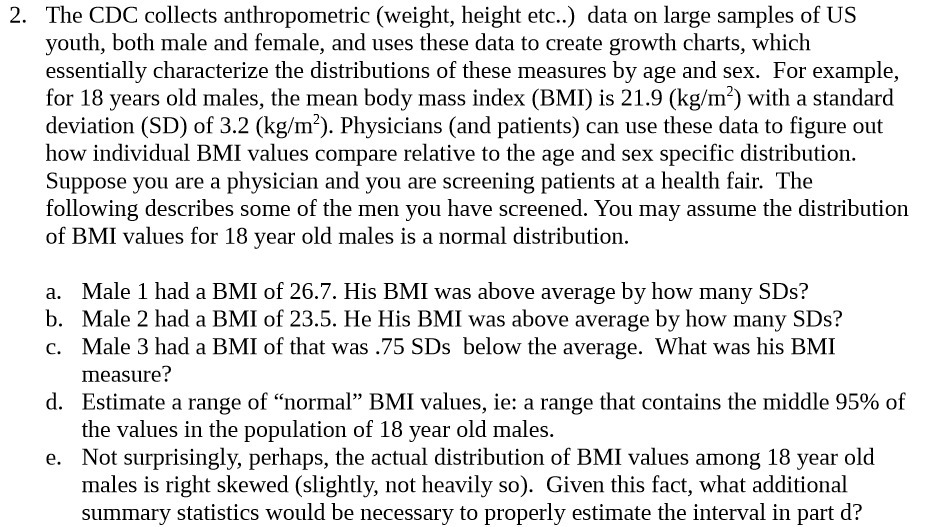
2. The CDC collects anthropometric (weight, height etc..) data on large samples of US youth, both male and female, and uses these data to create growth charts, which essentially characterize the distributions of these measures by age and sex. For example, for 18 years old males, the mean body mass index (BMI) is 21.9 (kg/m2) with a standard deviation (SD) of 3.2 (kgfmz). Physicians (and patients) can use these data to figure out how individual BMI values compare relative to the age and sex specific distribution. Suppose you are a physician and you are screening patients at a health fair. The following describes some of the men you have screened. You may assume the distribution of BMI values for 18 year old males is a normal distribution. a. b. C. Male 1 had a BMI of 26.7. His BMI was above average by how many SDs? Male 2 had a BMI of 23.5. He His BMI was above average by how many SDs? Male 3 had a BMI of that was .75 SDs below the average. What was his BMI measure? Estimate a range of \"normal\" BMI values, ie: a range that contains the middle 95% of the values in the population of 18 year old males. Not surprisingly, perhaps, the actual distribution of BMI values among 18 year old males is right skewed (slightly, not heavily so). Given this fact, what additional summary statistics would be necessary to properly estimate the interval in part (1
Step by Step Solution
There are 3 Steps involved in it

Get step-by-step solutions from verified subject matter experts
 Study Help