







Question: 2. The data set fertility.csv contains information about a = 4286 women in Botswana during 1988. This information includes number of children, years of education,
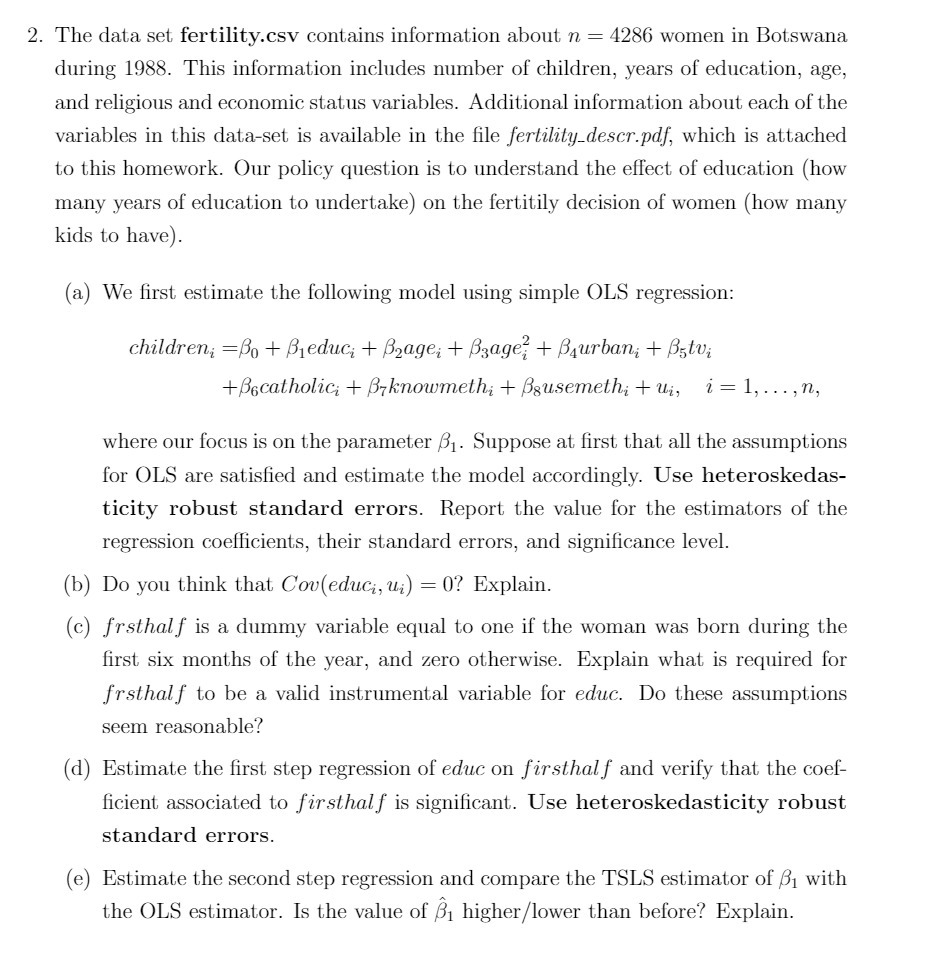
2. The data set fertility.csv contains information about a = 4286 women in Botswana during 1988. This information includes number of children, years of education, age, and religious and economic status variables. Additional information about each of the variables in this data-set is available in the le fertilittdescrpd which is attached to this homework. Our policy question is to understand the effect of education (how many years of education to undertake) on the fertitily decision of women (how many kids to have]. (a) We rst estimate the following model using simple OLS regression: children, 2,60 + ledaq + figagei + 1331ch | drrrban, + [1'5 t1}, +[i'cathofiq + ,{i'Tknmumethi + guscmeth, + in, i = l, . . . , n, where our focus is on the parameter [31. Suppose at rst that all the assumptions for OLE are satisfied and estimate the model accordingly. Use heteroskedas- ticity robust standard errors. Report the value for the estimators of the regression coefficients, their standard errors, and signicance level. (b) Do you think that Cm;(educ,;,m) = 6? Explain. (c) frsthalf is a dummy variable equal to one if the woman was born during the first six months of the year, and zero otherwise. Explain what is required for frsthalf to be a valid instrumental variable for edac. Do these assumptions seem reasonable? ((1) Estimate the first step regression of edits on firsthalf and verify that the coef- cient associated to firsthalf is signicant. Use heteroskedasticity robust standard errors. (e) Estimate the second step regression and compare the TSLS estimator of {31 with the OLS estimator. Is the value of 31 higher/lower than before? Explain
Step by Step Solution
There are 3 Steps involved in it

Get step-by-step solutions from verified subject matter experts
 Study Help