







Question: (2) The function V(x, y) =200+7x+xy+2y, 10x 10, -10 y 10, gives the elevation above sea level (in feet) on a valley floor at
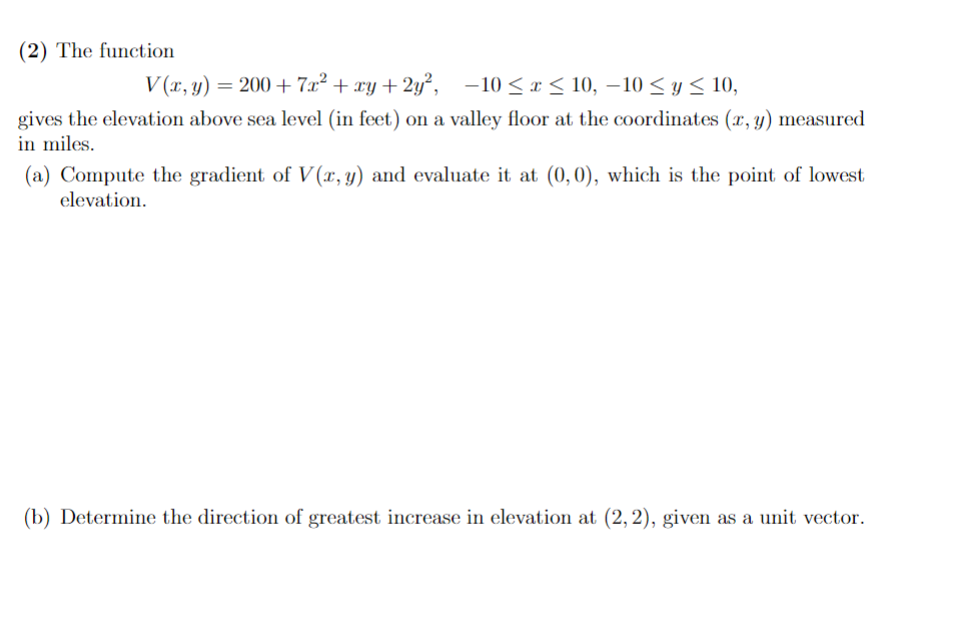
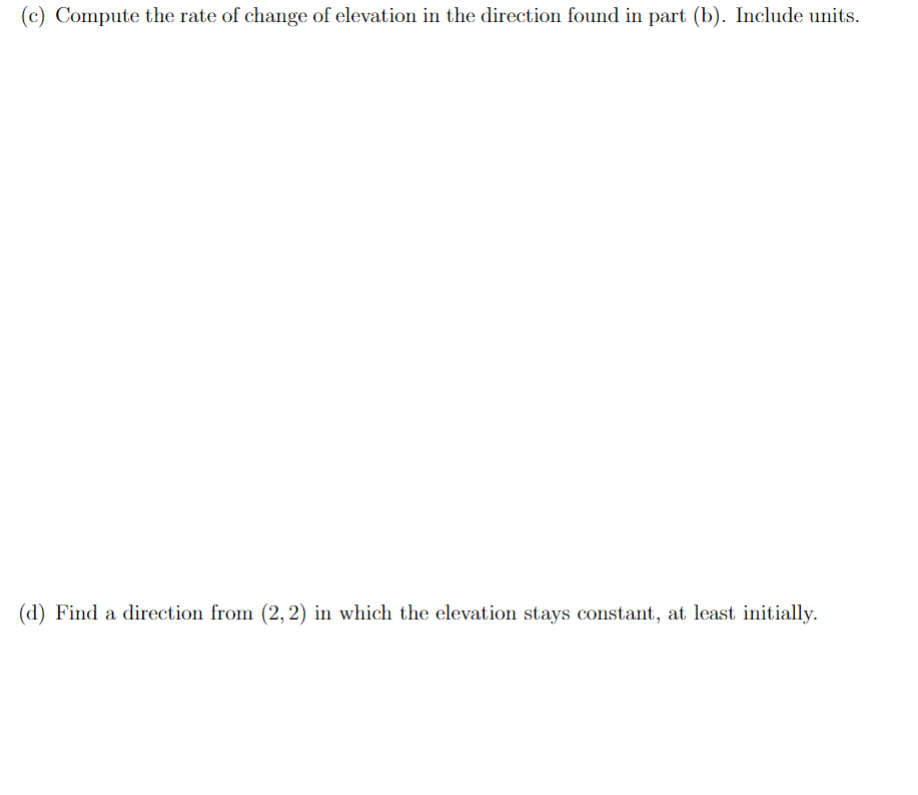
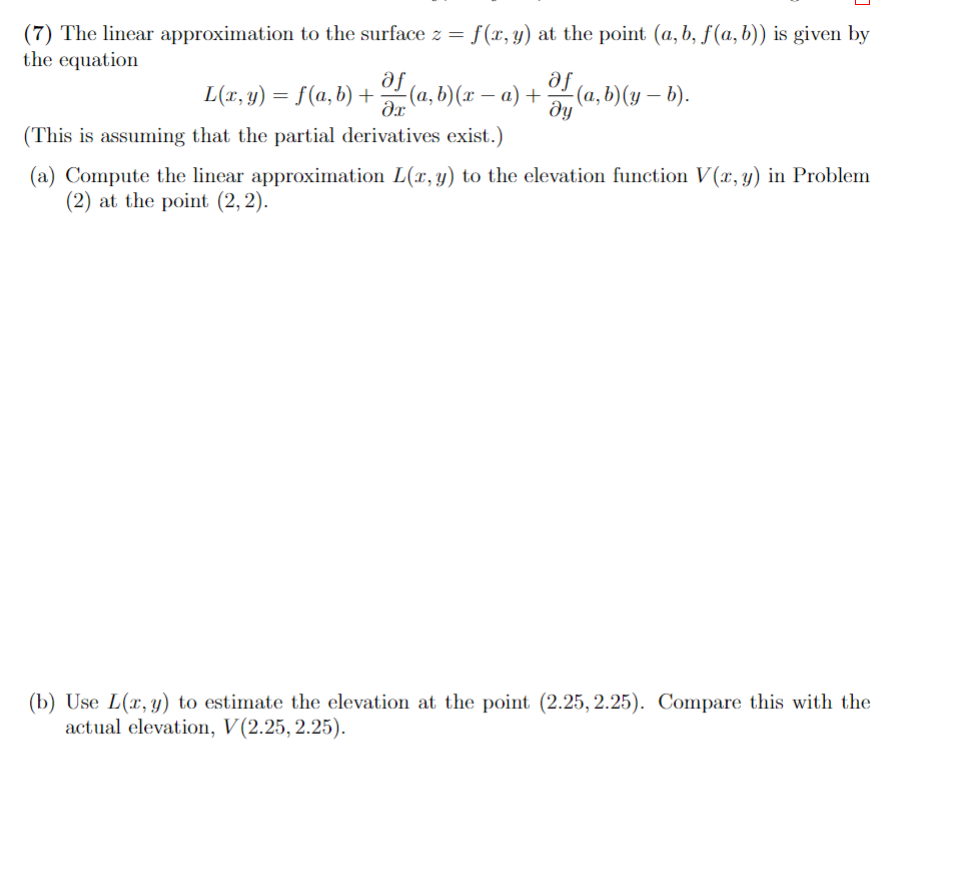
(2) The function V(x, y) =200+7x+xy+2y, 10x 10, -10 y 10, gives the elevation above sea level (in feet) on a valley floor at the coordinates (x, y) measured in miles. (a) Compute the gradient of V(x, y) and evaluate it at (0,0), which is the point of lowest elevation. (b) Determine the direction of greatest increase in elevation at (2, 2), given as a unit vector. (c) Compute the rate of change of elevation in the direction found in part (b). Include units. (d) Find a direction from (2, 2) in which the elevation stays constant, at least initially. (7) The linear approximation to the surface z = f(x, y) at the point (a, b, f(a,b)) is given by the equation L(x, y) = = f(a,b)+ -(a, b)(x a) + af -(a, b)(y b). (This is assuming that the partial derivatives exist.) (a) Compute the linear approximation L(x, y) to the elevation function V(x, y) in Problem (2) at the point (2,2). (b) Use L(x, y) to estimate the elevation at the point (2.25, 2.25). Compare this with the actual elevation, V(2.25, 2.25).
Step by Step Solution
There are 3 Steps involved in it

Get step-by-step solutions from verified subject matter experts
 Study Help