



Question: 2. The main field B0 is not really completely spatially homogeneous, and sometimes spatial inhomogeneity can become a sizable nuisance. Such spatial distortions of the
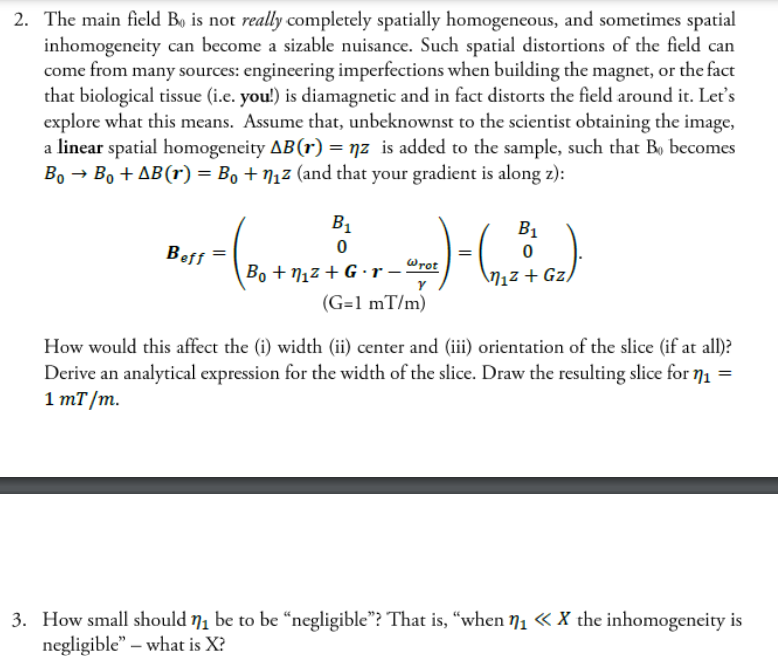
2. The main field B0 is not really completely spatially homogeneous, and sometimes spatial inhomogeneity can become a sizable nuisance. Such spatial distortions of the field can come from many sources: engineering imperfections when building the magnet, or the fact that biological tissue (i.e. you!) is diamagnetic and in fact distorts the field around it. Let's explore what this means. Assume that, unbeknownst to the scientist obtaining the image, a linear spatial homogeneity B(r)=z is added to the sample, such that B0 becomes B0B0+B(r)=B0+1z (and that your gradient is along z ): Beff=B10B0+1z+Grrot(G=1mT/m)=B101z+Gz How would this affect the (i) width (ii) center and (iii) orientation of the slice (if at all)? Derive an analytical expression for the width of the slice. Draw the resulting slice for 1= 1mT/m 3. How small should 1 be to be "negligible"? That is, "when 1X the inhomogeneity is negligible" - what is X
Step by Step Solution
There are 3 Steps involved in it

Get step-by-step solutions from verified subject matter experts