







Question: 2. The shortest remaining job first (SRJF) algorithm minimizes the average turnaround time. Prove this for a set of n processes, which arrive at the
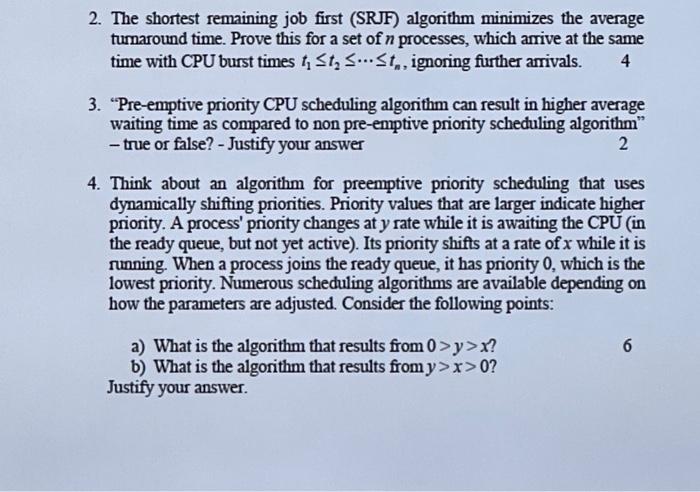
2. The shortest remaining job first (SRJF) algorithm minimizes the average turnaround time. Prove this for a set of n processes, which arrive at the same time with CPU burst times t1t2tn, ignoring further arrivals. 4 3. "Pre-emptive priority CPU scheduling algorithm can result in higher average waiting time as compared to non pre-emptive priority scheduling algorithm" - true or false? - Justify your answer 4. Think about an algorithm for preemptive priority scheduling that uses dynamically shifting priorities. Priority values that are larger indicate higher priority. A process' priority changes at y rate while it is awaiting the CPU (in the ready queue, but not yet active). Its priority shifts at a rate of x while it is running. When a process joins the ready queue, it has priority 0 , which is the lowest priority. Numerous scheduling algorithms are available depending on how the parameters are adjusted. Consider the following points: a) What is the algorithm that results from 0>y>x ? 6 b) What is the algorithm that results from y>x>0 ? Justify your
Step by Step Solution
There are 3 Steps involved in it

Get step-by-step solutions from verified subject matter experts
 Study Help