







Question: 2. This question asks you to consider the DornbuschFischerSamuelson model. Recall that there are two countries in the model, North and South, and a continuum
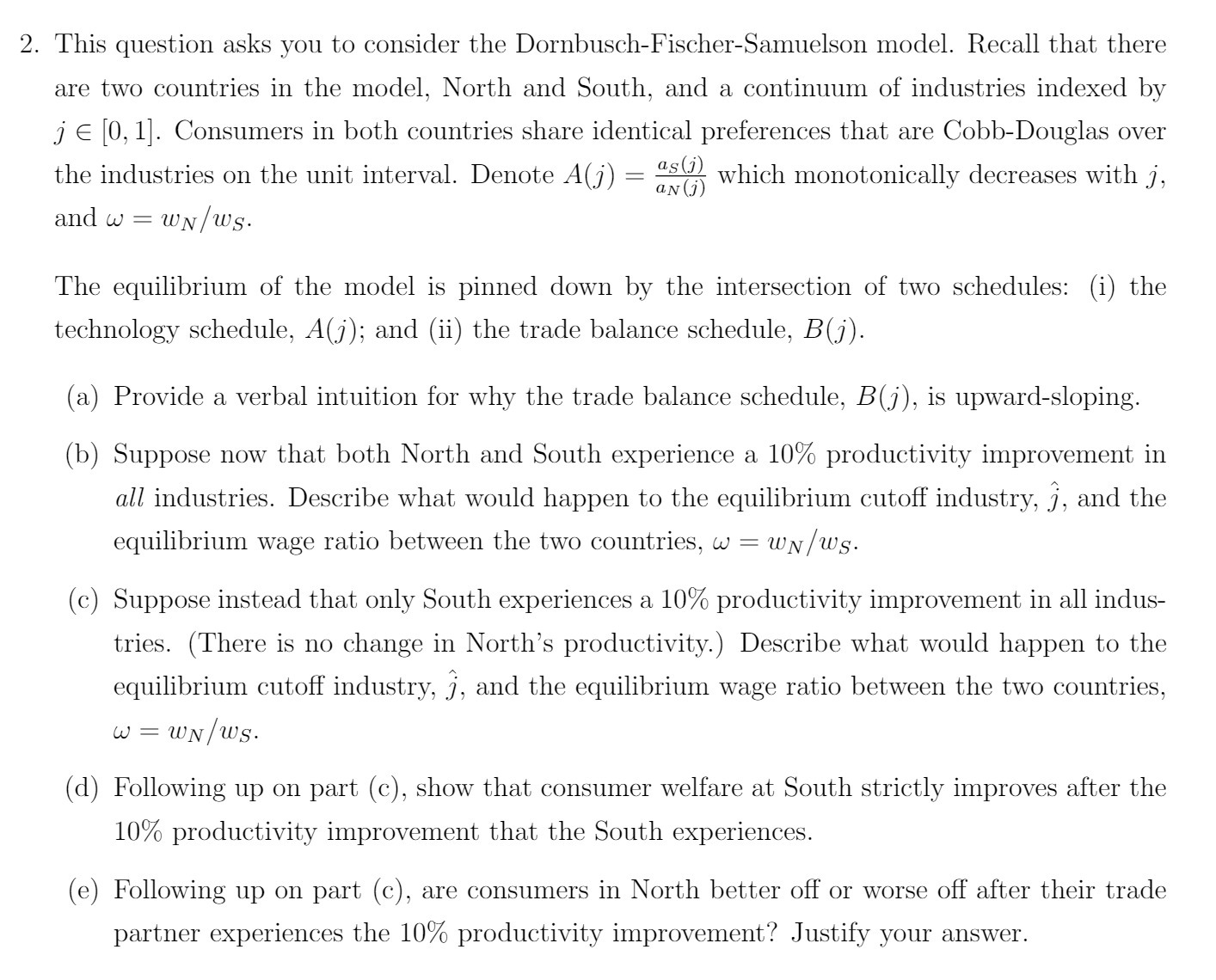
2. This question asks you to consider the DornbuschFischerSamuelson model. Recall that there are two countries in the model, North and South, and a continuum of industries indexed by j 6 [0,1]. Consumers in both countries share identical preferences that are CobbDouglas over \"5(1) the industries on the unit interval. Denote AU) 2 GNU) which monotonically decreases with j, and w = MIN/HIS. The equilibrium of the model is pinned down by the intersection of two schedules: (i) the technology schedule, AU); and (ii) the trade balance schedule, B ( 3) (a) Provide a verbal intuition for why the trade balance schedule, B ( j ), is upwardsloping. (b) Suppose now that both North and South experience a 10% productivity improvement in all industries. Describe what would happen to the equilibrium cutoff industry, 5, and the equilibrium wage ratio between the two countries, to = wN/wg. (c) Suppose instead that only South experiences a 10% productivity improvement in all indus tries. (There is no change in North's productivity.) Describe what would happen to the equilibrium cutoff industry, 5, and the equilibrium wage ratio between the two countries, 0.) = wN/wg. (d) Following up on part (c), show that consumer welfare at South strictly improves after the 10% productivity improvement that the South experiences. (e) Following up on part (c), are consumers in North better off or worse off after their trade partner experiences the 10% productivity improvement? Justify your
Step by Step Solution
There are 3 Steps involved in it

Get step-by-step solutions from verified subject matter experts
 Study Help