



Question: 2. To test memory retrieval, Kail and Nippold (1984) asked 8-, 12-, and 21-year-olds to name as many animals and pieces of furniture as possible
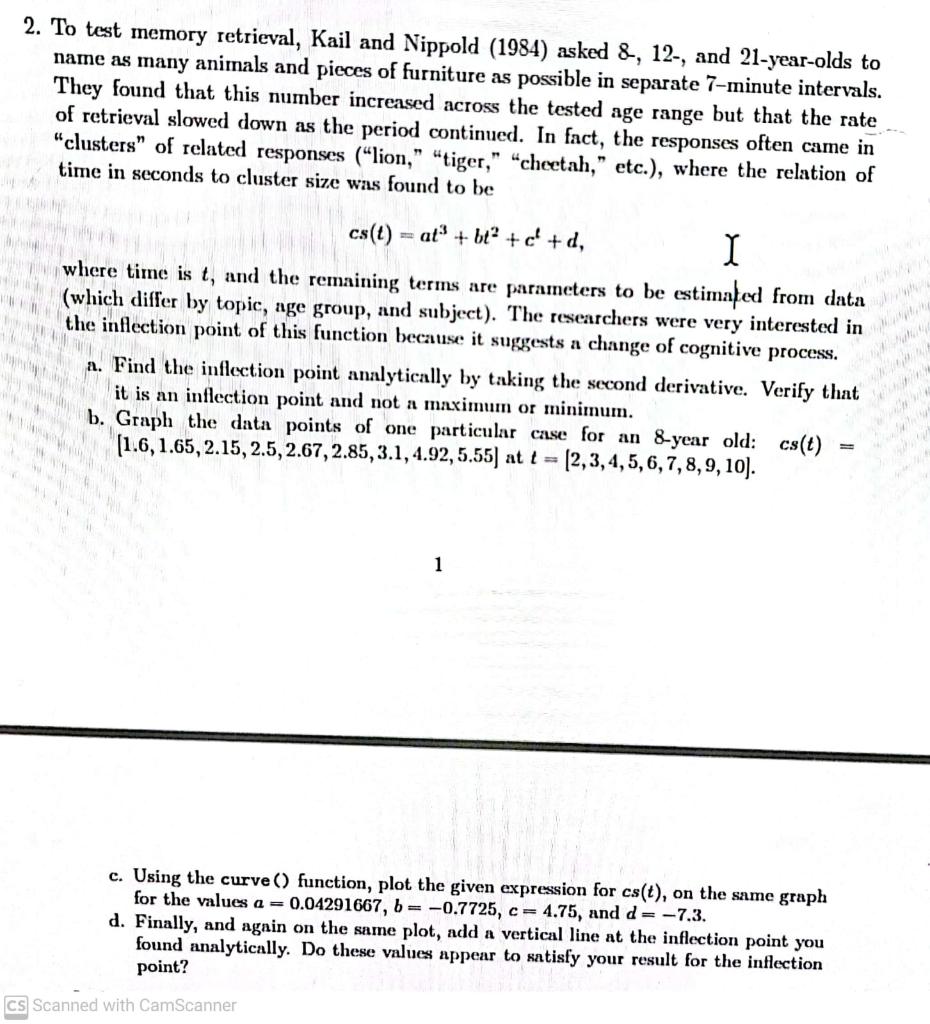
2. To test memory retrieval, Kail and Nippold (1984) asked 8-, 12-, and 21-year-olds to name as many animals and pieces of furniture as possible in separate 7 -minute intervals. They found that this number increased across the tested age range but that the rate of retrieval slowed down as the period continued. In fact, the responses often came in "clusters" of related responses ("lion," "tiger," "cheetah," etc.), where the relation of time in seconds to cluster size was found to be cs(t)=at3+bt2+ct+d, where time is t, and the remaining terms are parameters to be estimaked from data (which differ by topic, age group, and subject). The researchers were very interested in the inflection point of this function because it suggests a change of cognitive process. a. Find the inflection point analytically by taking the second derivative. Verify that it is an inflection point and not a maximum or minimum. b. Graph the data points of one particular case for an 8-year old: cs(t)= [1.6,1.65,2.15,2.5,2.67,2.85,3.1,4.92,5.55] at t=[2,3,4,5,6,7,8,9,10]. 1 c. Using the curve () function, plot the given expression for cs(t), on the same graph for the values a=0.04291667,b=0.7725,c=4.75, and d=7.3. d. Finally, and again on the same plot, add a vertical line at the inflection point you found analytically. Do these values appear to satisfy your result for the inflection point
Step by Step Solution
There are 3 Steps involved in it

Get step-by-step solutions from verified subject matter experts