







Question: 2 . U 4 . Consider a version of recent political developments in Britain related to the issue of leaving the European Union ( Brexit
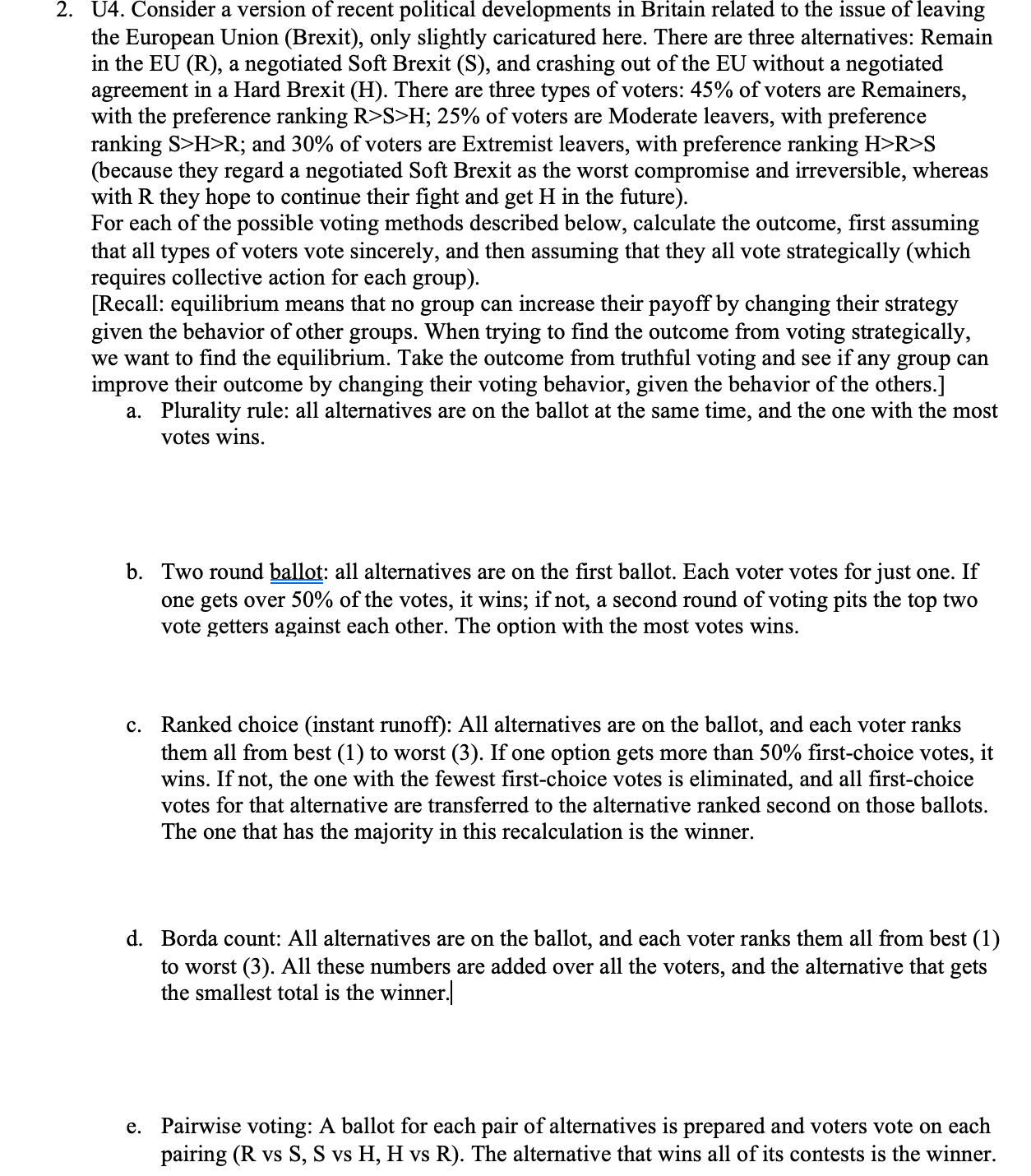
U Consider a version of recent political developments in Britain related to the issue of leaving the European Union Brexit only slightly caricatured here. There are three alternatives: Remain in the mathrmEUmathrmR a negotiated Soft Brexit S and crashing out of the EU without a negotiated agreement in a Hard Brexit H There are three types of voters: of voters are Remainers, with the preference ranking mathrmRmathrmSmathrmH ; of voters are Moderate leavers, with preference ranking mathrmSmathrmHmathrmR; and of voters are Extremist leavers, with preference ranking mathrmHmathrmRmathrmSbecause they regard a negotiated Soft Brexit as the worst compromise and irreversible, whereas with R they hope to continue their fight and get H in the future
For each of the possible voting methods described below, calculate the outcome, first assuming that all types of voters vote sincerely and then assuming that they all vote strategically which requires collective action for each group
Recall: equilibrium means that no group can increase their payoff by changing their strategy given the behavior of other groups. When trying to find the outcome from voting strategically, we want to find the equilibrium. Take the outcome from truthful voting and see if any group can improve their outcome by changing their voting behavior, given the behavior of the others.
a Plurality rule: all alternatives are on the ballot at the same time, and the one with the most votes wins.
b Two round ballot: all alternatives are on the first ballot. Each voter votes for just one. If one gets over of the votes, it wins; if not, a second round of voting pits the top two vote getters against each other. The option with the most votes wins.
c Ranked choice instant runoff: All alternatives are on the ballot, and each voter ranks them all from best to worst If one option gets more than firstchoice votes, it wins. If not, the one with the fewest firstchoice votes is eliminated, and all firstchoice votes for that alternative are transferred to the alternative ranked second on those ballots. The one that has the majority in this recalculation is the winner.
d Borda count: All alternatives are on the ballot, and each voter ranks them all from best to worst All these numbers are added over all the voters, and the alternative that gets the smallest total is the winner.
e Pairwise voting: A ballot for each pair of alternatives is prepared and voters vote on each pairing R vs mathrmSmathrmS vs mathrmHmathrmH vs R The alternative that wins all of its contests is the winner.
Step by Step Solution
There are 3 Steps involved in it
1 Expert Approved Answer
Step: 1 Unlock

Question Has Been Solved by an Expert!
Get step-by-step solutions from verified subject matter experts
Step: 2 Unlock
Step: 3 Unlock
 Study Help