







Question: 2) Using Lennard-Jones model for the potential energy (V) as a function of the distance (r) between particles, derive, at which separation: a) potential energy
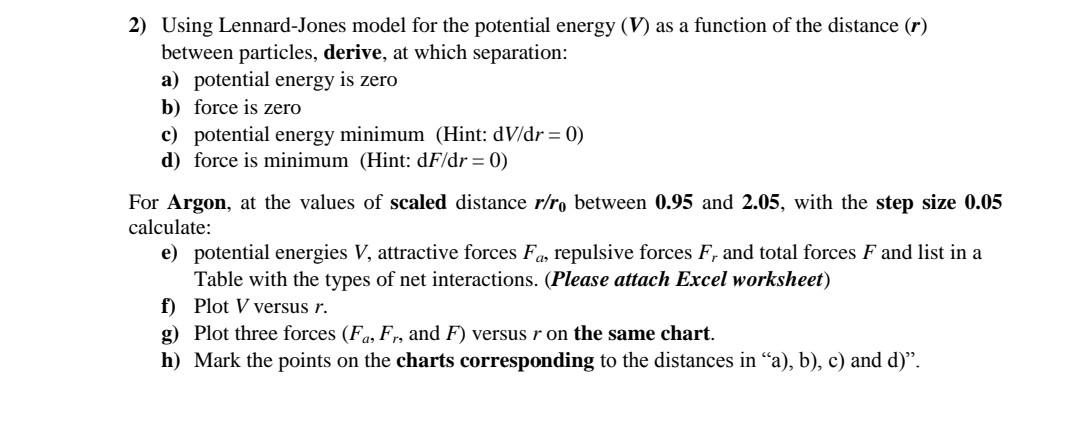
2) Using Lennard-Jones model for the potential energy (V) as a function of the distance (r) between particles, derive, at which separation: a) potential energy is zero b) force is zero c) potential energy minimum (Hint: dv/dr = 0) d) force is minimum (Hint: dF/dr = 0) For Argon, at the values of scaled distance r/r, between 0.95 and 2.05, with the step size 0.05 calculate: e) potential energies V, attractive forces Fa, repulsive forces F, and total forces F and list in a Table with the types of net interactions. (Please attach Excel worksheet) f) Plot V versus r. g) Plot three forces (Fa, Fr, and F) versus r on the same chart. h) Mark the points on the charts corresponding to the distances in a), b), c) and d)
Step by Step Solution
There are 3 Steps involved in it

Get step-by-step solutions from verified subject matter experts
 Study Help